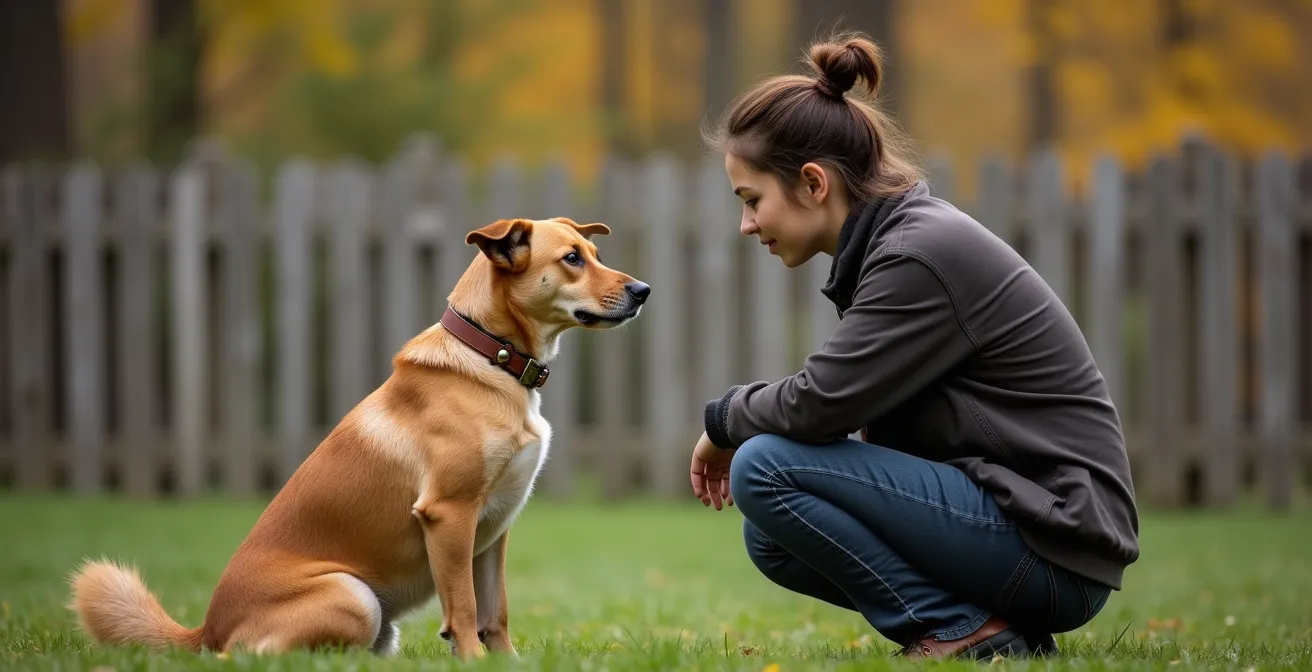
A dog bite is not a sudden act of aggression; it’s the final, predictable outcome of a communication breakdown where all prior evidence was missed.
- Most “aggressive” signals are actually attempts to de-escalate conflict, not provoke it. Punishing them removes the warning system.
- Context is everything: a tail wag, a yawn, or a lip lick can mean opposite things depending on the surrounding environmental and bodily cues.
Recommendation: Shift from trying to “correct” behaviour to forensically analyzing it. Identify and address the root cause of the stress *before* the dog feels the need to escalate to a bite.
As a forensic behaviorist, my work often begins after the incident: a bite that “came out of nowhere.” But in years of deconstructing these events, one truth is constant: it never comes out of nowhere. A dog bite is the final piece of evidence in a long, clear, and often ignored chain of communication. The tragedy is that most of these signals are not threats, but desperate pleas to avoid conflict. We, as owners and parents, simply fail to read the case file as it’s being written in real-time.
Many well-meaning guides focus on obvious signs like growling or showing teeth. This is like arriving at a crime scene after the sirens are already blaring. The real work of prevention happens much earlier, in the silent, subtle language of the body. Understanding this language is not about “dominating” your dog or applying outdated “alpha” theories. It’s about becoming a skilled observer, capable of interpreting micro-expressions and contextual clues to diffuse a situation long before it escalates. This is especially critical in Canada, where specific provincial laws and unique environmental factors, from urban density to winter clothing, can “contaminate” the evidence if not properly understood.
This analysis will not give you a simple checklist. Instead, it will equip you with a forensic mindset. We will dissect the so-called “Ladder of Aggression,” treating each rung not as a step to be punished, but as a critical piece of evidence. We will examine the wagging tail, the “whale eye,” the stress lick, and the misunderstood growl. By learning to analyze this evidence chain, you will move from reacting to an incident to proactively preventing one, ensuring the safety of your family and the well-being of your canine companion.
For those who prefer a visual format, the following conference recording offers a deep dive into the nuances of canine body language in various contexts, complementing the forensic analysis in this guide.
To systematically deconstruct these signals, we will proceed through a detailed analysis of the most commonly misinterpreted behaviours. This guide is structured to build your observational skills from the most subtle signs to the most critical, providing the tools to intervene effectively at each stage.
Summary: A Forensic Analysis of Canine Aggression Signals
- Why Does a Wagging Tail Not Always Mean a Friendly Dog?
- How to Spot “Whale Eye” and Freeze Behavior in 1 Second?
- Stress Lick or Tasty Treat: How to Tell the Difference in Context?
- The Growl Mistake: Why Punishing a Warning Leads to a Silent Bite
- When to Intervene at the Dog Park: Recognizing Tension Before the Fight
- How to Use the “SAFFER” Test to Evaluate a Dog’s Safety with Kids?
- The Alpha Roll Danger: Why Flipping Your Dog Increases Bite Risk
- Why Being the “Alpha” Doesn’t Work: The Science of Family Cooperation
Why Does a Wagging Tail Not Always Mean a Friendly Dog?
The belief that a wagging tail universally signals happiness is one of the most dangerous misconceptions in human-canine communication. From a forensic standpoint, the tail is a barometer of emotional arousal, not a flag of friendliness. The nature of this arousal—positive or negative—can only be determined by analyzing the specifics of the movement in conjunction with the rest of the body.
A dog’s tail is an incredibly nuanced communication tool. The direction, speed, height, and breadth of the wag all contribute to the message. For instance, research on tail-wagging patterns shows that dogs tend to wag more to their right side for positive emotions and to their left for negative ones. This is a micro-expression that is easily missed if you’re only looking for the presence of a wag, not its quality.
The context is paramount. A study observing dogs in Canadian urban centres found that a stiff, high, fast wag during a tight sidewalk pass is often a signal of high arousal and conflict assessment. The dog is not saying “hello”; it is saying “I am on high alert.” This is corroborated by the rest of the body: a tense posture, forward-leaning stance, and hard eyes. In contrast, a relaxed, loose body with a broad, sweeping wag at a lower height is a more reliable indicator of friendly intent. To properly read the evidence, you must consider:
- Tail Height: A high, stiff tail often indicates alertness or potential dominance, while a tucked tail signals fear or submission.
- Wag Speed: A slow, broad wag suggests relaxation. A fast, almost vibrating wag (sometimes called a “flagging” tail) indicates a very high level of arousal, which can tip into aggression quickly.
- Body Stiffness: A tense, rigid body negates any “friendly” interpretation of a wagging tail. A relaxed body posture is the key corroborating piece of evidence for a positive greeting.
Therefore, treating a wagging tail as a green light for interaction without analyzing these other data points is a critical investigative error. It’s the equivalent of ignoring all other evidence at a scene simply because one element seems benign.
How to Spot “Whale Eye” and Freeze Behavior in 1 Second?
Before a growl or a snap, a dog often gives a silent, powerful signal of distress: the “freeze” accompanied by “whale eye.” Spotting this is like finding a key piece of evidence just before an incident occurs. Whale eye, or sclera show, is when a dog turns its head slightly away but keeps its eyes fixed on a perceived threat, causing the white parts of the eyes to show in a crescent shape. This is not a casual glance; it’s a clear indication of anxiety and internal conflict.
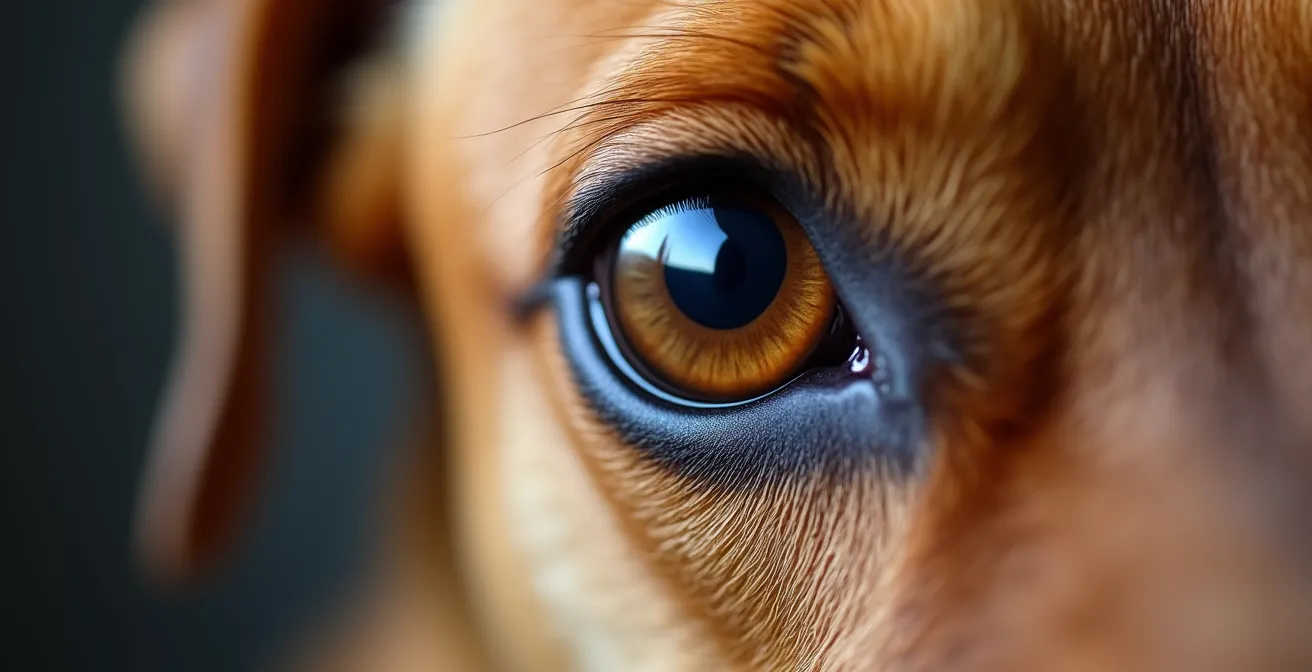
This ocular signal is almost always paired with a “freeze”—a sudden cessation of all movement. The dog becomes rigid, its body stiff, often holding its breath. This is a critical moment in the evidence chain. The dog is processing a stressful situation and is contemplating its next move, which could be fight or flight. According to veterinary behavior experts, multiple stressors occurring in succession, a phenomenon known as trigger stacking, can rapidly lead to this freeze state as a final warning.
A Canadian-specific example highlights this perfectly. The Ontario SPCA has documented cases where dogs exhibit pronounced whale eye and freeze behaviours when encountering people in unfamiliar winter gear. The puffy jackets, face-obscuring scarves, and heavy boots of a Canadian winter can transform a familiar human shape into something threatening. The dog freezes, showing whale eye, because it’s caught between curiosity and fear. Ignoring this signal and continuing to approach is like pressuring a witness—it forces an escalation.
Recognizing this combination is a one-second diagnostic tool. If you see a dog go still and the whites of its eyes appear, the situation is already too intense for that animal. The only correct response is to immediately increase distance and remove the source of the stress. This is a non-negotiable warning.
Stress Lick or Tasty Treat: How to Tell the Difference in Context?
A lip or nose lick is one of the most frequently misinterpreted pieces of canine evidence. Is the dog anticipating a treat, cleaning its nose, or communicating acute stress? The answer lies entirely in the context and the physical characteristics of the lick itself. A quick, darting tongue flick at the nose, especially when no food is present, is a classic “calming signal.” The dog is essentially saying, “I am feeling uncomfortable with this situation.”
These ambivalent behaviours are critical clues. As leading experts from VCA Canada’s team of veterinary behaviorists state, actions like yawning and nose-licking indicate a dog is cautious, concerned, or stressed, and has the potential to respond with aggression if the pressure isn’t removed. It’s a low-level admission of anxiety. Ignoring it is like dismissing the first nervous tremor in a suspect’s voice during an interrogation.
The forensic distinction between a stress-related lick and a food-related one is clear when you know what to look for. The following table breaks down the evidence:
| Behavior Type | Physical Characteristics | Context Clues | Accompanying Signals |
|---|---|---|---|
| Stress Lick | Quick, darting tongue flick | No food present | Yawning, head turning away |
| Food Lick | Slower, deliberate motion | Food/treats nearby | Focused attention, forward body posture |
| Ambivalent Lick | Repeated quick licks | Handling or grooming | Tense body, averted eyes |
This evidence becomes particularly clear during handling, such as nail trims, vet exams, or even an unwanted hug from a child. A dog that is repeatedly flicking its tongue is not enjoying the experience. It is actively trying to de-escalate its own rising stress and signal its discomfort to you. Clustering these signals is key: if you observe a lip lick combined with a yawn, a head turn, and a tense body, you have definitive proof of stress. The correct response is to stop what you’re doing and create space.
The Growl Mistake: Why Punishing a Warning Leads to a Silent Bite
A growl is not an act of aggression; it is the last clear, audible warning before a bite. It is the dog’s smoke detector, loudly proclaiming that there is a fire. As Canadian Canine Behavior Specialists put it, “Punishing a growl is like removing the batteries from your smoke detector because you don’t like the noise. You haven’t stopped the fire; you’ve just removed the warning system.” The result is a dog that learns its warnings are punished and, therefore, escalates directly to a bite without any audible signal.
This creates an exceptionally dangerous animal—one that bites “without warning.” The legal and financial implications in Canada are severe. In Ontario, the Dog Owners’ Liability Act (DOLA) operates on a strict liability basis, meaning the owner is responsible for any damage or injury caused by their dog. Creating a dog that bites silently dramatically increases this risk. The scale of the problem is staggering; according to 2024 Canadian dog bite statistics, over 500,000 bites occur annually in the country. That’s a national health issue, not just an individual training problem.
An analysis of bite incidents highlights the cost of missing these warnings. Official data shows that of patients treated for dog bites, 36.8% needed medical follow-up after emergency treatment, and 4.5% required hospital admission. These are not minor incidents.
The correct forensic response to a growl is not punishment, but information gathering. The “Thank and Retreat” method is the gold standard. First, mentally thank the dog for providing clear communication. Second, immediately increase distance between the dog and whatever triggered the growl (a person, another dog, a toy). Third, once the situation is defused, you analyze the cause. What was happening right before the growl? Were you approaching its food? Was a child cornering it? The growl is not the problem; it is evidence pointing *to* the problem.
When to Intervene at the Dog Park: Recognizing Tension Before the Fight
Dog parks are often seen as a panacea for canine socialization, but from a forensic perspective, they are frequently chaotic, uncontrolled environments ripe for “trigger stacking.” For many dogs, they are a source of immense stress, not fun. Intervening before a fight breaks out requires reading the subtle, escalating evidence of tension, not waiting for the first growl or snap.
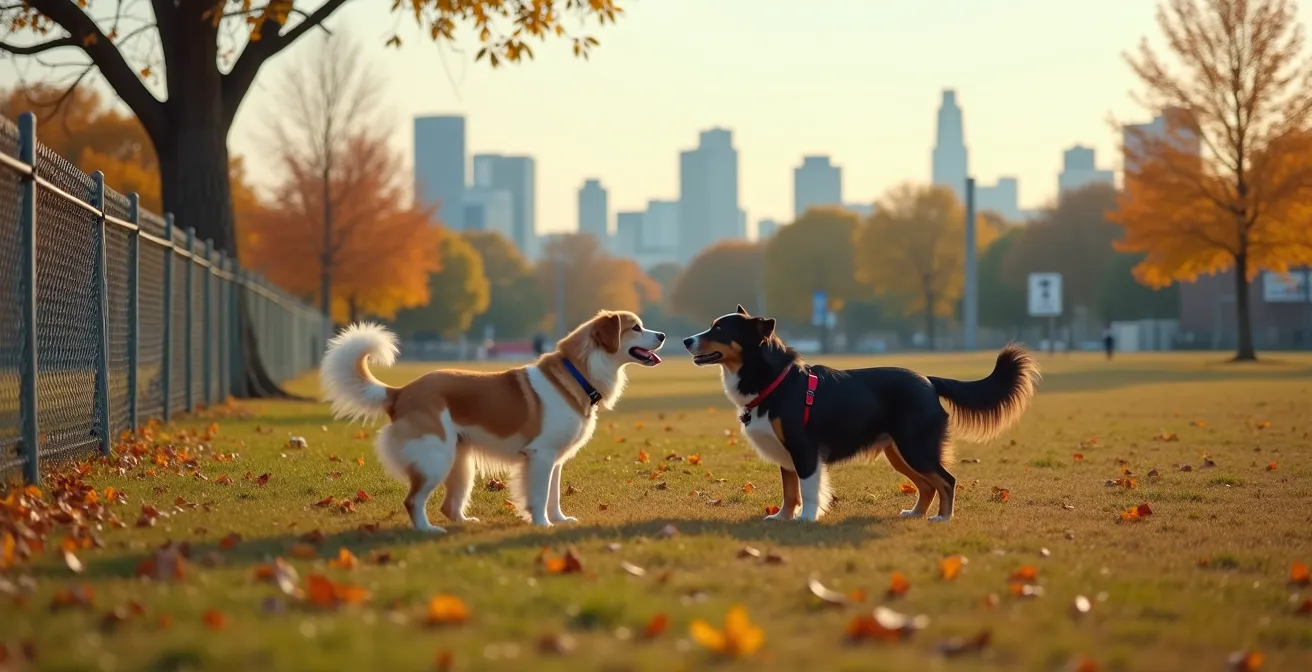
The risk is higher in urban settings. A University of Guelph study found that Canadians in cities are twice as likely to be bitten as those in rural areas. Dog parks, as concentrated hubs of interaction, are a significant factor. Your job as an owner is to be a vigilant security detail, not a passive observer.
Look for these red flags, which require immediate, calm intervention:
- T-Stancing: One dog stands perpendicularly over another dog’s shoulders. This is a classic power play and a display of dominance, not play.
- Pinning: One dog holds another down. If the dog on the bottom is struggling or the pin lasts more than a couple of seconds, it is not play. It’s bullying.
- Non-Reciprocal Chasing: Playful chasing is mutual, with roles reversing. If one dog is consistently the pursuer and the other is trying to hide, disengage, or has its tail tucked, the chase is a hunt. Intervene.
- Group Ganging Up: If two or more dogs begin to focus on or chase a single dog, the situation is escalating dangerously. Remove your dog immediately.
A simple “consent test” is an excellent investigative tool. Briefly and gently hold one of the dogs. If the other dog immediately disengages and looks away, the play was likely one-sided. If the other dog waits patiently and eagerly for its playmate to be released, the play is more likely to be mutual. Also, be aware of environmental triggers unique to Canada, like icy patches causing accidental, high-speed collisions that can spark a fight. The best strategy is to leave the park while your dog is still having fun, before it becomes overstimulated and its ability to make good social decisions degrades.
How to Use the “SAFFER” Test to Evaluate a Dog’s Safety with Kids?
Nowhere is the need for forensic observation more critical than in interactions between dogs and children. Children are, by their nature, unpredictable and often miss or misinterpret a dog’s stress signals. This is tragically reflected in injury data; Canadian injury data reveals that children aged 5-9 years account for the largest percentage of bite injuries, many to the face. The SAFFER™ assessment, developed by Dr. Suzanne Hetts, provides a structured framework for evaluating these high-stakes interactions.
SAFFER is not a pass/fail test, but an acronym for analyzing a dog’s behavioural response during an interaction: Safety, Arousal, Fear, Frustration, Elation, and Recovery. It provides a data-driven way to assess a dog’s comfort level. Instead of just hoping for the best, you are actively collecting evidence about the dog’s emotional state. Your role is to be a neutral observer, documenting the dog’s behaviour without judgment.
For example, imagine a child is petting your dog. Using the SAFFER framework, you would analyze the scene. Is the dog leaning into the petting (Elation) or leaning away, showing whale eye (Fear)? Is its tail doing a low, slow wag (calm) or is it stiff and high (Arousal)? Is it trying to move away but blocked by the child (Frustration)? How quickly does the dog’s body language return to a relaxed state after the child moves away (Recovery)?
This structured observation allows you to build a case file on what types of interactions are genuinely safe and which are merely tolerated. Tolerance is not safety. A dog that is merely tolerating a child’s attention is a dog that is accumulating stress, and that stress can eventually lead to a bite when its capacity for tolerance is exceeded.
Your Action Plan: Applying the SAFFER Observation Test
- Define the Interaction: Clearly identify the specific interaction you are observing (e.g., a child petting the dog, a child taking a toy).
- Observe and Record: Watch the dog’s entire body. Look for signals of Fear (whale eye, lip licking, tucked tail), high Arousal (stiff body, fast wag), and Frustration (inability to move away).
- Note Positive Evidence: Also look for clear signals of Elation (loose, wiggly body, relaxed mouth, seeking more interaction).
- Assess Recovery Time: When the interaction ends, time how long it takes for the dog to return to a completely relaxed state. A long recovery time indicates high stress.
- Make a Judgment: Based on the evidence, is this specific interaction safe to repeat? If you saw any signs of Fear, Frustration, or excessive Arousal, the answer is no. The interaction must be modified or prevented.
Using the SAFFER framework transforms you from a passive bystander into a proactive safety manager, protecting both the child and the dog by making decisions based on evidence, not hope.
The Alpha Roll Danger: Why Flipping Your Dog Increases Bite Risk
The “alpha roll”—forcibly flipping a dog onto its back and holding it down—is perhaps the most dangerous and misguided piece of dog training advice ever popularized. From a forensic behavioral perspective, this act is not interpreted by the dog as a lesson in leadership. It is perceived as a life-threatening, unprovoked physical assault by a trusted figure. It is the ultimate betrayal.
An alpha roll is not perceived as a lesson in leadership but as a life-threatening, unprovoked physical assault by a trusted figure. The dog’s bite is a desperate act of self-defence.
– ASPCA Behavioral Sciences Team, Dog Body Language Course Series
When a dog bites during an alpha roll, it is not being “dominant” or “defiant.” It is engaging in a desperate act of self-defense against what it perceives as a mortal threat. You have cornered the animal and initiated a violent attack. The dog’s response is predictable and, from its perspective, entirely justified. This action shatters the trust between dog and owner and teaches the dog that humans are unpredictable and dangerous.
The scientific and professional communities are united in their condemnation of this technique. Indeed, professional consensus confirms that 100% of reputable veterinary and behavior organizations in Canada and worldwide condemn the alpha roll method. There is no debate on this topic among modern, educated professionals. It is a relic of an ignorant past, and its continued promotion is a direct threat to the safety of both owners and their dogs.
Using this technique is the fastest way to create a fearful, defensively aggressive dog. It takes a communication problem and escalates it into a physical fight that you, the human, started. There is no scenario where an alpha roll is an appropriate or effective training tool. It is abuse, plain and simple, and it directly manufactures the very bite incidents it purports to prevent.
Key Takeaways
- A dog bite is the end of a long communication sequence, not the beginning. The goal is to intervene at the earliest, most subtle signal.
- Punishing a warning signal (like a growl) does not solve the underlying problem; it only removes the warning, leading to a bite that appears to come “without warning.”
- The “alpha” or dominance theory of dog training is outdated and has been scientifically debunked. Effective leadership is built on trust and cooperation, not force.
Why Being the “Alpha” Doesn’t Work: The Science of Family Cooperation
The entire concept of being the “alpha” in your household is built on a flawed scientific foundation. The original theory was based on 1940s studies of captive, unrelated wolves forced to live together in enclosures—an artificial, high-stress environment. It was essentially a prison study, and its findings have no bearing on the dynamics of a family pet dog.
Crucially, the very scientist whose early work popularized the “alpha wolf” idea, L. David Mech, has spent decades formally retracting and correcting his initial theory. Modern research of natural wolf packs, as detailed in a summary by Purdue University’s Canine Welfare Science team, shows they function like human families: a breeding pair (the parents) cooperatively raising their offspring. There is no constant, violent struggle for dominance. Leadership is based on deference and experience, not physical force.
Applying this outdated alpha model to your pet dog is not only scientifically wrong, it’s counterproductive. It frames your relationship as adversarial, a constant battle for control. This mindset leads to confrontational techniques like the alpha roll, staring contests, and physical corrections, all of which create fear, anxiety, and a breakdown of trust. This, in turn, increases the likelihood of a defensive, fear-based bite.
The modern, evidence-based approach is one of cooperation and benevolent leadership. Your role is not to be a dictator, but a trustworthy guide who provides structure, security, and clear communication. This involves:
- Building Trust: Your relationship should be based on mutual trust and respect, not submission.
- Clear Communication: Use positive reinforcement to teach your dog what you *want* it to do (e.g., teaching “sit” for greetings instead of punishing jumping), rather than just punishing what you don’t want.
- Providing Structure: Consistent rules and routines create a predictable, low-stress environment for your dog.
- Seeking Professional Guidance: When hiring a trainer in Canada, always verify their credentials. Look for certifications like CPDT-KA or CBCC-KA, which indicate a commitment to modern, science-based methods.
By abandoning the “alpha” myth, you shift from being a warden to being a parent and partner. This is the foundation of a safe, healthy, and bite-free relationship with your dog.
To put these forensic principles into practice, the next logical step is to proactively manage your dog’s environment and interactions based on the evidence you’ve learned to gather. Begin today by observing your dog with this new analytical lens to ensure a safer future for everyone in your home.