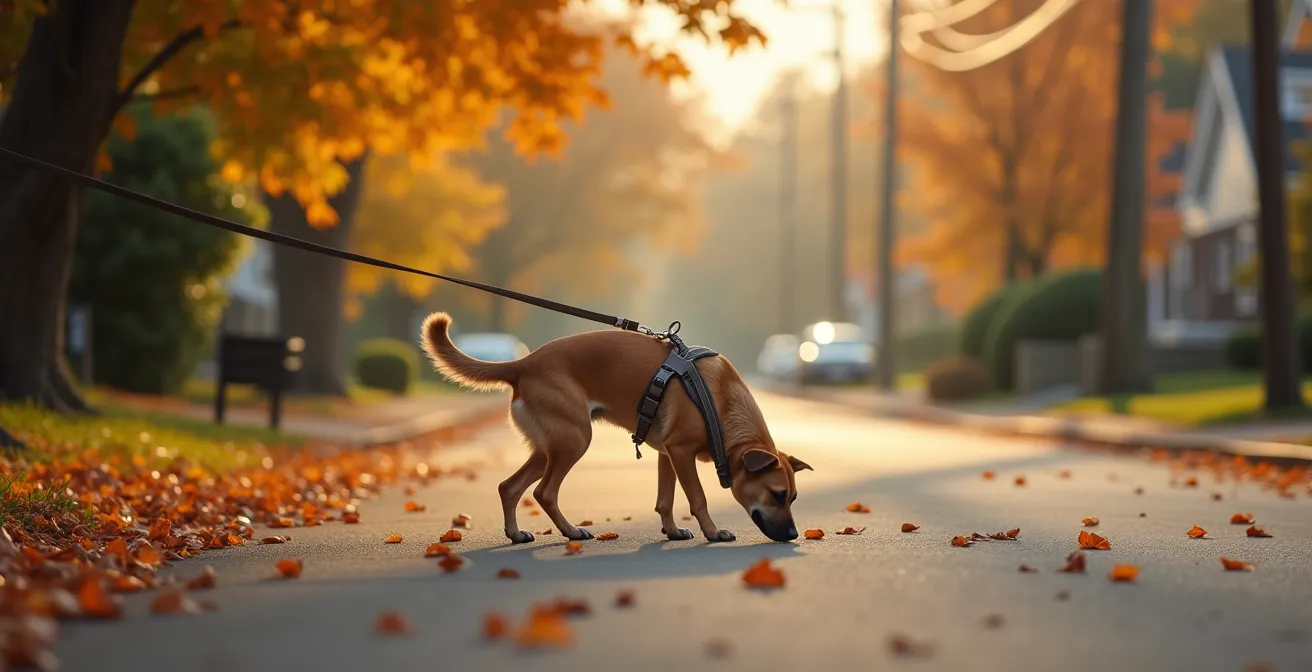
Nose work is more than a game; it’s a physiological tool that actively lowers your reactive dog’s stress by engaging their parasympathetic nervous system.
- Focused sniffing is proven to lower heart rate and counteract the fight-or-flight response to triggers.
- Simple “Find It” games can interrupt your dog’s fixation on triggers before a reaction even begins.
Recommendation: Start with the 3-level box game at home to build a strong, positive foundation before applying these skills on your walks.
The feeling is all too familiar for owners of reactive dogs in Canada: the tightening leash, the stiffening body, the dread that washes over you as another dog, person, or squirrel appears down the street. You’ve tried crossing the road, you’ve tried stuffing high-value treats in their face, and you’ve probably spent countless hours trying to simply “manage” the situation. These strategies can feel like putting a small bandage on a deep wound; they manage the moment but don’t address the underlying anxiety and arousal.
Conventional wisdom focuses on distraction and avoidance. But what if the key wasn’t just to distract your dog from the trigger, but to fundamentally change their physiological and emotional state in that moment? What if you could give them a tool to calm themselves down from the inside out? This is the power of therapeutic nose work. It’s not just about finding a scent; it’s about initiating an olfactory reset that shifts the brain and body out of a state of high alert.
This approach moves beyond simple management. We are going to explore the science behind why sniffing is so profoundly calming and how it creates a powerful parasympathetic shift away from reactivity. This guide provides a complete, practical framework designed for Canadian dog owners. We will cover everything from conducting a “sniffari” in a busy Toronto neighbourhood to adapting scent work for a Calgary winter, giving you the tools to transform your walks from a source of stress into an opportunity for connection and calm.
This article will walk you through the science, the tools, and the step-by-step techniques to implement therapeutic nose work. Discover how to turn your dog’s most powerful sense into their greatest calming mechanism.
Summary: A Therapeutic Nose Work Guide for Reactive Dogs
- Why Does Sniffing for 10 Minutes Lower Heart Rate?
- How to Conduct a “Sniffari” Walk in a Busy Neighborhood?
- Essential Oils or Treats: Which Scent Source is Best for Beginners?
- The Contamination Error: Why Touching the Scent Vessel Ruins the Game
- When to Cue the Search: Interrupting Fixation on Triggers
- Why Does Your Dog React to Elevator Sounds You Can’t Even Hear?
- Why Do Dogs Seek Out Tight Spaces During Thunderstorms?
- How to Teach “Find It” Using Cardboard Boxes and Kibble?
Why Does Sniffing for 10 Minutes Lower Heart Rate?
To understand why nose work is so effective for reactive dogs, we need to look at their nervous system. A dog’s response to a trigger—like another dog or a loud truck—is governed by the sympathetic nervous system, the “fight or flight” mechanism. This system floods the body with adrenaline, increases heart rate, and primes the muscles for action. It’s an ancient survival instinct. A reactive dog is essentially stuck in this high-arousal state. Nose work provides a biological off-ramp.
The act of sniffing deeply and intently activates the opposing system: the parasympathetic nervous system. This is the body’s “rest and digest” mode. It actively works to slow the heart rate, lower blood pressure, and bring the body back to a state of calm. An engrossing sniff session is not just a mental distraction; it is a physiological intervention. Research on canine stress responses confirms that the faster and more intensely a dog sniffs, the quicker their pulse lowers. You are essentially giving your dog a tool to self-soothe by encouraging an activity that is inherently de-stressing.
This isn’t just theory; it’s backed by scientific observation. As one study on heart rate variability explains:
The sympathetic nervous system is responsible for increasing the dog’s arousal in response to stress and the parasympathetic nervous system is responsible for counteracting the arousal and calming the dog. Environmental enrichment can help dogs to be more relaxed, which is likely to be reflected by increased parasympathetic activity.
– Heart Rate Variability Study in Shelter Dogs, Animals (MDPI)
By engaging your dog in a focused scent game, you are providing precisely this kind of powerful environmental enrichment. You are helping them perform an olfactory reset, shifting their nervous system from a state of panic to one of calm focus. A ten-minute “sniffari” is more than a game; it’s ten minutes of applied therapy.
How to Conduct a “Sniffari” Walk in a Busy Neighborhood?
A “sniffari” is a walk where the dog leads with their nose, and the primary goal is sniffing, not getting from point A to point B. For a reactive dog in a busy Canadian city like Vancouver or Montreal, this can seem impossible. The key is strategic adaptation. Instead of avoiding the environment, you teach your dog to engage with it through scent. This means letting go of the idea of a brisk, linear walk and embracing a slow, meandering exploration.
The first step is to choose your time and place wisely. Early mornings or later evenings often have fewer triggers. If your immediate area is overwhelming, it’s worth driving to a quieter industrial park or a large cemetery on weekends. When you encounter a trigger, instead of tensing up, you proactively engage your dog’s nose. A “treat scatter” is your best friend: toss a handful of high-value treats into a patch of grass or snow off the path. This immediately gets their nose down and their eyes up, breaking fixation on the trigger.
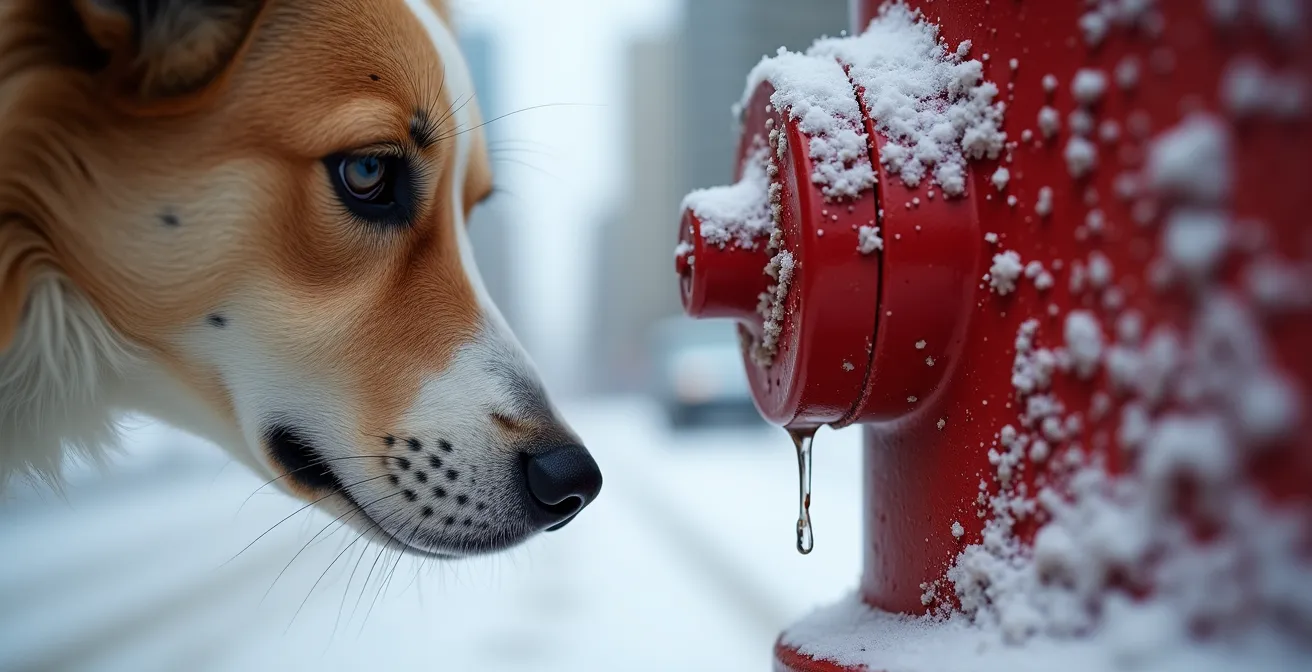
In a Canadian winter, the ground is often a frozen, scentless blanket of snow. This is where you must get creative with environmental scenting. Vertical surfaces become your new best friend. Use things that stick out of the snow and hold scent well:
- Hydro poles
- Park benches
- Fire hydrants
- Garbage bins
- Tree trunks
You can hide a smelly treat at the base of these objects or simply let your dog investigate the “pee-mail” left by other dogs. The goal is to make the environment a source of fascinating information to be sniffed, rather than a landscape of threats to be scanned for.
Essential Oils or Treats: Which Scent Source is Best for Beginners?
When starting nose work, the first question is often what scent to use. The two main options are high-value food treats or specific essential oils used in competition scent detection. For a beginner, especially a reactive dog, the answer is almost always to start with food. Food is a primary motivator; your dog already understands its value and will be naturally driven to find it. This builds enthusiasm and confidence quickly, which is crucial for a dog that may already be anxious.
However, the Canadian climate presents a unique challenge: extreme cold. Below -5°C, many soft treats can freeze into hard, scentless rocks, becoming frustrating for a dog to find and eat. This is where understanding your options becomes critical. Hydrosols (floral waters like lavender or chamomile) can be a safer next step than pure essential oils, as they are less potent and less likely to freeze solid than water-based treats.
Once your dog understands the game, you may consider introducing competition odours like birch or wintergreen essential oils. These have the advantage of providing a consistent, strong scent in any weather. However, safety is paramount. Essential oils can be toxic if ingested, and you must follow strict handling protocols. Never allow your dog to directly contact the oil.
This table compares the options, with a special consideration for Canadian winters, based on information from sources like the American Kennel Club:
| Scent Source | Pros | Cons | Canadian Winter Performance |
|---|---|---|---|
| High-Value Treats | Immediate reward, naturally motivating, safe for all dogs | Can freeze in winter, may lose scent when cold | Poor – treats become hard and scentless below -5°C |
| Essential Oils (Wintergreen/Birch) | Consistent scent in all weather, used in competitions | Requires safety precautions, toxic if ingested | Excellent – scent remains stable in extreme cold |
| Hydrosols (Lavender/Chamomile) | Safer than oils, gentle for beginners | Less potent, may need frequent refreshing | Good – less likely to freeze than water-based treats |
If you choose to use essential oils, you must adhere to a strict safety protocol. Always consult with a professional trainer and follow guidelines from organizations like the Canadian Association of Professional Dog Trainers (CAPDT) or the Canadian Veterinary Medical Association (CVMA).
The Contamination Error: Why Touching the Scent Vessel Ruins the Game
As you advance from scattering treats to hiding specific scents in containers, you enter the world of formal scent work. Here, one rule is absolute: avoid scent contamination at all costs. This is the single most common mistake beginners make, and it can completely derail your training. Contamination occurs when the target odour (e.g., birch oil) gets on anything other than the intended material (like a cotton swab) inside the scent vessel.
Why is this such a big deal? Your dog’s nose is thousands of times more sensitive than yours. If you handle the scented swab with your fingers and then touch the outside of the container, or other nearby objects, you leave a trail of scent everywhere. Your dog, who is trying to learn to pinpoint a single source, will become confused and frustrated. They may alert on the side of the box, on your hand, or on the floor five feet away. This breaks down their confidence and teaches them the wrong lesson: that the scent is everywhere and not concentrated in one spot.
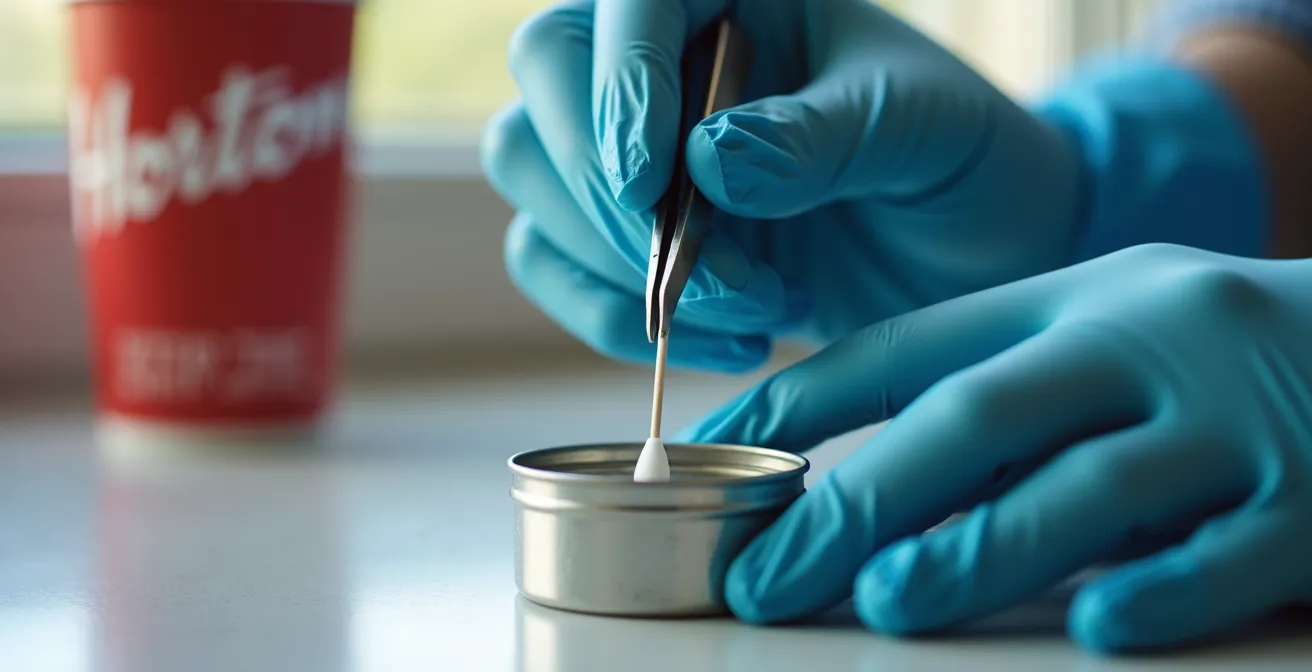
To maintain scent integrity, you must treat your training materials like evidence in a crime lab. The odour should always be novel and isolated. As experts from the AKC advise, you must always wear disposable gloves and handle the scented cotton swab with a dedicated pair of tweezers. This ensures that the only thing your dog is searching for is the scent hidden inside the container.
If contamination happens—and it will—it’s not the end of the world, but you need a decontamination protocol. Wash any plastic or metal vessels with unscented soap and hot water, and let them air dry completely. It’s also wise to have separate “hot” (scented) and “cold” (unscented) containers to prevent cross-contamination. This meticulousness isn’t about being fussy; it’s about setting your dog up for success by making the game clear, fair, and fun.
When to Cue the Search: Interrupting Fixation on Triggers
For a reactive dog, the world is a series of potential threats. Their default behaviour is often to scan the environment, lock onto a trigger, and escalate. The goal of therapeutic nose work on walks is to interrupt this pattern before the reaction happens. Timing is everything. Cueing a “Find It” game when your dog is already lunging and barking is too late; their sympathetic nervous system is already in overdrive, and they are “over threshold” and unable to learn or think clearly.
Your job is to become an expert at reading your dog’s earliest, most subtle body language. You need to identify the “yellow zone”—that moment when your dog has noticed a trigger but has not yet reacted. This is your window of opportunity. Early warning signs include:
- An ear flick in the direction of the trigger
- A slight stiffening of the body
- A closed mouth
- A “whale eye” (seeing the whites of their eyes)
- A forward weight shift
The instant you see one of these signs, you cheerfully and enthusiastically cue your game. A great technique, especially in Canadian urban environments, is the “treat scatter.” As noted by experts at Animal Kind, a Canadian animal welfare organization, this simple action serves a dual purpose: it helps your dog search with their nose instead of scanning with their eyes, and the very act of sniffing helps to calm them down. By the time they’ve vacuumed up the treats, the trigger may have passed without an incident.
This is not a bribe. You are not rewarding the fixation. You are proactively redirecting their brain from a visual, predatory/defensive pathway to an olfactory, seeking pathway. This olfactory reset is a powerful management tool that, over time, can help change your dog’s conditioned emotional response to triggers. It teaches them that the appearance of another dog doesn’t have to mean panic; it can mean an opportunity for a fun and rewarding game with you.
Why Does Your Dog React to Elevator Sounds You Can’t Even Hear?
If you live in a Canadian condo or apartment building, you might be baffled by your dog’s reaction to seemingly nothing in the hallway. They might suddenly get tense, bark, or refuse to move near the elevator shaft. The reason is simple: your dog’s world is exponentially richer in sound than yours. They aren’t reacting to nothing; they are reacting to high-frequency sounds you are physically incapable of hearing.
The science is clear. Humans have a hearing range that tops out at around 20,000 Hertz (Hz). It’s a well-established fact that dogs hear up to 65,000 Hz, allowing them to perceive a huge range of ultrasonic sounds. The whirring of an elevator motor, the electronic chime, the scraping of the cables, and even the fluorescent lights in the hallway can all produce high-frequency noises that are nonexistent to us but potentially startling or irritating to a dog.
For a dog already prone to anxiety or reactivity, these invisible sounds can be a significant source of stress, contributing to “trigger stacking” before you even get outside. This is where nose work becomes a powerful tool for desensitization and counter-conditioning. By playing scent games in these challenging environments, you can change your dog’s association with the space from a place of scary noises to a place of fun and reward.
A gradual approach is key. You can start by playing a simple “Find It” game at the far end of the hallway, away from the elevator. Over several sessions, you can gradually decrease the distance. Use extremely high-value treats near the source of the noise. The goal is to make the rewarding scent game so engaging that the scary sounds fade into the background. You are actively rewriting their emotional response, teaching them that the sound of the elevator predicts delicious cheese or chicken, not danger.
Why Do Dogs Seek Out Tight Spaces During Thunderstorms?
Many dog owners have observed this behaviour: at the first rumble of thunder or crack of fireworks, their dog tries to cram themselves into the smallest space possible—under a desk, in a closet, or behind the toilet. This isn’t just a quirky habit; it’s a deeply ingrained instinct related to a concept called thigmotaxis, the tendency of an organism to seek contact with other objects.
For a dog experiencing anxiety, an open space feels threatening. They have to be vigilant in all directions, which is mentally exhausting. By pressing themselves into a tight space, they receive steady, deep pressure on their sides, back, and top of their head. This pressure mimics the feeling of being in a safe, secure den. It reduces the need for vigilance by physically protecting them on multiple sides, creating a profound sense of security. This is the same principle behind the effectiveness of Thundershirts and anxiety wraps.
As experts in canine fear note, reactive dogs often feel uncertain and anxious, and this can be mitigated with enrichment. This denning instinct is something we can and should leverage in our therapeutic nose work. Instead of seeing your dog’s crate or favourite hiding spot as a place they go only when scared, you can transform it into a “scent fort”—a place of proactive, confidence-building fun.
Start by playing “Find It” games with high-value treats inside their crate or under the coffee table. Hide treats in blankets or snuffle mats within this “den” to create a powerful positive association. During mild weather disturbances, initiate a nose work game in their safe space. This teaches the dog that the sound of rain or wind is a cue for a fun, rewarding activity. You are combining the calming effect of the parasympathetic shift from sniffing with the innate security of their denning instinct, giving them a powerful two-pronged strategy for coping with environmental stressors.
Key Takeaways
- Sniffing isn’t a distraction; it’s a physiological state-changer that activates the calming parasympathetic nervous system.
- Start nose work in a controlled environment (like with cardboard boxes) to build a strong foundation before using it to manage triggers on walks.
- In Canada, adapt your strategy for winter by using vertical surfaces for scent placement when snow covers the ground.
How to Teach “Find It” Using Cardboard Boxes and Kibble?
The foundation of all therapeutic nose work is a simple game of “Find It.” Before you can use this skill to manage reactivity on a busy street, your dog must first understand and love the game in a low-distraction environment, like your living room. The cardboard box game is the perfect starting point. It’s cheap, easy, and builds tremendous confidence through an “errorless learning” approach.
The principle of errorless learning is to make it incredibly easy for your dog to succeed, especially in the beginning. As scent work experts emphasize, you should not frustrate a green dog by presenting many choices. The goal is to make the right choice obvious, building enthusiasm and a love for the game. This reduces confusion and prevents the dog from giving up. You want them to think this is the best game ever invented.
Setting the dog up for success reduces confusion, frustration and errors by making the right choice obvious. It should be easy to succeed and difficult to fail.
– Hunters Heart, Nosework: What is Scent Work?
Use everyday objects for this game. You don’t need fancy equipment. A few empty moving boxes from Canadian Tire, old shipping boxes, or even Tim Hortons cup holders are perfect. Start with your dog’s regular kibble to keep the stakes low and the motivation high.
Your Action Plan: The 3-Level Beginner Box Game
- Level 1 (First 5 Minutes): With your dog watching, toss a piece of kibble into a single, open cardboard box. As they go to eat it, say “Find It!” in a happy, encouraging tone. Repeat 5-10 times to build a strong association between the cue and the action of finding food in a box.
- Level 2 (Next 5 Minutes): Place three open boxes on the floor. While your dog watches, place a piece of kibble in just one of them. Give the “Find It!” cue. Cheer enthusiastically when they find the right one. This teaches them to start using their nose to differentiate between boxes.
- Level 3 (Final 5 Minutes): Have your dog wait in another room or behind a baby gate. Hide kibble in one of the three boxes. Bring your dog in and cue “Find It!”. This is their first “blind” search. When they succeed, give them a jackpot (a handful of treats) to mark the momentous occasion.
Keep these initial sessions very short—no more than 15 minutes total—to end on a high note and leave them wanting more. This game builds the bedrock of focus and desire that you will later take on the road.
This simple box game is the first and most important step in your journey. By building this foundation of fun, focus, and confidence at home, you are preparing your dog with a powerful self-soothing tool. Begin today by setting up this game; it’s the first step in giving your dog—and yourself—the gift of calmer walks.