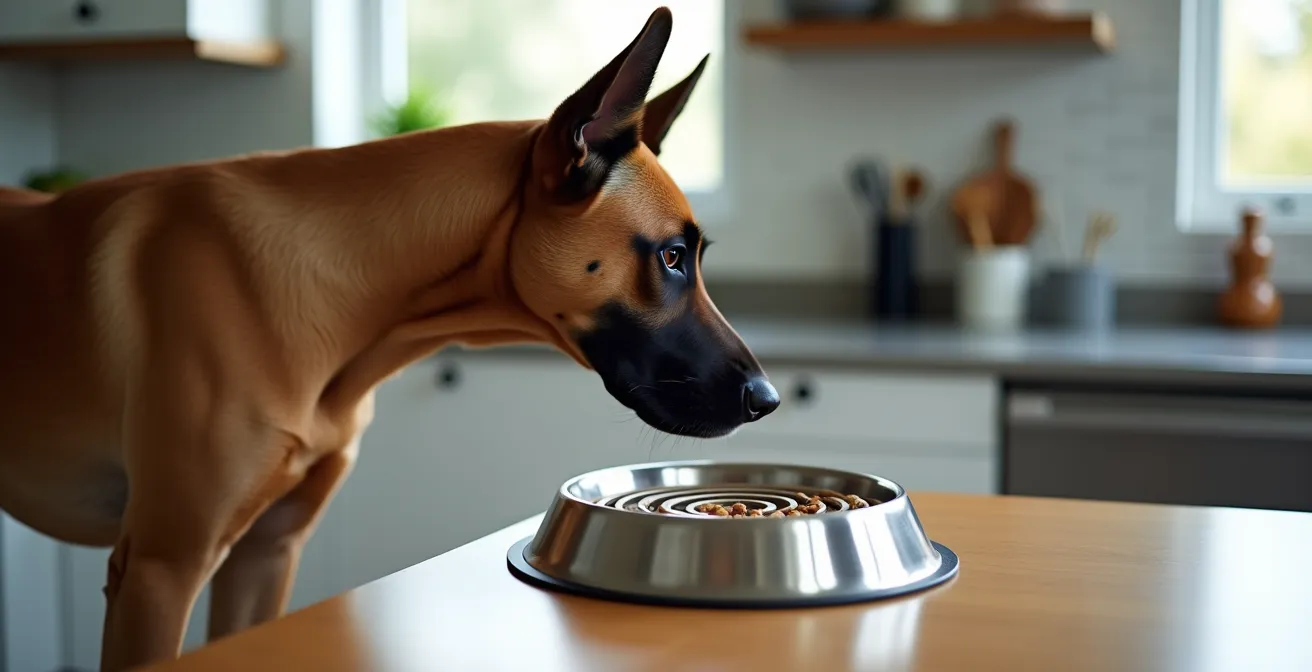
A slow feeder bowl is a crucial tool, but it’s not a magic bullet against bloat; it’s one component of a complete, evidence-based risk management system.
- True prevention involves controlling *how fast* your dog eats (aerophagia), what the bowl is made of (bacterial load), and their activity *after* the meal.
- For high-risk breeds, a preventative gastropexy surgery is the most effective measure to stop deadly stomach torsion.
Recommendation: Adopt a holistic “feeding ecosystem” approach and discuss prophylactic gastropexy with your Canadian veterinarian to truly protect your dog.
As a veterinarian focused on preventative health, I see the terror in the eyes of owners of deep-chested breeds like Great Danes, Weimaraners, and German Shepherds. The word “bloat,” or more clinically, Gastric Dilatation-Volvulus (GDV), is a shadow that looms over them. It’s a swift, devastating, and often fatal condition where the stomach fills with gas and twists on itself. In response, the market has exploded with a seemingly simple solution: the slow feeder bowl. Many owners purchase one, believing they’ve checked the “bloat prevention” box.
The common advice is to slow down your dog’s eating, and these bowls certainly do that. But relying on a single piece of plastic or ceramic to protect against a complex medical emergency is a dangerous oversimplification. The truth is, while a slow feeder is an important part of the strategy, it’s just one piece of the puzzle. True prevention isn’t about a product; it’s about understanding and controlling the entire feeding ecosystem—the mechanics of eating, the timing of meals, the materials your dog interacts with, and the environment they eat in.
This article moves beyond the simple “buy a slow feeder” platitude. We will deconstruct the multiple risk factors for GDV and build a comprehensive, veterinarian-approved protocol. We’ll examine why gulping air is the real enemy, how to choose a bowl that doesn’t just slow your dog down but is also safe and hygienic, and establish the critical rules for exercise and feeding that every large-breed owner in Canada should know. This is your complete guide to a systemic approach to GDV risk mitigation.
This guide will walk you through the evidence-based components of a complete bloat prevention strategy. The following sections break down each critical element, from the science of air gulping to emergency response protocols.
Summary: A Veterinarian’s Complete Guide to Bloat Prevention
- Why Does Gulping Air During Eating Increase Volvulus Risk?
- How to Select a Bowl Pattern That Isn’t Frustrating for Flat Faces?
- Ceramic or Plastic: Which Slow Feeder Harbors Less Bacteria?
- The Plastic Chewing Risk: Why Aggressive Eaters Need Silicone Bowls
- When to Exercise After Eating: The 2-Hour Rule Explained
- The Feeding Error That Causes Food Aggression in 40% of Multi-Pet Homes
- How to Calculate Exactly How Many Cups Your Dog Needs (Not What the Bag Says)?
- How to Induce Vomiting safely (and When NEVER to Do It)?
Why Does Gulping Air During Eating Increase Volvulus Risk?
The primary benefit of a slow feeder isn’t just about slowing food intake; it’s about reducing aerophagia, the technical term for swallowing excessive amounts of air. When a large, deep-chested dog gulps its food, it also gulps a significant volume of air. This air rapidly fills the stomach, causing it to distend like a balloon—the “gastric dilatation” part of GDV. A gas-filled, heavy stomach is unstable. It’s far more likely to rotate or twist on its axis (the “volvulus”), cutting off its own blood supply and trapping the gas inside. This is the moment a dangerous situation becomes a life-threatening emergency.
The stakes are incredibly high. According to the Merck Veterinary Manual, even with aggressive emergency surgery, the mortality rate for GDV is between 20-45% in treated dogs. For certain breeds, the risk is astronomical. For example, one landmark study found the Great Dane has a lifetime risk of 42.4%, making it a focal point for GDV research. This is not a risk to be taken lightly. A slow feeder mechanically interrupts the gulping behavior, forcing the dog to eat more deliberately and ingest less air, directly mitigating the initial step in this catastrophic chain of events.
Interestingly, while owners often worry about their dogs drinking too much water, the same principle applies: it’s the rapid gulping of air along with the water that poses the risk. Contrary to old advice, studies have also shown that using elevated food bowls can actually increase the risk of GDV, likely because the angle encourages even more air swallowing. The safest approach is a floor-level bowl that is designed to create a mechanical barrier to rapid eating.
How to Select a Bowl Pattern That Isn’t Frustrating for Flat Faces?
Once you’ve decided to use a slow feeder, the next challenge is choosing the right one. The market is flooded with a dizzying array of maze patterns, spirals, and ridges. A pattern that works wonders for a German Shepherd can be an exercise in pure frustration for a French Bulldog. The goal is to slow eating, not to make it impossible or stressful. A frustrated dog may give up on the bowl, or worse, try to chew or break it to get to the food. The key is matching the bowl’s design to your dog’s facial structure and muzzle length.
Brachycephalic (flat-faced) breeds like Pugs, Boxers, and Bulldogs need shallow bowls with wider, softer obstacles like spirals or low hills. Their short snouts can’t navigate deep, narrow channels. Forcing them to use an overly complex maze can cause damage to their eyes and noses. Conversely, dogs with long muzzles, such as Retrievers and Shepherds, require more challenging, intricate patterns with deeper grooves to provide an appropriate level of difficulty. For them, a simple spiral may not slow them down enough to be effective. As Dr. Marty Becker, DVM, noted, the right bowl can turn a “pig-out session into a relaxing — and safer — meal.”
The following table provides a general guideline for selecting a pattern based on your dog’s build. Use this as a starting point to find the perfect balance between challenge and accessibility.
| Breed Type | Recommended Pattern | Why It Works |
|---|---|---|
| Brachycephalic (Pugs, French Bulldogs) | Spirals & soft hills | Allows flat faces to access food without frustration |
| Long-snouted (Shepherds, Retrievers) | Deep mazes & intricate patterns | Provides appropriate challenge for longer muzzles |
| Medium breeds (20-45 lbs) | Medium-depth ridges | Balanced difficulty for average jaw size |
Ceramic or Plastic: Which Slow Feeder Harbors Less Bacteria?
The pattern of the bowl is for your dog’s pacing; the material is for their health. The two most common materials for slow feeders are plastic and ceramic, but both come with significant drawbacks, especially concerning hygiene. The complex ridges and mazes that slow eating also create a perfect environment for biofilm—a slimy, resilient layer of bacteria—to thrive. This is a major concern that is often overlooked. Your dog’s bowl can become a petri dish for harmful pathogens if not chosen and maintained correctly.
While plastic bowls are cheap and widely available, they are porous and scratch easily. Every tiny scratch becomes a protected reservoir for bacteria. Research from Hartpury University found that plastic bowls tend to harbor the highest overall bacterial counts. Ceramic bowls might seem like a better option, but they can develop hairline cracks that are invisible to the naked eye, and the same study found they were more likely to harbor the most dangerous species, including E. coli and MRSA. For this reason, as a veterinarian, I almost universally recommend stainless steel. It is non-porous, durable, easy to sanitize, and offers the best defense against bacterial colonization.
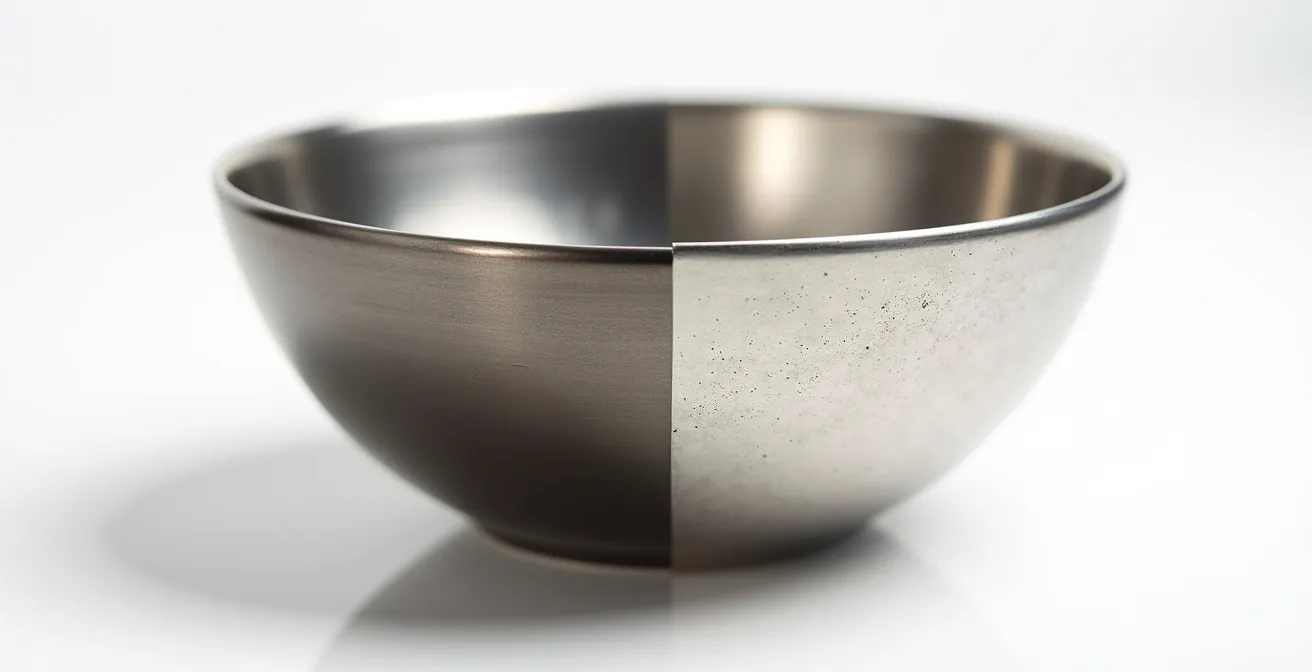
Regardless of the material, a strict cleaning protocol is non-negotiable. A quick rinse is not enough. The mechanical action of scrubbing is necessary to break down biofilm. Adhering to a consistent and thorough cleaning schedule is as important as the bowl itself for your dog’s overall health.
Your Vet-Approved Bowl Cleaning Checklist
- Wash bowls after every single meal using hot water and standard dish soap.
- Use a dedicated sponge or brush reserved only for pet bowls to prevent cross-contamination.
- Perform a weekly deep clean by soaking the bowl in a diluted bleach solution (1 part bleach to 50 parts water) for 10 minutes, then rinse thoroughly.
- Allow bowls to air dry completely before the next use, as a damp surface encourages bacterial growth.
- Immediately replace any plastic or ceramic bowls that show signs of scratching, chipping, or cracking.
The Plastic Chewing Risk: Why Aggressive Eaters Need Silicone Bowls
The title of this section reflects a common marketing angle, but as a veterinarian, I must clarify a critical safety point: for truly aggressive chewers, neither plastic nor silicone is the safest option. While some dogs are gentle and simply lick their food from a slow feeder, others will attack the bowl with frustration, biting and chewing the plastic barriers. This behavior poses a significant risk of ingesting plastic fragments, which can lead to a gastrointestinal obstruction—a painful and life-threatening condition requiring emergency surgery. In major Canadian cities like Toronto or Vancouver, these emergency surgery costs range from $3,000 to $7,000.
Silicone is often positioned as a softer, safer alternative to hard plastic. While high-grade, food-safe silicone is more flexible and less likely to shatter into sharp shards, it is still tearable. A determined, powerful chewer can rip off and swallow pieces. The safest hierarchy of materials for dogs with a history of destructive chewing is clear. Your first and best choice should always be stainless steel, which is virtually indestructible. Hard, BPA-free plastic should only be used under strict supervision for dogs who are not aggressive chewers.
Dogs who wolf down their food or cats who ‘binge and purge’ have more than met their match with Outward Hound Fun Feeder Slo-Bowls that turn a pig-out session into a relaxing — and safer — meal
– Dr. Marty Becker, DVM, on the benefit of a well-designed bowl
This table outlines the durability of common materials. Use it to make a risk-based decision for your specific dog. If your dog is a “power chewer,” the choice is simple: stainless steel is the only material that provides peace of mind.
| Material | Durability Rating | Best For | Supervision Needed |
|---|---|---|---|
| Stainless Steel | Most Durable | All aggressive chewers | No |
| Hard BPA-free Plastic | Moderate | Supervised feeding only | Yes |
| High-grade Silicone | Flexible but tearable | Gentle lickers/non-chewers | Yes |
When to Exercise After Eating: The 2-Hour Rule Explained
Controlling what happens *after* a meal is just as important as the meal itself. A stomach full of food and gas is heavy and pendulous, making it much more susceptible to twisting during vigorous activity. The common advice to “not exercise your dog after eating” is correct, but it lacks the practical specifics owners need. As a general guideline, veterinarians recommend a “2-Hour Rule” as a safe waiting period between a meal and any strenuous exercise.
Strenuous exercise includes activities like running, high-intensity fetch, wrestling with other dogs, or any activity that involves jumping and rolling. These movements can physically cause a full stomach to flip. However, this rule doesn’t mean your dog must be confined to a crate. Calm activities are perfectly safe and often necessary. For example, a slow, 10-minute leashed walk for bathroom purposes immediately after a meal is fine. Mental stimulation is also an excellent post-meal option; puzzle toys, ‘find it’ games, or calm sniffing in the yard can help burn energy without posing a physical risk.
This schedule should be adapted to your life and environment. For those of us in Canada, a frigid -20°C winter evening may necessitate a shorter wait for a quick bathroom break. The key is to avoid high-impact, jarring movements on a full stomach. Planning your day so that major exercise happens before meals or several hours after is a cornerstone of a responsible GDV prevention protocol.
Here is a safe activity schedule to implement:
- Immediately after meal: Calm, leashed 10-minute walk for elimination only.
- 0-2 hours post-meal: Low-impact activities. Mental stimulation (puzzle toys), training sessions, or calm sniffing walks.
- 2+ hours post-meal: High-intensity activities are now safer. This is the time for dog parks, running, or games of fetch.
- Avoid for 3 hours: Activities involving rolling or agility training where the dog’s body may twist.
The Feeding Error That Causes Food Aggression in 40% of Multi-Pet Homes
While the title of this section cites a common statistic, the key takeaway is that competition during feeding is a significant source of stress, and stress is a known risk factor for GDV. In homes with multiple pets, the simple act of putting down food bowls can trigger resource guarding and food aggression. A dog that feels pressured to eat quickly before another pet can steal its food will inevitably gulp its meal—and large amounts of air. This completely negates the benefit of a slow feeder bowl. Creating a calm, secure feeding environment is paramount.
The most common and critical error owners make is feeding multiple dogs in the same room at the same time. Even if dogs seem to get along, the underlying tension of a shared resource can cause anxiety and competitive eating. The solution is total separation during mealtimes. This doesn’t just mean placing bowls on opposite sides of the kitchen; it means creating a space where each dog can eat without feeling watched, threatened, or rushed. This simple environmental change can dramatically reduce mealtime stress and the dangerous aerophagia that comes with it.
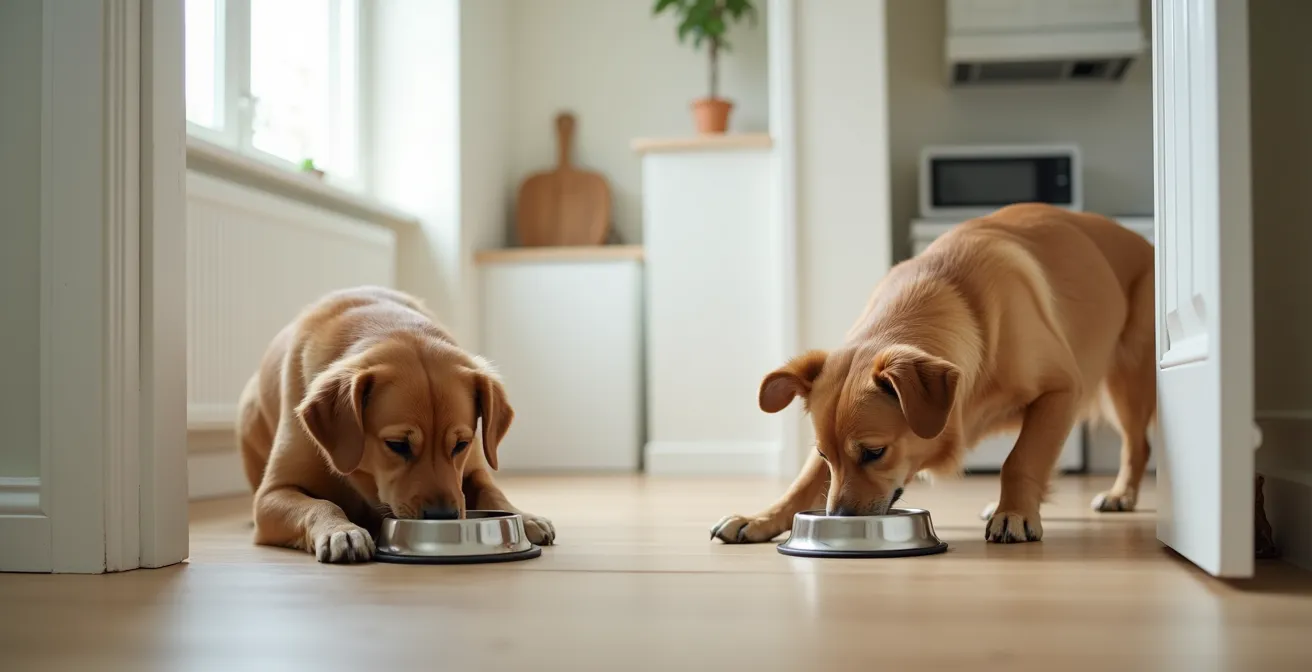
Implementing a structured management plan is essential for a peaceful, multi-dog household. Each dog should have its own designated, private eating area. If you struggle with severe resource guarding, it is crucial to seek help from a certified professional, such as one recommended by the Canadian Association of Professional Dog Trainers (CAPDT). Never try to physically correct a dog for growling over its food; this can escalate the aggression. Instead, manage the environment to prevent the conflict from ever occurring.
How to Calculate Exactly How Many Cups Your Dog Needs (Not What the Bag Says)?
Reducing the volume of each meal is a key strategy for preventing stomach distension. This is why veterinarians universally recommend feeding 2-3 smaller meals per day rather than one large one. But how much is a “small meal”? The feeding guides on dog food bags are notoriously inaccurate. They are generic starting points that do not account for your specific dog’s age, metabolism, activity level, or whether they are spayed or neutered. Overfeeding is rampant, and it contributes to both obesity and an increased risk of bloat.
To feed your dog the correct amount, you must first calculate their Resting Energy Requirement (RER), and then adjust it for their lifestyle. The formula for RER is: RER (in calories) = 70 x (your dog’s weight in kg)^0.75. Once you have the RER, you multiply it by a factor based on their activity level (e.g., 1.6 for a typical neutered, moderately active dog). This gives you their total daily calorie needs. Finally, you check the calorie content of your dog’s food (listed as kcal/cup on the bag) and divide to find the exact number of cups they need per day. This total amount should then be split into two or three meals.
Your Canadian veterinarian can help you perform this calculation and, more importantly, assess your dog’s Body Condition Score (BCS). This hands-on assessment is the best way to determine if your dog is at a healthy weight and to fine-tune their portions monthly.
Case Study: Calculating a Daily Portion
Let’s take a typical 28kg (62 lb) Golden Retriever living in Vancouver. First, we calculate her RER: 70 x (28)^0.75 = 897 calories. As a neutered, moderately active dog, we multiply this by 1.6, for a total daily need of 1,435 calories. If her food has 350 kcal/cup, her daily portion is 1,435 / 350 = 4.1 cups. This 4.1 cups should be divided into two meals of approximately 2 cups each to reduce stomach load and lower GDV risk.
Key Takeaways
- A slow feeder is only one part of GDV prevention; a holistic “feeding ecosystem” approach is required.
- The primary risk is aerophagia (air gulping), which a slow feeder helps mitigate mechanically.
- For high-risk breeds, prophylactic gastropexy is the most effective surgical intervention to prevent the fatal “volvulus” (twist).
Recognizing the Emergency and When You Must NEVER Induce Vomiting
Even with the best prevention system, owners of high-risk breeds must know how to recognize the signs of GDV and what to do in an emergency. This is a scenario where minutes matter. The most critical thing to understand is this: if you suspect bloat, you must NEVER attempt to induce vomiting. A twisting stomach closes off the esophagus, so the dog is physically unable to vomit. Trying to force it will only cause more pain and waste precious time.
The classic signs of GDV are distinct from simple indigestion. Look for:
- Non-productive retching: The dog is trying to vomit, but nothing comes up.
- A hard, swollen, or distended abdomen: The stomach area will feel tight like a drum.
- Pacing, restlessness, and inability to get comfortable.
- Excessive drooling or foaming at the mouth.
- Signs of shock: Pale gums, rapid heart rate, weakness, or collapse.
If you see these signs, this is your protocol: call your nearest 24-hour emergency veterinarian (like a VCA Canada 24/7 referral center) to let them know you are on your way, and transport your dog immediately. Do not wait. Do not try home remedies. Inducing vomiting should only *ever* be done under the explicit instruction of a veterinarian, typically for certain toxin ingestions, not for bloat. Keep the Pet Poison Helpline number (1-855-764-7661), which serves Canada, saved in your phone for such cases.
For owners of very high-risk breeds, the ultimate preventative measure is a discussion with your veterinarian about a prophylactic gastropexy. This is a surgical procedure, often done at the same time as a spay or neuter, where the stomach is permanently tacked to the abdominal wall. This does not prevent the stomach from bloating (dilating), but it physically prevents it from twisting (the volvulus), which is the fatal event. Studies show that dogs who don’t receive gastropexy after a GDV episode have an 80% recurrence rate. A prophylactic gastropexy is the single most effective way to eliminate the risk of torsion.
Ultimately, safeguarding your dog from GDV requires a proactive partnership with your veterinarian. By implementing this comprehensive feeding ecosystem and discussing the option of a prophylactic gastropexy, you can replace fear with empowered, effective action.
Frequently Asked Questions About Feeding and Bloat Prevention
Should I follow the feeding guide on the dog food bag?
Bag recommendations are general starting points and often overestimate needs. Your dog’s actual calorie requirements depend on their specific age, activity level, metabolism, and Body Condition Score. It’s best to calculate their needs or consult your veterinarian.
How often should I adjust feeding amounts?
You should monitor your dog’s body condition monthly with a hands-on check of their ribs and waist. Adjust portions up or down by about 10% based on these findings. Always consult your Canadian veterinarian for a proper Body Condition Score assessment and guidance.
How does feeding frequency relate to GDV prevention?
Feeding two to three smaller meals daily significantly reduces GDV risk compared to offering one large meal. This is because smaller volumes lessen the degree of stomach distension and weight at any given time, making the stomach less likely to bloat or twist.