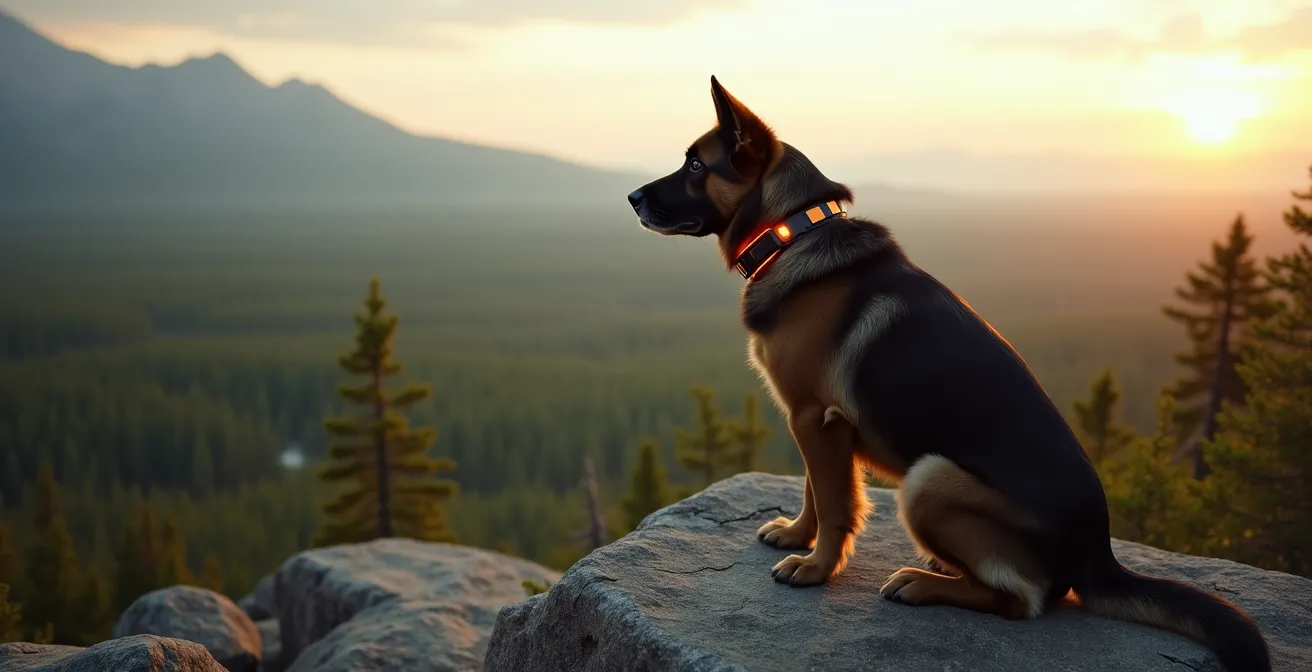
For true Canadian wilderness, radio-frequency (RF) trackers are the only reliable choice; cellular GPS and Bluetooth tags create a dangerous illusion of safety.
- Cellular GPS fails in the vast majority of Canada’s landmass due to non-existent cell service, a critical flaw in remote parks.
- Radio-frequency systems work independently of cell towers, offering real-time tracking, but face their own legal and cost considerations in Canada.
Recommendation: Stop searching for a single magic gadget. Instead, build a fail-safe pet safety system combining the right technology (RF for backcountry) with robust physical security and non-negotiable recall training.
The silence of the Canadian backcountry is both serene and terrifying. For any hiker or camper with a dog, that terror crystallizes into one primal fear: the moment your companion vanishes into the dense woods, beyond voice and sight. The instinct is to turn to technology. We see ads for slick cellular GPS collars or hear about the convenience of a simple Bluetooth tag and assume we’ve bought a solution. But in the vast, rugged, and often freezing landscapes of Canada, this assumption can be a critical mistake.
Most reviews will give you a simple list of features. They’ll talk about waterproofing and battery life as advertised on a box. This guide is different. As tech reviewers who are also dog owners and avid outdoors people, we know that the real question isn’t just “Which gadget is best?” but “What actually works when you’re miles from the nearest cell tower in a B.C. provincial park or deep in the Algonquin interior?” The answer lies not in a single device, but in building a complete, layered fail-safe system.
The common belief that any tracker provides a safety net is what we call the Technology Fallacy. A true safety system for the Canadian wild involves understanding technology’s harsh limits, reinforcing your gear against the elements, and doubling down on the one thing that never loses a signal: your dog’s training. This article dissects each layer of that system, so you can make a choice based on rugged reality, not marketing hype.
To help you navigate these critical decisions, this guide breaks down every component of a true wilderness safety system. We will analyze why certain technologies fail, how to evaluate them for our unique climate, and why training remains your most important tool.
Summary: GPS Collar vs. Bluetooth Tag: A Guide for Canadian Hikers
- Why Do Cellular GPS Collars Fail in Remote Provincial Parks?
- How to Test Real-World Battery Life in Cold Weather?
- Subscription Model or Radio Frequency: Which is Cheaper Long-Term?
- The Tracker Fallacy: Why Technology Doesn’t Replace Recall Training
- How to Secure a Tracker So It Doesn’t Fall Off in Brush?
- Whistle Recall or Voice Command: Which Carries Further in Windy Weather?
- Wood Fence or Electric Wire: Which Actually Stops Prey Drive?
- How to Proof Your Recall Against Squirrels and Geese in City Parks?
Why Do Cellular GPS Collars Fail in Remote Provincial Parks?
The primary reason most popular GPS trackers are functionally useless for true backcountry hiking in Canada is their reliance on cellular networks. These devices work by getting a location via the Global Positioning System and then transmitting that data to your phone over a 4G or LTE network, just like a cell phone. The problem is the immense “coverage gap” in our country. While providers boast of reaching most of the population, official coverage maps reveal that less than 20% of Canada by area has any meaningful service. Once you leave the Trans-Canada corridor and enter a remote provincial or national park, your expensive cellular tracker becomes a dead piece of plastic.
This leaves Radio Frequency (RF) systems as the only viable alternative for off-grid tracking. These devices, like the Garmin Astro series, create a direct link between the collar and a handheld unit, completely independent of cell towers. They offer real-time updates and are the gold standard for hunters and search-and-rescue teams. However, there’s a Canadian-specific catch. Most Garmin tracking systems sold in the U.S. use MURS band radio signals, which are restricted by the Canadian government for this purpose. Therefore, it is crucial to purchase a model specifically approved for Canada, such as the Garmin Astro 900, to ensure you are operating legally.
Ultimately, a cellular tracker can be a great tool for tracking a lost dog in a city or suburb. But for the Canadian wilderness, relying on one is a gamble against geography you will almost certainly lose. The only reliable tech is one that doesn’t depend on infrastructure that simply isn’t there.
How to Test Real-World Battery Life in Cold Weather?
A tracker’s advertised battery life is almost always based on ideal conditions: moderate temperatures and minimal activity. For Canadian hikers, this is a dangerously misleading metric. Cold-weather degradation is a real and significant factor, as lithium-ion batteries lose a substantial portion of their charge and performance capacity when temperatures drop below freezing. A tracker that claims a 14-day battery life might die in less than 48 hours during a winter hike in the Rockies.
As tech reviewers, we don’t trust the box. You shouldn’t either. You can run your own brutal, real-world test at home before you bet your dog’s life on a device. A simple protocol involves placing the fully charged tracker in a home freezer set to -18°C for several hours to simulate harsh conditions. This allows you to monitor the battery depletion rate in a controlled, cold environment. It’s crucial to test how the battery performs during different activity levels, as the update frequency, often triggered by movement, drastically impacts power consumption.

By documenting the performance after this cold shock, you can compare the manufacturer’s claims to reality. In some tests, certain devices can even outperform expectations; for example, some users find a Tractive GPS can last much longer than its stated life in low-power modes. However, only by simulating the freeze-thaw cycles of a multi-day trip can you gain true confidence in your equipment’s endurance when it matters most.
Subscription Model or Radio Frequency: Which is Cheaper Long-Term?
When evaluating pet trackers, the initial sticker price is only half the story. The true expense is the total cost of ownership, which differs wildly between cellular and RF systems. Cellular GPS trackers like Fi or SpotOn typically have a lower upfront cost for the device but require an ongoing monthly or annual subscription to maintain the data connection. This model is identical to a cell phone plan. While a fee of $14/month may seem small, it adds up significantly over the lifetime of the device.
In contrast, Radio Frequency (RF) systems like the Garmin Alpha have a much higher initial investment, often costing $900 or more for the handheld unit and a single collar. However, they have zero monthly fees. That upfront cost is the total cost. This makes them more economical for long-term use, especially if you have multiple dogs, as a single handheld can typically track numerous collars simultaneously without additional subscriptions.
To illustrate the difference, a recent total cost analysis over five years shows the true financial picture. A cellular plan can easily exceed the initial cost of an RF system over time.
| System Type | Initial Cost | Monthly Fee | 5-Year Total (CAD) | Multi-Dog Capability |
|---|---|---|---|---|
| Cellular GPS (Fi) | $149 | $14/month | $989 | Separate device per dog |
| Garmin Alpha RF System | $900+ | $0 | $900+ | One handheld tracks multiple collars |
| SpotOn GPS | $999 | $6.95/month (optional) | $1416 | Separate device per dog |
Furthermore, some features, and even battery life, can be tied to the subscription. For instance, with certain virtual fence products, battery performance data shows over 25+ hours on cellular tracking mode, but this can increase significantly if you stop paying for the subscription and lose that live-tracking feature. The decision comes down to your use case: for frequent backcountry users, the one-time, subscription-free cost of an RF system is often the more financially sound and reliable choice.
The Tracker Fallacy: Why Technology Doesn’t Replace Recall Training
Investing in the best tracking technology can create a dangerous sense of security, leading to what we call the Technology Fallacy: the belief that a gadget can replace foundational training. A tracker tells you where your dog is, but it does absolutely nothing to bring them back. In a real wilderness emergency—a sudden encounter with a bear, a pack of coyotes, or a moose—you don’t have minutes to check an app. You have seconds to act. In those seconds, the only tool that matters is a rock-solid, immediate recall.
Wildlife encounters are a serious risk in the Canadian wilderness, and technology is a passive observer, not an active protector. As the American Kennel Club bluntly puts it, a reliable recall is a literal lifesaver.
Make sure your dog has a reliable recall. This means your dog comes to you pretty much every time you ask. If a coyote approaches your dog in an off-leash area, you may not have time to get the leash on. Having a reliable recall can save your dog’s life.
– American Kennel Club, AKC Expert Advice on Coyote Protection
This isn’t a theoretical problem. The woods are full of scenarios where only training can prevent disaster. A tracker is for finding a lost dog; training is for preventing them from getting lost in the first place.
Case Study: Wildlife Encounter Scenarios
In online forums dedicated to Canadian canoe tripping, experienced wilderness campers share stories that highlight this distinction. Multiple users report using tools like bear bangers or powerful whistles to scare off wolves that were showing predatory intent towards their dogs. In these tense moments, their first action wasn’t to check a GPS location, but to issue a powerful recall command to get their dog back to their side immediately, before the situation could escalate. This emphasizes the core truth: technology tells you where your pet is, but only effective training brings them back safely.
Think of your tracker as the airbag in a car. It’s a critical safety feature for when everything else has gone wrong, but you should never rely on it as a substitute for defensive driving. Your recall is your seatbelt and your brakes—the primary system you use every single second to stay safe.
How to Secure a Tracker So It Doesn’t Fall Off in Brush?
You’ve invested in the right technology and spent countless hours on training. But there’s a final, brutally simple point of failure in your safety system: the tracker physically falling off your dog’s collar. The dense undergrowth of the Canadian wilderness—full of salal, devil’s club, and snagging branches—is incredibly effective at ripping off poorly secured equipment. A lost tracker is worse than useless; it provides a false sense of security while your dog is truly untraceable.
Standard clip-on holders and flimsy attachments are not designed for this environment. You must actively “Canadian-proof” your tracker attachment to ensure it can withstand the rigors of off-trail scrambling. This means moving beyond the out-of-the-box solution and reinforcing the connection points yourself.

A few extra dollars and minutes spent on reinforcement can be the difference between a successful recovery and a lost device. The goal is to make the tracker an integral part of the collar, not a fragile accessory hanging off it. Before you trust it in the wild, test the attachment by pulling and twisting it vigorously and having your dog run through some dense local brush.
Your Action Plan: Canadian-Proofing Your GPS Tracker
- Secure with Redundancy: Use heavy-duty zip ties passed through the tracker’s loops and around the collar itself as a secondary attachment.
- Reinforce Mounting Points: Apply a strip of high-strength Gorilla Tape or T-Rex Tape over the entire tracker mount for an extra layer of security against snags.
- Prioritize Integrated Collars: When possible, choose collar systems where the GPS unit is built directly into the collar material, rather than relying on a separate holder.
- Inspect Material Quality: Opt for devices built for durability, with features like premium-grade titanium bolts and robust, impact-resistant casings.
- Consider Custom Protection: For extreme environments, look into custom 3D-printed guards or kydex sheaths that can be built to shield the tracker from direct impacts and snags.
Whistle Recall or Voice Command: Which Carries Further in Windy Weather?
The effectiveness of your recall command—the cornerstone of your training—depends entirely on your dog being able to hear it. In the wide-open, windy conditions of a mountain ridge or a coastal trail, the human voice dissipates quickly. Shouting into the wind is exhausting and often futile. This is where a high-frequency whistle becomes an indispensable part of your fail-safe system. Unlike the human voice, the sharp, piercing sound of a good training whistle cuts through wind and ambient noise with remarkable efficiency.
The physics are simple: the specific, high-pitched frequency of a whistle travels farther and is more easily distinguished by a dog from other sounds in the environment. This is not just a theory; it’s a proven advantage in any adverse weather condition.
The sound carries – Even if your dog is running off into the distance, the blast from a whistle can easily be heard. Good luck yelling that far! Use in any weather – The sound of a dog whistle is loud enough to overcome wind, rain, and crashing waves.
– Canine Journal Training Experts, Best Dog Training Whistle Guide
For maximum effect, consider an emergency or “storm” whistle. Models like the Storm Whistle, often cited as the loudest in the world, are designed for human rescue situations and can be heard from a great distance. They serve a dual purpose: a powerful recall tool for your dog and a personal safety device to signal for help if you are injured or lost. By conditioning your dog to respond to this unique, powerful sound with the same urgency as a voice command, you add a layer of long-distance reliability that your voice alone can never match.
Wood Fence or Electric Wire: Which Actually Stops Prey Drive?
While trackers are for recovery, the first line of defense is always containment. Whether at home or setting up a long-term campsite, preventing your dog from chasing after wildlife is key. The two main options are a physical barrier (like a wood fence) or a virtual one (an electric or GPS-based wire system). When dealing with a dog with a high prey drive, the choice is not just about keeping your dog in, but also about what you need to keep out.
A solid wood or chain-link fence is the most reliable way to contain a dog and provides a physical barrier against some wildlife. However, against determined Canadian fauna like coyotes or black bears, a simple fence is not enough. To be effective against coyotes, fencing should be at least 6 feet tall, buried 18 inches deep to prevent digging, and ideally outfitted with “coyote rollers”—aluminum rods along the top that spin when gripped, preventing an animal from getting a foothold to climb over. Even then, a physical fence will not stop a determined bear.
Virtual fences, including traditional buried wire and modern GPS systems, work by creating a boundary that delivers a stimulus (sound, vibration, or static correction) when crossed. Modern GPS fence systems offer up to 72 hours of battery life and the flexibility to create safe zones on large, unfenced properties. The major weakness of any virtual fence is that it does nothing to stop wildlife from entering the “safe” zone. A deer can walk right through, tempting your dog to give chase and run through the static correction. A virtual fence contains the dog, not the trigger.
For a complete system, especially in areas with active predators, combining fence types with other deterrents is most effective. This can include:
- Installing motion-sensor lights or sprinklers pointed outside the fence line.
- Using coyote rollers on top of a physical fence.
- Never leaving your dog unattended, even in a fenced yard.
Key Takeaways
- For remote Canadian wilderness, Radio-Frequency (RF) trackers are the only reliable option due to vast cellular “coverage gaps.”
- Always test tracker battery life in freezing conditions, as advertised performance is irrelevant in Canadian winters.
- A reliable, trained recall is your primary safety tool; technology is a last resort, not a substitute for training.
How to Proof Your Recall Against Squirrels and Geese in City Parks?
The foundation for a life-saving wilderness recall isn’t built on a mountainside; it’s forged in the high-distraction environment of your local city park. Squirrels, geese, and other dogs are the “stress tests” that reveal the true strength of your training. If your dog’s recall isn’t reliable when a squirrel chatters from a tree, it will fail spectacularly when a deer bolts across a trail. Proofing your recall against these everyday temptations is non-negotiable homework for any owner who ventures into the backcountry.
The key is to make returning to you more rewarding than any distraction. This involves consistent, positive reinforcement and turning training into an engaging game. As the AKC’s training experts recommend, you must actively “refresh your dog’s knowledge by playing recall games, using positive reinforcement training methods.” This means high-value treats, exciting praise, and starting with small distances before gradually increasing the difficulty and level of distraction. If your recall command has been “poisoned”—meaning your dog has learned to ignore it—it’s time to choose a new verbal cue or, even better, switch to a whistle.
A whistle’s unique sound can cut through the noise of a park, and professional trainers confirm that some whistles can be heard from miles away. While that may be optimistic, their range far exceeds the human voice. By consistently practicing in environments filled with squirrels and geese, you are not just teaching your dog to come when called; you are building a deeply ingrained habit of attention and response that becomes their default behaviour, no matter the temptation. This is the bedrock of your entire fail-safe system.
Ultimately, your dog’s safety in the Canadian wilderness hinges on this systematic approach. By choosing technology appropriate for our vast, service-poor landscapes, rigorously testing it against our harsh climate, and backing it up with unbreakable training, you move beyond wishful thinking and build a system of genuine security.