
Contrary to the law’s intent, Ontario’s Breed-Specific Legislation (BSL) doesn’t just target “pit bulls”; it puts any dog with a blocky head or muscular build at risk due to its reliance on scientifically unsound visual identification.
- Visual identification of “pit bull-type” dogs by shelter staff and even veterinarians is incorrect more than half the time when compared to DNA evidence.
- Data from Ontario and comparative analysis with cities like Calgary show that BSL has failed to reduce dog bites, while breed-neutral, responsibility-focused laws have succeeded.
Recommendation: Proactively build a “responsible ownership portfolio” for your dog, documenting training, socialization, and vet history to counter potential prejudice based on appearance.
For any prospective dog owner in Ontario, particularly those drawn to the unique charm of a mixed-breed from a shelter, a shadow of anxiety looms. You find the perfect companion, a dog with a loving temperament and a sturdy build, only to be struck by a nagging question: does my new family member look “too much” like a pit bull? This fear is a direct consequence of Ontario’s Dog Owners’ Liability Act (DOLA), which includes a controversial ban on “pit bull terriers”—a term so vaguely defined that it casts a wide and dangerous net.
The common advice is to simply avoid these breeds or to just be a “responsible owner.” However, this guidance fails to address the core of the problem for those with mixed-breed dogs. The law isn’t just about a specific, registered breed; it’s about perception and “physical characteristics that are substantially similar.” This means your beloved Boxer-mix, your loyal Lab-cross, or any dog with a square jaw and short coat could be misidentified and subjected to seizure, legal battles, and even euthanasia.
But what if the very foundation of this law—the ability to judge a dog’s breed and temperament by its looks—is scientifically bankrupt? This article moves beyond the emotional debate to provide a legal and evidence-based rebuttal. We will dismantle the myth of visual identification, demonstrating that it is a flawed and unreliable standard. You are not helpless. By understanding the science and the law’s weaknesses, you can arm yourself with the knowledge to protect your dog.
This guide will walk you through the scientific evidence against visual identification, the data proving BSL’s ineffectiveness, the crucial difference between genetics and behaviour, and the actionable steps you can take to build a proactive defense for your mixed-breed dog in Ontario.
Summary: Navigating Ontario’s BSL for Mixed-Breed Dogs
- Why Can You Not Predict Aggression Based on a Dog’s Physical Appearance?
- How to Use the “SAFFER” Test to Evaluate a Dog’s Safety with Kids?
- Genetics or Training: Which Has the Bigger Impact on Reactivity?
- The “Guilty Look” Myth: Why Your Dog Isn’t Actually Sorry for Peeling the Couch
- How to Channel Herding Instincts in a Suburban Backyard?
- Why Is the “Alpha Wolf” Theory Scientifically Outdated?
- Why Does a Wagging Tail Not Always Mean a Friendly Dog?
- How to Introduce a Second Dog Without Ruining Your First Dog’s Life?
Why Can You Not Predict Aggression Based on a Dog’s Physical Appearance?
The entire premise of breed-specific legislation in Ontario hinges on a single, deeply flawed assumption: that you can reliably identify a dog’s breed, and therefore its potential for aggression, simply by looking at it. This concept of visual identification has been repeatedly and overwhelmingly debunked by scientific research. For an owner of a mixed-breed dog, this is the most critical fact in your defense. The law judges your dog based on a standard that is, by all objective measures, pure guesswork.
The problem is that genetics are not like mixing paint. A dog with a blocky head or a muscular build might have zero “pit bull” DNA. Countless breeds, from Boxers and Mastiffs to Bulldogs and various terriers, can contribute to a “look” that falls under the vague criteria of the law. Even seasoned professionals are notoriously poor at this guessing game. For instance, a University of Florida study revealed that shelter staff misidentified dogs over half the time; they labelled 52% of dogs as pit bull-types, whereas DNA tests confirmed only 21% actually were.
This is not a failure of individuals, but a failure of the method itself. The unreliability of visual ID is why the vast majority of expert organizations stand in firm opposition to BSL. Bodies like the Ontario & Canadian Veterinary Medical Associations, the Canadian Kennel Club, and major humane societies have all condemned the legislation as an ineffective and unjust policy. They recognize that behaviour is a product of individual genetics, training, and environment—not a crude assessment of physical features.
The key factors contributing to this unreliability are clear:
- Even veterinarians, with years of clinical experience, have a widely variable success rate in visually identifying pit bull heritage dogs.
- Studies show that one in three dogs that had no pit bull-type DNA were still labelled as such by shelter staff.
- The genetic lottery means physical traits from a complex mix of breeds do not express themselves in a predictable, linear fashion.
How to Use the “SAFFER” Test to Evaluate a Dog’s Safety with Kids?
While a specific protocol like the “SAFFER” test provides a structured way to assess a dog, the broader and more pressing question for Ontario residents is: what is the most effective public policy for ensuring safety? The province has staked its strategy on BSL, but the data tells a story of complete failure. Instead of reducing incidents, the focus on breed has demonstrably failed to make communities safer, proving that safety assessments must be about individual behaviour, not appearance.
The evidence is stark. Despite having BSL since 2005, a report highlighted that Toronto experienced a 39% increase in dog bites in 2022 and a staggering 57% rise over the preceding decade. This data strongly suggests that banning a “look” does nothing to address the root causes of canine aggression, such as lack of training, poor socialization, or irresponsible ownership. It creates a false sense of security while allowing problematic behaviours in non-banned breeds to go unaddressed.
The most powerful rebuttal to Ontario’s approach comes from a direct comparison with a city that chose a different path: Calgary. Rather than banning breeds, Calgary invested heavily in a breed-neutral model focused on strong licensing, robust enforcement of leash and bite laws, and community education. The results speak for themselves.
This tale of two cities offers a clear, evidence-based conclusion on how to genuinely improve public safety.
| City/Province | Approach | Results |
|---|---|---|
| Ontario (BSL since 2005) | Breed-specific ban on pit bulls | Dog bite incidents increased |
| Calgary | Strong licensing, enforcement, community approach | Five-fold reduction: 10 bites per 10,000 people (1986) to 2 (2006) |
Genetics or Training: Which Has the Bigger Impact on Reactivity?
The debate over “nature vs. nurture” is central to the BSL argument. The law operates on the assumption that genetics—specifically, the supposed genetics of a “pit bull”—are the primary determinant of dangerous behaviour. However, modern canine science and expert consensus overwhelmingly point in the other direction: training, management, and socialization have a far greater impact on a dog’s reactivity and overall behaviour than its genetic makeup.
This is particularly true for the dogs targeted by BSL, which are almost universally mixed-breeds. A compilation of scientific studies on dog bites found that 98% of dogs identified as pit bull-types were, in fact, mixed-breed dogs. On average, these dogs had less than 50% of their DNA from any “bully breed” ancestry. This genetic diversity means that attempting to assign a uniform set of behavioural traits to such a varied population is scientifically nonsensical. Your dog is an individual, not a stereotype.

This scientific reality is why the professional community is so united against BSL. As one extensive veterinary survey on the topic highlighted, the experts who work with animals daily understand that behaviour is complex.
96% of veterinarians oppose breed-specific legislation and overwhelmingly endorse breed-neutral policies. 89% agreed that BSL does not improve public safety.
– Veterinary survey, Dog Bite-Related Studies compilation
For an owner in Ontario, this is a powerful argument. The law is fixated on a tiny and often non-existent fraction of your dog’s genetic code while ignoring the single most important factor you control: their training and environment. A well-trained, well-socialized mixed-breed is infinitely safer than a poorly managed dog of any other breed.
The “Guilty Look” Myth: Why Your Dog Isn’t Actually Sorry for Peeling the Couch
One of the most dangerous side effects of BSL is how it encourages the misinterpretation of normal canine behaviour through a lens of prejudice. The classic “guilty look”—cowering, ears back, avoiding eye contact—is often cited by people as proof a dog “knows” it did something wrong. In reality, this is a display of appeasement and submission. The dog is not feeling guilt; it is reacting to your tense body language and angry tone of voice, trying to de-escalate a perceived threat.
When a dog is already stereotyped as “dangerous” due to its appearance, these normal stress signals can be tragically misread as signs of instability or defiance. This misunderstanding has real and fatal consequences. Under Ontario’s BSL, dogs are judged not just on their looks, but on how their behaviour is perceived by animal control officers or neighbours who may be operating with these biases. The tragic result is that the Ontario Veterinary Medical Association blamed BSL for over 1,000 dogs and puppies euthanized based on their physical characteristics since 2012.
The law itself is built on this kind of ambiguity. It targets dogs with “a strong square jaw, short ears, broad shoulders, and short hair,” a description so broad it could easily encompass dozens of breeds and mixes, from Boxers and Mastiffs to American Bulldogs. This legislative vagueness forces people to make subjective judgments, and prejudice fills the gap. A fearful Lab-mix might be seen as “anxious,” while a fearful dog with a blocky head is labelled “unpredictable and dangerous” for displaying the exact same body language.
How to Channel Herding Instincts in a Suburban Backyard?
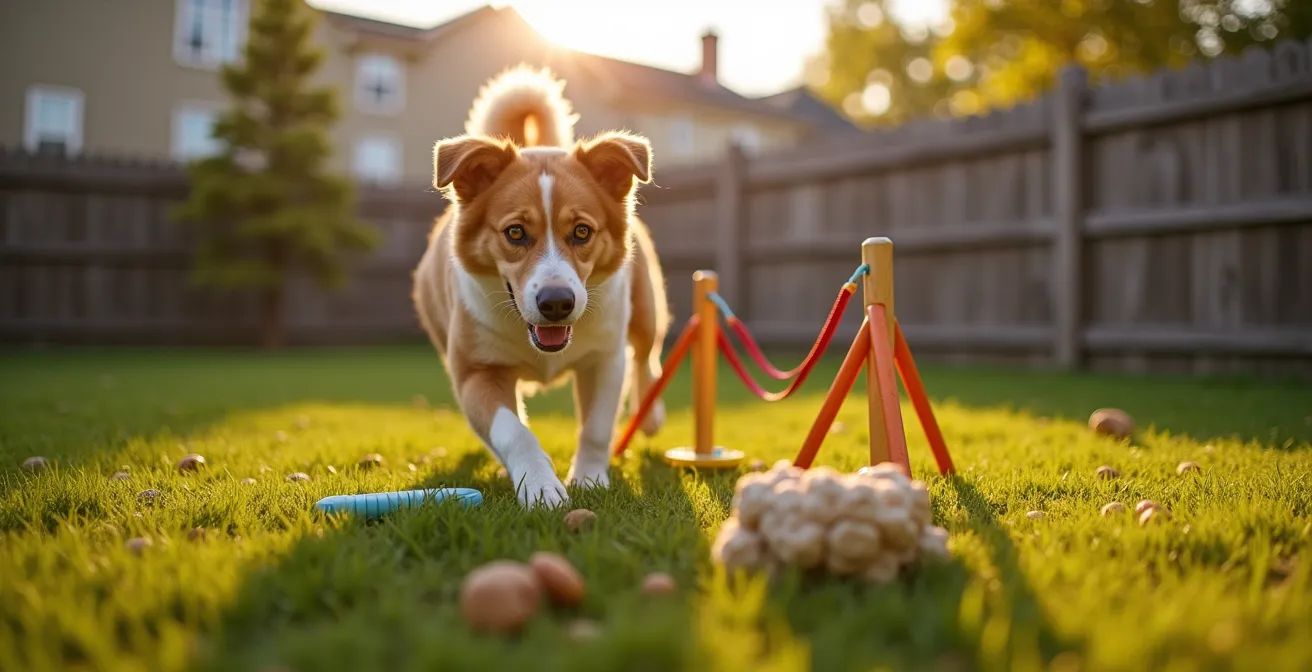
While the title mentions herding, the principle applies to all dogs, especially those with strong drives or athletic builds who are often targeted by BSL: a bored dog is a dog at risk of developing behavioural problems. The most effective antidote to the prejudice of BSL is to be an exemplary dog owner, and that means providing your dog with appropriate outlets for its physical and mental energy. A well-exercised and mentally stimulated dog is a happy, stable, and safe companion, regardless of its appearance.
Instead of worrying about stereotypes, focus on proactive enrichment. For a strong, intelligent mixed-breed, this can include:
- Flirt poles: An excellent way to satisfy prey drive in a controlled manner.
- Puzzle feeders and snuffle mats: These engage a dog’s brain and natural foraging instincts.
- Nose work games: Hiding treats around the yard encourages problem-solving.
- Basic agility: Setting up small jumps or a weave pole course provides great physical and mental exercise.
By focusing on these activities, you are not only improving your dog’s quality of life but also building a portfolio of responsible ownership. The potential lost when these dogs are banned is immense.
Case Study: Neville, the Rescued “Pit Bull” Turned K9 Hero
A “pit bull” named Neville was rescued from Ontario following the 2005 ban. He was not euthanized but instead given a chance. Today, Neville serves as a K9 for the Washington State Police, where he protects the public every day by sniffing for explosives on the state ferry system. By banning dogs based on appearance, Ontario lost an invaluable working dog that now saves countless lives, a testament to the potential squandered by prejudice.
Why Is the “Alpha Wolf” Theory Scientifically Outdated?
The “alpha” or “dominance” theory of dog training is not just scientifically outdated; it is actively dangerous, especially for an owner of a dog scrutinized under BSL. This theory, based on flawed observations of captive, unrelated wolves, promotes confrontational methods like “alpha rolls,” scruff shakes, and intimidation. These techniques do not build respect; they build fear, anxiety, and distrust. A dog trained with these methods is more likely to develop defensive aggression, making it a prime target for a complaint under the Dog Owners’ Liability Act.
Modern, science-based training revolves around positive reinforcement. This approach uses rewards (treats, praise, toys) to encourage desired behaviours, building a strong, positive relationship between you and your dog. It is more effective, more humane, and creates a confident, well-adjusted canine citizen. For an Ontario dog owner, adopting these methods is a critical part of your proactive defense strategy. It demonstrates your commitment to responsible, modern training practices and provides a documented history of positive behaviour.
Building a portfolio of responsible ownership is your best shield against breed prejudice. This involves moving beyond outdated theories and embracing methods endorsed by every reputable veterinary and behaviour organization.
Your Action Plan: Building a Proactive Defense Portfolio
- Focus on modern training: Ditch dominance theory. Work exclusively with certified trainers who use positive reinforcement methods, creating a positive learning history for your dog.
- Document everything: Keep detailed records of all training classes, certifications (like Canine Good Neighbour), and private sessions. This is tangible proof of your commitment.
- Avoid confrontation: Never use punishment or intimidation. These methods can create the very reactivity and fear-based aggression that BSL purports to prevent.
- Collect positive references: Obtain letters or emails from your veterinarian, trainer, and dog walkers attesting to your dog’s good temperament and your responsible handling.
- Work with certified professionals: Ensure any trainer you hire is certified and explicitly rejects the outdated and harmful “alpha” theory. Their professional endorsement adds weight to your case.
Why Does a Wagging Tail Not Always Mean a Friendly Dog?
Just as a “guilty look” is a myth, the “friendly wagging tail” can also be a dangerous oversimplification. Understanding the nuances of canine body language is a vital skill for any dog owner, but it is a non-negotiable necessity for someone whose dog could be judged at any moment. A tail wag is simply a sign of emotional arousal; it can signify excitement and happiness, but it can also signal anxiety, frustration, or even imminent aggression. The rest of the dog’s body tells the story.
A loose, sweeping wag with a relaxed body is friendly. A high, stiff, fast-vibrating wag on a tense dog is a clear warning sign. Under BSL, the risk is that a person unfamiliar with dog behaviour will see a wag, approach your anxious dog, ignore its other “back off” signals (like lip licking, yawning, or a stiff body), and provoke a defensive reaction. In this scenario, your dog, not the person who ignored its clear communication, will be blamed. The consequences are severe, as Ontarians who own a dog deemed to be a “pit bull” could face fines up to $10,000 and up to six months in jail, on top of a likely destruction order for the dog.
It is your responsibility to become an expert in your dog’s communication and to advocate for its space. This means recognizing the subtle signs of stress or fear—often misinterpreted as guilt or unpredictability—long before they escalate. Key appeasement and stress signals include whale eye (showing the whites of the eyes), lip licking, yawning when not tired, and a lowered body posture. These are your dog’s attempts to say, “I am uncomfortable.” Recognizing and responding to them by creating distance or removing the stressor is the hallmark of a responsible owner and your best defense against incidents.
Key Takeaways
- Ontario’s BSL is based on visual identification, a method scientifically proven to be unreliable for identifying breed heritage.
- Data shows BSL has failed to increase public safety in Ontario, while breed-neutral, responsibility-focused laws (like in Calgary) have been highly effective.
- A dog’s behaviour is primarily shaped by training and environment, not by the debunked stereotypes associated with its perceived breed.
How to Introduce a Second Dog Without Ruining Your First Dog’s Life?
Navigating the dynamics of a multi-dog household is a challenge for any owner. But in Ontario, it comes with an added layer of legal complexity. If you own a mixed-breed dog that could be visually misidentified, bringing a second dog into your home—or even just having your dog interact with others—requires careful management and an awareness of the current legal landscape.
The law’s presence can create tension. What happens if a minor squabble between your dogs is witnessed and reported by a biased neighbour? Who is deemed the “aggressor”? The dog with the blocky head is almost certain to face greater scrutiny. This reality underscores the importance of a slow, structured introduction process and impeccable management to prevent any incidents that could bring you to the attention of animal control.
The legal situation itself remains a threat, despite small positive adjustments. In 2021, the Ontario government made a change to the regulations. As noted by the Toronto Humane Society, this adjustment allows an animal seized solely on appearance to be returned home while a DNA test is performed. This is a step forward from the previous policy of automatic impoundment. However, it is not a solution. If the DNA test (or a visual assessment by a designated expert) concludes the dog is a “pit bull,” it is still subject to being permanently removed from its home and family.
This legal tightrope means that as a responsible owner of a “look-alike” dog, your standard for management and training must be higher. You cannot afford the minor mistakes that owners of other breeds might get away with. Your dogs’ interactions must be managed to ensure safety and prevent any situation that could be misconstrued by an outsider.
Your primary task is to be an unimpeachable dog owner. The most powerful tool against a prejudicial law is a portfolio of proactive, responsible ownership. Start today by documenting your dog’s training, seeking positive behaviour certifications, and educating yourself and others with the facts. Your advocacy is your dog’s best protection.
Frequently Asked Questions About Ontario’s BSL and Mixed-Breed Dogs
What vague physical descriptions does Ontario’s BSL use?
The law targets a dog that “has an appearance and physical characteristics that are substantially similar” to a list of banned breeds. This is often interpreted as having a strong square jaw, short ears, broad shoulders, and short hair with a moderate height and weight.
Which breeds could be mistakenly identified as pit bulls?
The vague description means a wide variety of breeds and their mixes are at risk. This includes, but is not limited to, Boxers, Mastiffs, Dogo Argentinos, Presa Canarios, Cane Corsos, American Bulldogs, Bull Terriers, and many other terrier or bully-type mixes.
What happened to Miami-Dade County’s BSL effectiveness?
Miami-Dade County in Florida provides another example of BSL’s failure. Despite having a ban for years, about 800 “pit bulls” were confiscated and euthanized in 2008 alone, with no corresponding decrease in the overall number of reported dog bites.
Are there any ‘grandfathered’ pit bulls still legally in Ontario?
The law was enacted in 2005. By now, most of the bully-breed dogs that were “grandfathered” in at that time are no longer alive. This means that, in theory, nearly every dog that fits the “pit bull” description in Ontario today is there illegally, according to the law.
What happens when Ontario shelters receive suspected pit bulls?
Municipal shelters and humane societies in Ontario, like the Toronto Humane Society, are bound by the law. If they receive a dog they believe to be a banned breed, they are legally obligated to adopt that dog to a home located outside of the province of Ontario.
Can pit bulls participate in dog shows in Ontario?
Yes, there is a specific exemption. The law allows a dog that would otherwise be banned to be temporarily present in the province, with official permission, for the exclusive purpose of participating in a recognized dog show.