In summary:
- Building a winter-proof catio in Canada requires a systems approach, focusing on smart materials and predator-specific defences.
- Success depends on using 19-gauge or thicker hardware cloth, not chicken wire, to stop dexterous predators like raccoons.
- Proper insulation must be paired with robust ventilation to create a “thermal envelope” that prevents moisture buildup and respiratory issues.
- Vertical space is not a luxury but a behavioural and safety necessity, providing warmth, enrichment, and distance from ground-level threats.
- Local predators like Great Horned Owls and coyotes require specific countermeasures like fully-covered roofs and coyote rollers.
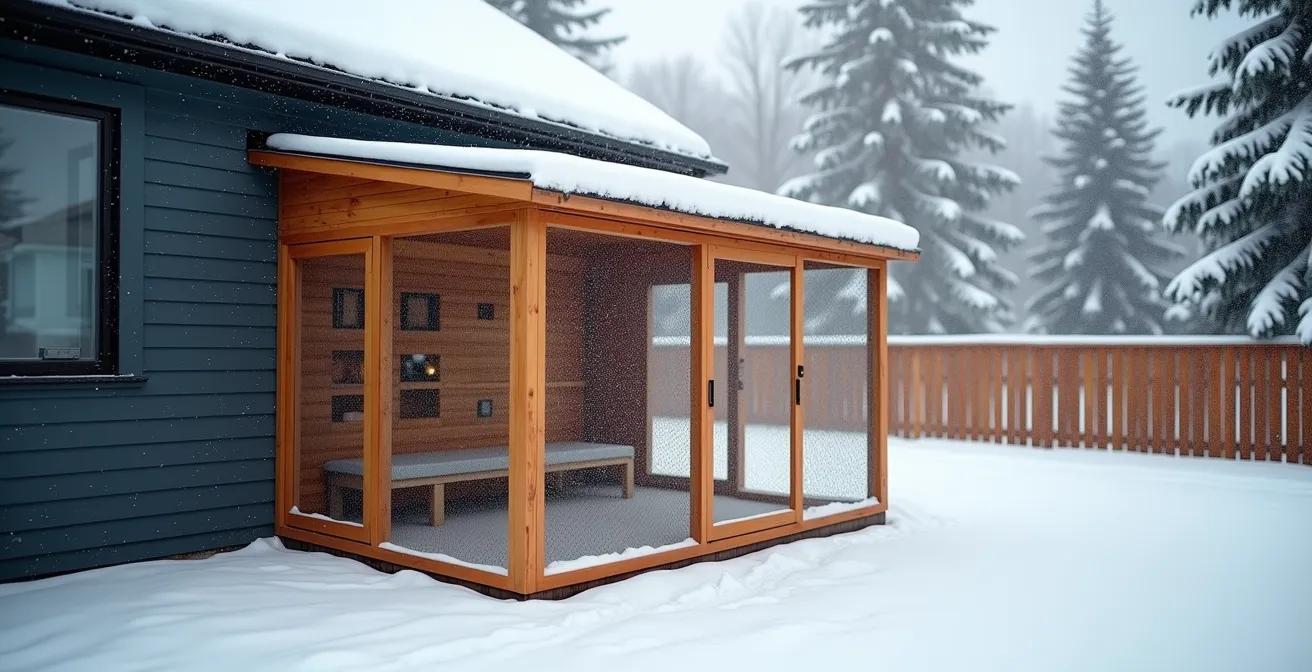
As a Canadian cat owner, you face a unique dilemma. You want to give your indoor cat the enrichment of outdoor sights and sounds, but the dangers are significant. From the biting cold of a January freeze to the clever paws of a raccoon or the silent threat from the sky, the Canadian environment demands more than just a simple screened-in porch. Many well-intentioned owners build enclosures that look secure, only to find they offer little real protection against our climate or our wildlife.
The internet is full of generic advice to “use strong wire” or “add insulation.” But these platitudes fail to address the specific challenges of a Canadian winter. What does “strong” mean when a raccoon can tear through most mesh? How do you insulate without creating a damp, unhealthy environment? The key isn’t just to build a box; it’s to engineer a complete habitat system that outsmarts specific local predators and defeats extreme weather through smart material science and an understanding of animal behaviour.
This guide moves beyond the basics. We’ll deconstruct the specific threats and provide a construction-savvy blueprint for a catio that is truly predator-proof and winter-ready. We’ll cover the engineering principles that apply not only to catios but to other small animal enclosures like rabbit hutches and tortoise pens, ensuring your pet is safe and comfortable. We will explore material selection that withstands freeze-thaw cycles, ventilation strategies that prevent illness, and design choices that cater to your pet’s natural instincts for safety and comfort.
This article provides a detailed roadmap for your project. You will discover the critical differences in materials, the science behind animal comfort in cold weather, and the specific DIY techniques to counter Canadian predators, ensuring your pet’s outdoor space is a true sanctuary.
Summary: How to Engineer a Predator-Proof Catio for a Harsh Canadian Winter
- Why Do Cats Need Vertical Shelves More Than Floor Space in Enclosures?
- How to Insulate a Rabbit Hutch for -20°C Weather Safely?
- Hardware Cloth or Chicken Wire: Which Actually Stops a Raccoon?
- The Insulation Mistake That Causes Respiratory Infection in Coops
- How to Plant a ‘Grazing Garden’ Inside Your Tortoise Enclosure?
- Why Are Great Horned Owls Targeting Pets in Residential Neighborhoods?
- How to DIY Coyote Rollers to Prevent Climbing Escapes?
- Why Do Cats Need Vertical Shelves More Than Floor Space in Enclosures?
Why Do Cats Need Vertical Shelves More Than Floor Space in Enclosures?
When designing an enclosure, our human bias is to think in terms of square footage. But for a cat, territory is defined by height. A wide, empty floor is a vulnerable space, whereas a multi-level structure offers security, vantage points, and enrichment. Creating this vertical territory is the single most important design element for a cat’s well-being in a catio. It taps into their innate instinct to survey their environment from a safe, elevated position, mimicking their natural behaviour of climbing trees to watch for prey and predators.
This isn’t just about fun; it’s about mental health. A cat without access to vertical spaces can experience chronic stress, leading to behavioural issues. Providing a rich vertical world gives them choice and control over their environment. They can choose to bask in a high, sunny spot, retreat to a secluded perch, or use the shelves as a highway to move around the enclosure without touching the “exposed” ground. This is especially crucial in winter, as elevated perches keep them off the cold floor and closer to warmer air near the top of the catio.
The behavioural benefits are well-documented. In fact, scientific research confirms that vertical enrichment reduces stress-related behaviours and significantly increases a cat’s voluntary activity levels. For an indoor cat, a catio is their slice of the wild, and vertical shelves are the trees and cliffs that make that world complete. When planning your build, prioritize budget and space for an array of shelves, ramps, and perches over simply expanding the footprint.
Ultimately, a well-designed vertical landscape transforms a simple cage into a dynamic, stimulating habitat that satisfies your cat’s deepest psychological needs.
How to Insulate a Rabbit Hutch for -20°C Weather Safely?
The challenge of insulating an outdoor enclosure in Canada isn’t just about adding warmth; it’s about managing moisture and ensuring pet safety. The same principles that apply to a rabbit hutch are directly transferable to creating a winter-safe “warm zone” within a catio. A common and dangerous mistake is to simply stuff insulation into walls without considering airflow or material toxicity. This creates a damp environment, a breeding ground for mould and a leading cause of respiratory infections.
The solution is to create a complete thermal envelope. This system involves more than just insulation; it requires a vapour barrier on the warm side of the insulation to prevent moisture from the animal’s breath and body heat from condensing within the walls. This is critical in our cold climate. The illustration below shows the correct layering: the vapour barrier is placed between the interior wall and the insulation, protecting it from moisture saturation which would render it useless.
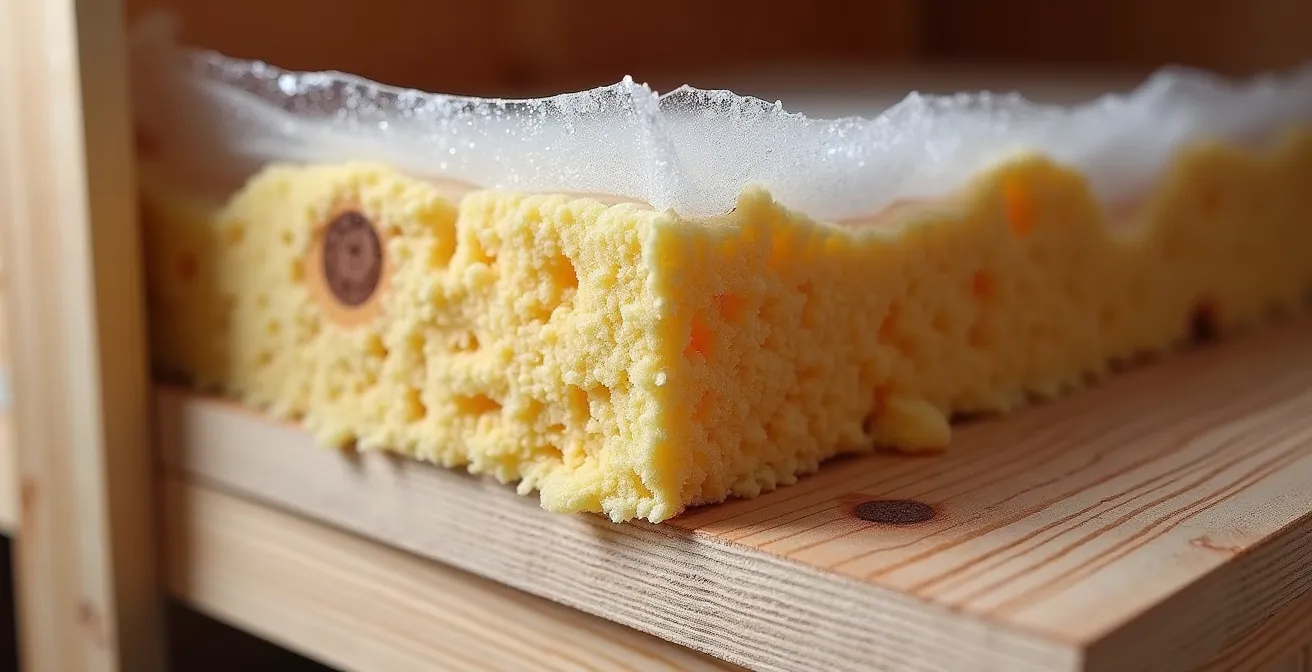
As the cross-section demonstrates, each layer has a specific job. The choice of insulation material is also paramount. You need a high R-value (a measure of thermal resistance) that is also pet-safe. Materials like mineral wool are excellent because they are fire-resistant, non-toxic if accidentally exposed, and have a high R-value suitable for the coldest parts of Canada.
This comparative table, based on data from enclosure specialists, breaks down the best options for a Canadian build. Notice how different materials are suited for different applications, from wall insulation to deep litter flooring.
| Material | R-Value | Pet Safety | Best For |
|---|---|---|---|
| Mineral Wool (Rockwool) | R-15 to R-23 | Non-toxic, fire-resistant | Prairie provinces (-30°C) |
| Rigid Foam Board | R-10 to R-20 | Must be fully covered | Moderate cold regions |
| Straw Deep-Litter | R-1.5 per inch | Completely safe | Floor insulation |
| Sealed Wood Panels | R-1 per inch | Safe when sealed | Wind barriers |
By focusing on a complete thermal system rather than just insulation, you create a genuinely safe and warm winter refuge for your pet.
Hardware Cloth or Chicken Wire: Which Actually Stops a Raccoon?
This is arguably the most critical decision in predator-proofing any outdoor enclosure in Canada. Many DIY builders choose chicken wire because it’s cheap and readily available. This is a critical and often catastrophic mistake. Chicken wire is designed to keep chickens *in*, not to keep intelligent, powerful predators *out*. A raccoon, with its surprising strength and dexterous paws, does not see chicken wire as a barrier.
The failure of chicken wire lies in its construction. It is a thin, flexible hexagonal mesh that is easily manipulated. As the experts at Cat Topia point out in their guide on winter-friendly catios, the mechanism of failure is key:
Raccoons don’t break chicken wire; they use their dexterous paws to pull, tear, and manipulate the thin, hexagonal wire. Hardware cloth, with its welded grid, resists this manipulation.
– Cat Topia Design Team, Tips for a Winter-Friendly Catio Guide
The correct material is galvanized hardware cloth. This is a rigid, welded wire grid, typically in a square mesh. It resists the pulling and tearing that defines a raccoon’s attack. For most of Canada, a 1/2-inch, 19-gauge hardware cloth is the minimum standard. In regions with smaller, more tenacious predators like fishers or martens, upgrading to a 1/4-inch, 16-gauge mesh is a wise investment. The lower the gauge number, the thicker and stronger the wire.
Case Study: The Bancroft, Ontario Catio Upgrade
David and Susan, catio builders in Bancroft, Ontario, learned this lesson firsthand. They initially used chicken wire and soon discovered that chipmunks were squeezing through. Realizing that what lets a chipmunk in won’t stop a raccoon, they retrofitted their entire enclosure. They replaced all the mesh with hardware cloth and, crucially, added a 12-inch-high footer of the cloth buried or secured at the base to prevent digging. Their most important finding was in the attachment method: they secured the cloth with screws and washers every 4-6 inches, as staples can be pried out by predators.
Action Plan: Installing Predator-Proof Hardware Cloth
- Use a minimum of 1/2-inch, 19-gauge galvanized hardware cloth for raccoons; upgrade to 1/4-inch, 16-gauge for areas with fishers and martens.
- Source from true farm supply stores like TSC Stores or Peavey Mart, which stock genuine predator-rated gauges, unlike some big-box hardware stores.
- Attach the cloth using pan-head screws and washers every 4 to 6 inches along every stud and rail. Never rely on staples alone.
- Overlap seams by at least 2 inches and ensure there are absolutely no gaps at corners or connection points where a paw could gain purchase.
- Install a “footer” by burying the cloth 12 inches deep or creating an L-shaped flange at the base extending 12 inches outward to stop digging predators.
Choosing hardware cloth and installing it correctly is the single most important investment you can make in your pet’s security.
The Insulation Mistake That Causes Respiratory Infection in Coops
We’ve discussed how to insulate, but the deadliest mistake isn’t using the wrong material—it’s forgetting what must accompany it: ventilation. A perfectly insulated, sealed-up enclosure becomes a trap in winter. An animal’s own respiration and body heat create a significant amount of moisture. In a poorly ventilated space, this humid air condenses on cold surfaces, leading to damp bedding, frost buildup, and a perfect breeding ground for mould and bacteria. This is the primary cause of respiratory infections in animals housed outdoors in winter.
The goal is not to create a warm, airtight box like a room in your house. The goal is to create a dry, draft-free shelter. This requires constant, passive air exchange. You need to allow the moist, stale air to escape and be replaced by fresh, dry air without creating a cold draft on the animal itself. This is the core principle of a healthy “thermal envelope.” Even at -30°C, a small but steady airflow is non-negotiable for preventing moisture buildup.
The most effective method is a 4-corner ventilation system. This involves placing vents high up on the walls (for exhaust) and vents low to the floor (for intake). Because warm, moist air rises, it will naturally exit through the high vents, while cool, dry air is drawn in through the low vents. By positioning them correctly and ensuring they are not pointed directly at resting areas, you create gentle, continuous circulation. A simple “smoke test” using an incense stick can help you visualize the airflow patterns and ensure there are no direct drafts on sleeping spots.
Of course, any vent is a potential entry point for predators, so they must be covered securely on the outside with the same hardware cloth used for the walls. Monitoring temperature is still important; data from enclosure studies shows that access should be supervised when temperatures drop. For cats in a catio, temperature monitoring data shows that while above 7°C (45°F) is generally safe, temperatures between 0-7°C (32-45°F) require caution, and access during sub-freezing weather should be limited to short, supervised periods, even in a well-built shelter.
Proper ventilation isn’t an optional extra; it is the active system that makes your passive insulation safe and effective.
How to Plant a ‘Grazing Garden’ Inside Your Tortoise Enclosure?
Enrichment isn’t just for cats. For herbivores like tortoises, the ability to forage for their own food is a powerful behavioural stimulant. Creating a “grazing garden” inside their enclosure provides this opportunity, but it’s a challenge during a long Canadian winter. The solution is to bring the garden indoors, creating a sustainable, year-round foraging system using shallow trays and supplemental lighting.
The concept is to rotate several shallow ceramic or food-safe plastic trays. You can plant a variety of tortoise-safe greens like wheatgrass, clover, dandelion greens, or specialty tortoise seed mixes. By starting a new tray every week or two, you create a continuous cycle where one tray is sprouting, another is ready for grazing, and a third is being replenished. This system prevents the tortoise from devouring the entire crop at once and ensures a constant supply of fresh, live food.
During the dark Canadian winter months, natural light is insufficient. A simple LED grow light panel positioned over the trays is essential. These lights provide the specific spectrum of light needed for robust plant growth. The setup below illustrates how multiple trays can be cultivated under a single light source, creating an efficient indoor farm for your pet.

This principle of winter adaptation is used by resourceful Canadian pet owners for various animals. One case study highlights a creative approach to feline enrichment during the winter.
Case Study: Montreal’s Winter Foraging Catio
Yasaar Nakchbendi, a pet owner in Montreal, adapted her catio for four-season fun. While not for grazing, she applied the foraging principle by leaving dried catnip stalks in hanging baskets for her cats to interact with throughout the winter. She also placed barrels of tall ornamental grasses inside the catio; while dormant, the texture and scent of the leaves provided an interesting sensory experience and cozy beds, demonstrating how the concept of a “garden” can be adapted to provide enrichment even in the coldest months.
By bringing the garden indoors, you provide not just nutrition, but also the crucial mental stimulation of foraging that brightens the long winter months.
Why Are Great Horned Owls Targeting Pets in Residential Neighborhoods?
The sight of a Great Horned Owl is a breathtaking Canadian experience, but for a pet owner, it’s also a serious threat. These powerful apex predators are increasingly seen in suburban and even urban areas, and small pets left unattended can be targets. It’s a common misconception to view this as an act of aggression; it’s a matter of adaptation and opportunity. The root cause is the relentless expansion of our cities and towns into their natural habitat.
As residential neighbourhoods push into woodlands and fields, the owls’ traditional food sources—like rabbits and rodents—are displaced or reduced. The owls, however, adapt. They learn to hunt in the new landscape. A small, unattended cat or dog in a backyard at twilight looks remarkably similar to their natural prey. This ecological pressure is the driving force behind the increased encounters. In fact, habitat fragmentation data reveals that as Canadian urban centers expand, pet-predator encounters have risen, especially during the critical hunting periods of dawn and dusk.
This perspective is crucial for understanding the risk. It’s not a random or malicious act. As the Toronto Wildlife Centre, an authority on urban wildlife interactions, explains, we are inadvertently inviting them.
This isn’t an attack, it’s an adaptation. As cities expand into woodlands, owls’ natural food sources are displaced. Small pets in unfenced yards become a readily available substitute.
– Toronto Wildlife Centre, Urban Wildlife Adaptation Report
For a catio builder, this has one non-negotiable design implication: a secure roof is mandatory. An open-topped catio is an open invitation. The roof must be constructed with the same predator-proof hardware cloth as the walls, with no gaps. There is no other reliable way to protect against an aerial predator as powerful and silent as a Great Horned Owl. Assuming your cat is safe just because the walls are high is a dangerous gamble.
Protecting your pet requires acknowledging this reality and building a fully enclosed, 360-degree sanctuary.
How to DIY Coyote Rollers to Prevent Climbing Escapes?
While a catio is designed to keep a cat in, the same principles can be used to keep predators out of a yard or away from an enclosure. One of the most effective and humane deterrents against climbing predators like coyotes and raccoons is the coyote roller. This simple mechanical device sits on top of a fence or wall and spins freely, making it impossible for an animal to get the grip needed to pull itself over.
Building your own coyote rollers is a straightforward DIY project using materials readily available at Canadian hardware stores. The core component is a length of 4-inch PVC pipe, which acts as the roller. This pipe is strung onto a length of galvanized aircraft cable, which is then mounted between eye bolts attached to brackets on the fence. The key is that the pipe is wider than the brackets, allowing it to spin without obstruction. When an animal places its paws on the roller, it spins, and the animal simply falls off, unable to gain purchase.
Case Study: Chicago Winter Enclosure Security
A builder in the Chicago area, a climate very similar to many parts of Canada, successfully integrated a security system for their year-round catio. The structure was built with exterior-grade treated wood that has withstood winter conditions for over 18 months. Crucially, their fence line was protected by a coyote roller system that remained effective even with significant snow accumulation at the base of the fence. Their design placed the rollers under a 1.5-foot roof overhang, which helped keep the mechanism free of ice and snow, ensuring it could spin freely when needed.
When building for a Canadian climate, snow depth is a critical factor. The height of your fence and roller system must account for the maximum expected snowdrift in your region. A good rule of thumb is to set the roller height at least two feet above the highest historical snowdrift height to ensure it remains an effective barrier all winter long. You can find the materials at most major hardware stores.
- 4-inch PVC Pipe: Available at Canadian Tire or Home Depot.
- 1/8-inch Galvanized Aircraft Cable: Found in the fencing or hardware section at stores like Rona.
- 5-inch Eye Bolts: Ensure they are rated for outdoor use to prevent rust and failure.
By preventing the initial climb, you neutralize the threat before it can even test the primary enclosure.
Key Takeaways
- A predator-proof enclosure is a system: It combines a strong physical barrier (hardware cloth), a healthy microclimate (insulation with ventilation), and species-appropriate enrichment (vertical space).
- Material choice is non-negotiable. Chicken wire fails against raccoons; 19-gauge or thicker hardware cloth attached with screws and washers is the only safe option.
- In Canada, a roof is not optional. It is the only defence against aerial predators like Great Horned Owls, whose presence is increasing in residential areas due to habitat loss.
Why Do Cats Need Vertical Shelves More Than Floor Space in Enclosures?
We’ve covered the critical components of a secure Canadian catio: the right wire, a complete thermal envelope, and a solid roof. But the final, and perhaps most important, layer of safety and well-being is the internal architecture. This brings us back to the fundamental question of vertical space. A thoughtfully designed vertical territory is not just enrichment; it is the culmination of your entire predator-proofing strategy.
Think of it this way: the hardware cloth, rollers, and roof are the outer fortress walls. The vertical shelves, perches, and ramps inside are the secure keep. By providing an engaging and accessible vertical world, you encourage your cat to live in the upper, safer two-thirds of the catio. This naturally creates distance from the ground level, which is the primary zone of interest for terrestrial predators like coyotes or a passing stray dog. Even if a predator were to investigate the base of the catio, your cat would be comfortably observing from a high, secure perch, reducing stress and risk.
Furthermore, in a winterized catio, this vertical design is a key part of the thermal strategy. Warm air rises. The highest perches in the catio will be the warmest, most comfortable spots. By installing a low-wattage heated pad on a high, sheltered shelf, you create an irresistible winter basking spot that keeps your cat off the cold ground and in a pocket of warmth. This synergy between behavioural enrichment and physical safety is the hallmark of an expertly designed habitat.
Therefore, the need for vertical space is not a separate consideration from safety; it is integral to it. It completes the security system by influencing your cat’s behaviour in a way that inherently minimizes risk and maximizes comfort. A catio with a vast, empty floor is a missed opportunity, but one rich with vertical territory is a true sanctuary.
Start planning your build today. By combining a tough exterior with a smart, stimulating interior, you can give your cat the safe and enriching outdoor experience they deserve, no matter what a Canadian winter throws at you.