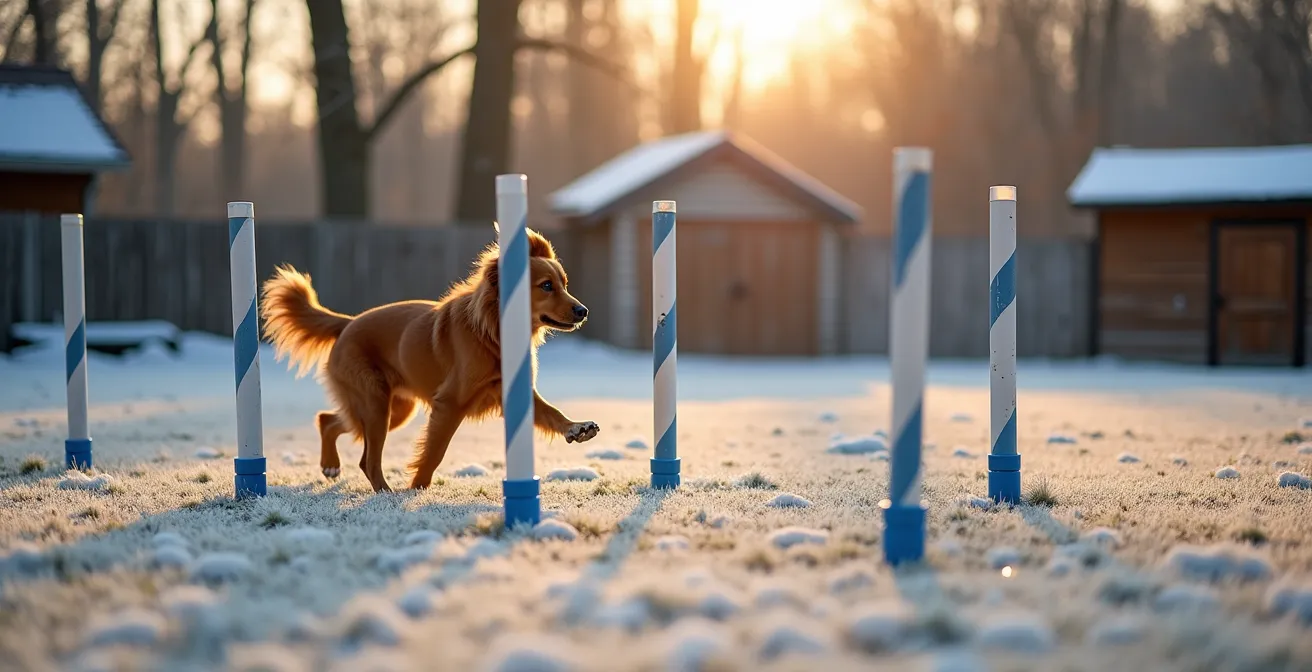
Building safe, effective DIY weave poles for the Canadian climate isn’t about cutting corners; it’s about prioritizing your dog’s spinal health through smart engineering.
- Standard 24-inch spacing is a non-negotiable rule for protecting your dog’s spine from harmful twisting motions.
- PVC channel bases are superior to stick-in-ground poles, offering year-round training stability from frozen winter ground to muddy spring thaws.
- A gradual speed protocol is essential to prevent injuries, as forcing speed too early is a primary cause of spinal strain.
Recommendation: Before buying any materials, focus first on understanding the biomechanics of weaving to build equipment that prevents injury, not just enables practice.
The dream of practicing dog agility in your own backyard often starts with a simple idea: “I can build that myself!” A quick search reveals dozens of tutorials for DIY weave poles, promising a weekend project with some PVC pipe from the local hardware store. For Canadian hobbyists on a budget, this seems like the perfect entry point into a rewarding sport. However, this cost-saving approach often overlooks the most critical factor: the safety and long-term health of your canine partner.
Most generic guides focus on the “what”—the measurements and materials. They rarely explain the “why”—the crucial biomechanics behind the 24-inch spacing or the severe spinal stress a poorly made or improperly used set can cause. Furthermore, they completely ignore the unique challenges of training in Canada. What works on a perfectly manicured lawn in California fails spectacularly on frozen January ground in Alberta or during the muddy spring thaw in Ontario. The real key to successful DIY weave poles isn’t just building them cheap; it’s about engineering them to be safe and functional across all four distinct Canadian seasons.
This guide shifts the focus from simple construction to injury-prevention engineering. We’ll move beyond basic pipe-cutting and delve into the principles that protect your dog’s body. You’ll learn why specific measurements are critical, how to choose a design that works year-round, and how to create a training plan that builds skill without risking a visit to the veterinary chiropractor. It’s time to build smarter, not just cheaper.
This article provides a comprehensive roadmap for building and using your DIY weave poles safely and effectively, with special considerations for the Canadian context. You’ll find detailed explanations on everything from materials to training methods, all designed to ensure a positive and injury-free experience for you and your dog.
Summary: A DIY Guide to Safe Weave Pole Construction
- Why Is 24-Inch Spacing Critical for Spine Safety?
- How to Teach the “Entry” Method for Weaves in 5 Minutes a Day?
- Stick-in-Ground or Channel Base: Which Is Better for Learning?
- The Spinal Twist Risk: Why Speeding Up Too Fast Causes Injury
- How to Stabilize Poles on Grass vs Artificial Turf?
- How to Teach an Instant “Out” Command During High Arousal?
- The Laminate Floor Danger: Why Indoor Fetch Can Cause ACL Tears
- How to Train Jump Sequences Without Destroying Your Dog’s Joints?
Why Is 24-Inch Spacing Critical for Spine Safety?
When you’re building your first set of weave poles, it’s tempting to think a little variance in spacing won’t matter. But the 24-inch (or 61 cm) standard is not an arbitrary number; it’s a critical safety dimension based on canine biomechanics. This specific distance allows a dog to maintain a smooth, rhythmic, single-track gallop through the poles. It provides just enough room for their body to bend in a healthy ‘S’ curve, engaging their core and back muscles without forcing an unnatural or jarring twist.
Spacing that is too narrow forces a dog to “bunch up,” shortening their stride and creating a choppy, high-impact motion that puts excessive torque on their lumbar spine. Spacing that is too wide encourages them to “flatten out,” losing the collection and rhythm needed for efficient weaving, which can also lead to strain. The 24-inch standard is the sweet spot that promotes a safe, fluid, and efficient movement pattern for the widest range of dog sizes. Adhering to this is the single most important decision you’ll make for your dog’s long-term spinal health. In fact, current competition standards confirm that 100% of major organizations (like USDAA, AKC, and Canada’s own AAC) now mandate or allow this safer spacing.
AAC-Approved Spacing Checklist for Canadian Handlers
- Measure exactly 24 inches (61 cm) from the center of one pole position to the center of the next.
- Use weather-resistant tape or ground stakes to mark your measurements before drilling or placing any poles.
- In winter, account for 1-2 inches of additional clearance needed if snow accumulation might narrow the path.
- If training multiple dogs of different sizes, test the spacing with both a small breed (under 30 lbs) and a large breed (over 50 lbs) to ensure it works for both.
- Re-verify your measurements each spring after the ground freeze/thaw cycles, which are common in Canada and can shift pole positions.
By treating the 24-inch rule as a non-negotiable foundation of your DIY project, you’re not just building equipment; you’re building a promise of safety to your training partner.
How to Teach the “Entry” Method for Weaves in 5 Minutes a Day?
The most intimidating part of weaving isn’t the speed; it’s getting the entry right. A dog must always enter the weave poles with the first pole on their left shoulder. The most effective and widely used method for teaching this is the 2×2 (two-by-two) method. It breaks the complex sequence down into its simplest component: navigating just two poles. By focusing on short, positive, 5-minute sessions, you prevent frustration and build a rock-solid foundation of understanding.
The setup is simple: two poles spaced 24 inches apart. Your goal is to reward the dog for finding the correct entry path from various angles. You can use toys or treats to lure them through the gap, always ensuring they enter with the first pole to their left. The key is high-rate-of-reinforcement and keeping sessions extremely short to maintain high motivation and focus. This method is especially suited for indoor winter training in a garage or basement, a common necessity for Canadian handlers.
Case Study: Winter Indoor Training Success with the 2×2 Method
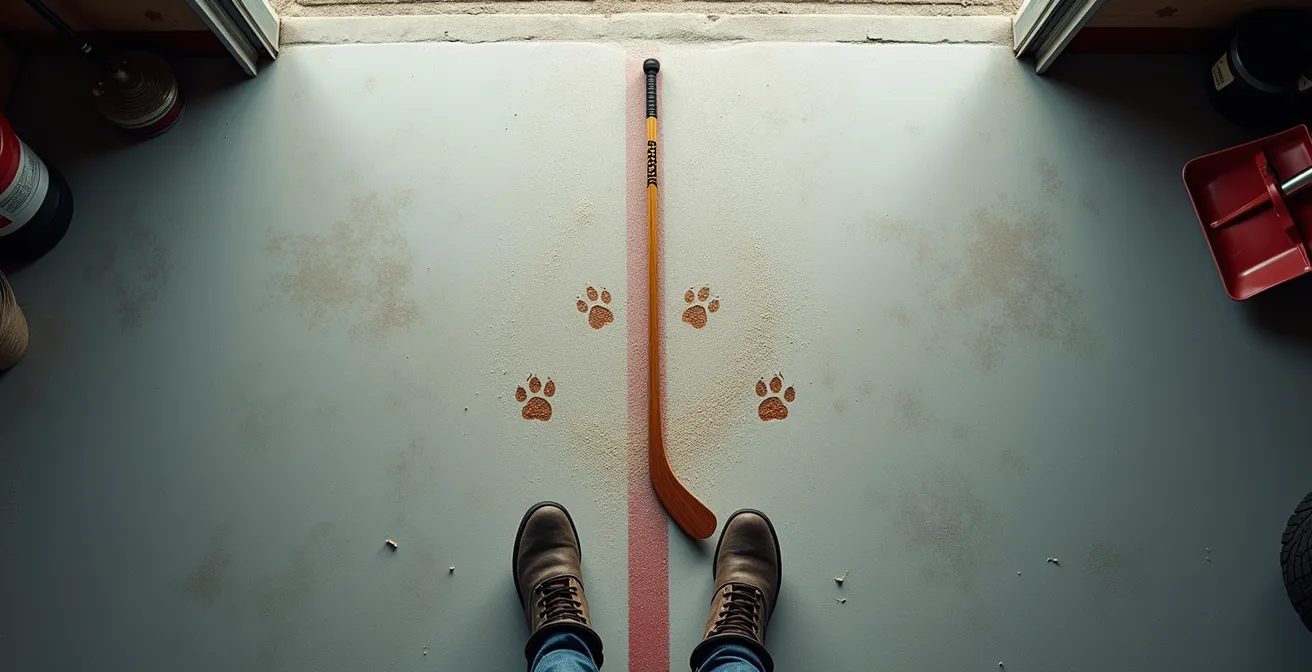
A dog trainer in Ontario faced the challenge of a long winter and a new dog to train. Using DIY 2×2 poles in her garage, she committed to daily 5-minute sessions. To make the entry path obvious, she used a brilliant piece of Canadiana: a hockey stick laid on the ground to create a visual channel guiding the dog. The dog quickly understood the game, and after just two weeks of consistent micro-sessions, it was offering reliable entries. By the fourth week, she had progressed to a full set of six poles, demonstrating the power of this focused, incremental approach.
This visual guide, as shown below, makes the correct path crystal clear to the dog, dramatically speeding up the learning process. The guide is then gradually faded out as the dog’s confidence and muscle memory develop.
By breaking down the skill and keeping training fun and brief, the 2×2 method transforms a daunting task into an achievable and enjoyable game, no matter the weather outside.
Stick-in-Ground or Channel Base: Which Is Better for Learning?
When designing your DIY weaves, one of the first decisions is how to mount the poles. The two most common options are individual “stick-in-the-ground” poles or poles set into a “channel” or “plank” base made of PVC or wood. For a Canadian hobbyist, the choice is clear: a channel base is vastly superior for year-round training and effective learning.
Stick-in-the-ground poles rely on being pushed into soft earth. This presents an immediate problem in Canada, where typical Canadian weather data shows we face 5-6 months of frozen or muddy ground conditions. They are impossible to set up in winter and unstable during the spring thaw. A PVC channel base, however, can be used on any surface—grass, artificial turf, packed snow, or even indoors in a garage or basement. This versatility is essential for the consistent practice that weaving requires.
Furthermore, a channel base is perfectly suited for modern training methods like the 2×2 system. You can easily create sets of two, four, or six poles and arrange them in different configurations (e.g., channel weaves, offset weaves) to help the dog learn. This is incredibly difficult to do with stick-in-the-ground poles, which are laborious to move and reset accurately.
The following table breaks down the practical differences for a handler in a Canadian climate, clearly showing why a base is a better investment of your DIY time and effort.
| Factor | Stick-in-Ground | PVC Base |
|---|---|---|
| Winter Use (Nov-Mar) | Impossible – frozen ground | Fully functional indoors/outdoors |
| Spring Setup (Apr-May) | Difficult – muddy/unstable | Stable with sandbag anchors |
| Summer Performance | Good if ground is firm | Excellent on any surface |
| Storage Requirements | Minimal – poles only | More space needed for base |
| Cost at Canadian Retailers | $60-80 for 6 poles | $120-150 for complete set |
| 2×2 Training Compatible | Very difficult | Perfectly suited |
While the initial cost and storage space might be slightly higher, the flexibility and training advantages of a PVC base make it the undeniable winner for serious hobbyists training in a four-season environment.
The Spinal Twist Risk: Why Speeding Up Too Fast Causes Injury
Once your dog understands the weaving pattern, the temptation is to immediately push for speed. This is one of the most common and dangerous mistakes a handler can make. Weaving is a high-impact, physically demanding obstacle that requires immense core strength, flexibility, and coordination. Pushing for speed before the dog has developed the necessary physical conditioning and muscle memory is a direct path to injury, particularly to the spine.
When a dog is not yet conditioned, adding speed causes their form to break down. Instead of a smooth, fluid motion, they begin to fling their rear end around, creating a violent twisting force (torque) on their lumbar and thoracic vertebrae. This repeated, uncontrolled twisting can lead to muscle strains, subluxations (misalignments), and long-term degenerative issues. As one expert warns, sudden changes in weaving behaviour are a major red flag.
Weave poles are one of the hardest obstacles on your dog’s body. If you have a dog that normally finds their entry well or normally loves their weaves but then all of sudden is popping out or missing entries your first thought should be seeing a chiropractor to make sure your dog is not in pain.
– Barbara Currier, Fenzi Dog Sports Academy AG470 Course
True speed in the weaves comes from confidence and efficiency of movement, not from frantic effort. It’s your job as a handler to build that confidence and conditioning methodically. This means prioritizing perfect footwork at a walk and trot before ever asking for a canter. A caring handler knows that checking for proper alignment and conditioning is part of the training process itself.

To avoid the risks of rushing, you must follow a structured speed-building protocol. This ensures your dog’s body has time to adapt and strengthen, turning them into a powerful and safe weaver.
Your Action Plan: The 4-Week Speed Progression Protocol
- Week 1: Walk-through Speed Only. Focus entirely on correct footwork patterns and rhythm. Reward calm, deliberate movement. Limit sessions to a maximum of 3 repetitions to keep it positive.
- Week 2: Slow Trot Permitted. Begin to introduce a slow trot. Watch your dog’s spine closely; it should remain relatively neutral. If you see any “bunching” or awkward twisting, immediately return to a walk.
- Week 3: Controlled Canter. Only proceed if entries are 95% accurate at slower speeds. Allow your dog to canter, but keep it controlled. Limit to only 2 fast runs per session to avoid over-exertion.
- Week 4: Short Speed Bursts. Now you can ask for short bursts of speed. Attempt a maximum of 3 full-speed runs, followed by a proper cool-down walk to let the muscles relax and recover.
How to Stabilize Poles on Grass vs Artificial Turf?
You’ve built a beautiful set of channel-base weaves, but the moment your dog hits them with speed, the whole apparatus slides across the yard. A stable base is essential for both your dog’s confidence and safety. A shifting pole can cause a dog to trip, misjudge their stride, or hesitate, all of which increase injury risk. The method for stabilization depends heavily on the surface and the season, a key consideration for any Canadian.
On grass during the summer, the solution is straightforward. Long metal “tent pegs” or sod staples can be driven into the ground through holes drilled in your PVC base. This provides a rock-solid anchor. However, this method is useless on artificial turf, indoor surfaces, or the frozen, unyielding ground of a Canadian winter. In these scenarios, weight is your best friend. This is where a bit of DIY ingenuity shines.
The core issue in many parts of Canada is the ground itself. Engineering studies demonstrate that frost heave can cause 3-4 inches of ground movement during freeze-thaw cycles, making any in-ground solution unreliable for months. A weighted, surface-based system bypasses this problem entirely.
Case Study: DIY Sandbag Solution for Four-Season Canadian Training
An agility trainer in Ontario developed a cheap and highly effective year-round stabilization system. She purchased simple canvas tool bags from Canadian Tire and filled them with inexpensive play sand (about $5 per bag). These heavy, flexible sandbags can be draped over the PVC base of the weave poles. The system provides excellent stability on frozen ground, packed snow, and even the muddy surfaces of spring. For indoor use, she secures the base with gaffer’s tape, which holds firmly but removes cleanly. This entire versatile system cost under $30, using materials readily available at any local Canadian hardware store.
By combining methods—stakes for summer grass and DIY sandbags for every other condition—you can ensure your weave poles remain a safe and stable piece of equipment all year long, regardless of what the Canadian weather throws at you.
How to Teach an Instant “Out” Command During High Arousal?
The most important safety feature of your weave poles isn’t part of their construction; it’s a command you teach your dog. The “Out” command (or “Away,” “Leave It”) is your emergency brake. It’s the verbal cue that tells your dog to immediately disengage from the obstacle and turn back to you, no matter how excited or driven they are. This command is arguably more critical than the “Weave” command itself.
Why is it so vital? An effective “Out” can prevent an injury in a split second. If you see your dog approaching the entry incorrectly, at a dangerous angle, or with poor form, the “Out” command can avert a collision or a bad twist. It’s also crucial for managing arousal. In agility, dogs operate at a very high level of excitement. A reliable “Out” command proves that you have control even in that heightened state, ensuring that training remains a safe and structured partnership, not a chaotic free-for-all.
Teaching this command starts in a low-distraction environment. You reward the dog for turning away from a low-value item (like a piece of kibble) and coming back to you for a high-value reward (like cheese or a tug toy). The principle is to teach the dog that “Out” doesn’t mean “the fun stops,” but rather “better fun is happening over here!” You then gradually increase the level of distraction, working your way up to practicing in your yard with all its typical Canadian triggers—squirrels, barking neighbor dogs, or even falling snow—that can send arousal levels soaring.
Building this verbal control is the ultimate expression of your role as a responsible handler. It transforms your DIY equipment from a simple backyard toy into a genuine training tool within a system of safety and communication.
The Laminate Floor Danger: Why Indoor Fetch Can Cause ACL Tears
For many Canadian dog owners, the long, cold winter means exercise moves indoors. While keeping your dog active is important, many common indoor activities pose a significant and often overlooked danger. Playing fetch or allowing your dog to chase toys on slippery surfaces like laminate, tile, or hardwood floors is a leading cause of severe leg injuries, particularly tears of the Anterior Cruciate Ligament (ACL), or more accurately in dogs, the Cranial Cruciate Ligament (CCL).
When a dog scrambles for traction, turns sharply, or tries to stop suddenly on a slick floor, their paws can’t get a grip. This causes their leg to twist or hyperextend while their body’s momentum continues forward. This shearing force puts immense strain on the knee joint, often resulting in a painful and costly CCL tear. The risk is so significant that veterinary insurance data reveals a 70% increase in ACL/CCL injuries during winter months, when indoor exercise is most common.
Fortunately, there are far safer ways to provide physical and mental stimulation indoors. This is where your DIY agility equipment, particularly a set of 2×2 weave poles, becomes an invaluable tool for safe winter conditioning.
Case Study: Safer Indoor Winter Training Alternatives
A Canadian canine rehabilitation center documented its success in replacing dangerous indoor fetch with controlled conditioning exercises. To create safe training zones, they used inexpensive rubber-backed runners from Costco Canada ($40) on their slippery floors. They implemented structured drills using 2-pole weave exercises, cavaletti work (stepping over low poles) made from pool noodles, and balance disc exercises. Over two winters with more than 50 dogs participating, they reported zero CCL injuries, a stark contrast to the multiple tears seen in previous years from incidents on slippery floors.
By swapping uncontrolled, high-impact running for controlled, low-impact exercises on non-slip surfaces, you can keep your dog fit and happy through the winter while actively preventing devastating joint injuries.
Key takeaways
- The 24-inch spacing for weave poles is a non-negotiable safety standard to protect your dog’s spine.
- A PVC channel base is the superior DIY choice for the Canadian climate, allowing for stable, four-season training on any surface.
- True weaving speed is built through a slow, methodical progression focusing on conditioning, not by rushing an unprepared dog.
How to Train Jump Sequences Without Destroying Your Dog’s Joints?
Once you and your dog have started to master the weaves, it’s natural to look at the next challenge: jumps. Just like with weaves, a DIY approach to building jumps can be rewarding, but the same principle of “safety first” must apply. The repetitive impact of landing from a jump can, over time, cause significant wear and tear on a dog’s joints, particularly their shoulders and wrists. The goal of backyard training isn’t to replicate competition heights, but to build confidence and fitness safely.
The most important rule for backyard jump training is to keep the bars low. For general fitness and practice, there is no reason to set jump bars any higher than the dog’s pastern (wrist) height. This minimal height, often just a few inches off the ground, is enough to teach the dog the mechanics of jumping—approach, takeoff, and landing—without the damaging impact of high jumps. As renowned expert Dr. Chris Zink emphasizes, safety outweighs height.
For backyard fitness, jump heights should be kept low at pastern/wrist height regardless of the dog’s athletic ability. This prevents repetitive stress injuries while maintaining cardiovascular benefits.
– Dr. Chris Zink, Canine Sports Medicine and Rehabilitation
Another critical safety feature for DIY jumps is that the bar must be easily displaceable. Never use a fixed bar that the dog could crash into. A bar made from a lightweight pool noodle or foam pipe insulation, resting in shallow jump cups, will simply fall away if hit, preventing injury and a loss of confidence. Your goal is to build a tool that teaches form, not one that punishes mistakes.
Checklist: Building Safe DIY Breakaway Jumps for Canadian Backyards
- Purchase 1-inch diameter PVC pipe and fittings, readily available at stores like Home Depot Canada or Canadian Tire.
- Create your jump standards (the uprights) between 24-48 inches tall, ensuring they have wide ‘T’ bases for excellent stability.
- Use lightweight pool noodles or foam pipe insulation for the jump bars. Never use solid PVC pipe as a jump bar.
- Set your jump cups loosely or use specialty breakaway cups so the bar falls away easily on contact.
- Always start with the bar at pastern height (approximately 2-4 inches), regardless of your dog’s size or athletic ability.
- Practice with straight approaches only. Do not ask your dog to make a tight turn within 10 feet before or after a jump.
By applying the same principles of biomechanics and injury prevention to jumps as you do to weaves, you create a complete, safe, and effective backyard agility course.
Now that you’re equipped with the knowledge to build not just weave poles, but a safe training environment, the next step is to grab your tools and materials. Start with the foundation—a stable, correctly spaced set of 2×2 weaves—and commit to the slow, rewarding process of building skill and confidence with your canine partner. Happy building!
Frequently Asked Questions on How to Build Safe DIY Weave Poles for Backyard Exercise?
Why is the ‘Out’ command more important than ‘Weave’ for safety?
The ‘Out’ command can instantly prevent injury from bad entries, collisions with poles, or dangerous speed when the dog’s form breaks down. It must work even at peak excitement levels.
How do I practice ‘Out’ with typical Canadian distractions?
Start indoors with low distractions, then practice with squirrels at bird feeders, neighbor dogs barking, and snow falling – all common Canadian backyard scenarios that trigger high arousal.
What reward should follow a successful ‘Out’ command?
Immediately redirect to an equally exciting activity like tug play or fetch, so ‘Out’ means switching fun activities, not stopping fun entirely.