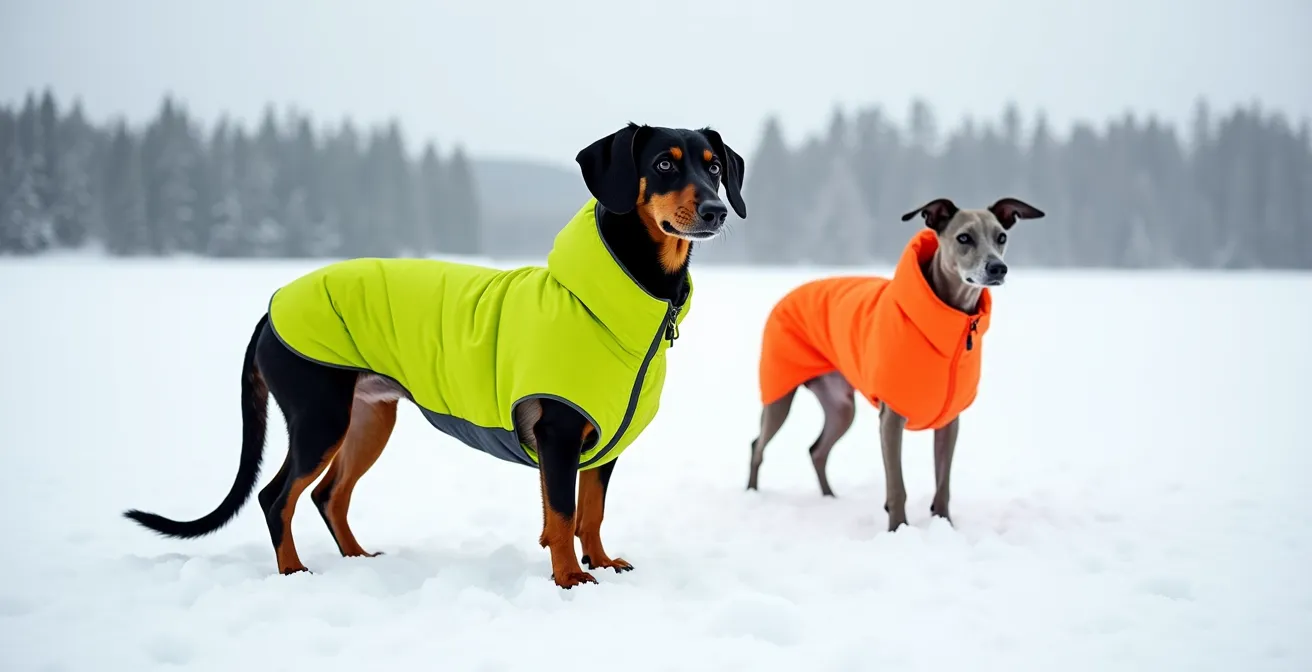
Fitting a winter coat on a Dachshund or Greyhound isn’t about finding a bigger size; it’s about finding a different shape that respects their unique biomechanics.
- Standard coats fail by ignoring the unique topline curve and deep chest, causing slippage, dangerous gaps in coverage, and painful chafing.
- Critical features for Canadian winters include full belly coverage to protect from ground-level cold and robust, non-Velcro fasteners that won’t fail in snow and ice.
Recommendation: Prioritize coats with multi-point “dynamic adjustability” over simple girth straps to achieve a true, non-restrictive biomechanical fit that moves with your dog.
For owners of Dachshunds, Greyhounds, and other long-bodied or deep-chested breeds, the annual quest for a winter coat is a familiar frustration. You follow the advice: you measure the chest, the neck, and the back. You buy the recommended size, only to find a coat that spins like a cape, leaves the belly dangerously exposed, or rubs their armpits raw. The standard dog coat is designed for a generic, boxy shape, failing to account for the unique spinal curvature of a Dachshund or the profound chest depth of a Greyhound.
The common solutions—”just get an adjustable one”—miss the point entirely. A single adjustable strap can’t fix a fundamental design flaw. The problem isn’t just about measurements; it’s about geometry and biomechanics. Generic coats slip and bunch because they fight against the dog’s natural movement, creating gaps where cold and moisture seep in. This is especially critical in the harsh and variable conditions of a Canadian winter, where exposure can quickly become a safety issue.
But what if the key wasn’t finding a coat that’s “close enough,” but understanding the specific failure points of generic designs and seeking out features engineered to solve them? This guide moves beyond simple measurements to explore the principles of a true biomechanical fit. We will deconstruct why belly coverage is non-negotiable, how to measure a topline correctly, why certain fasteners are destined to fail in snow, and how to protect your active dog from painful chafing. It’s time to find a coat that works with your dog’s body, not against it.
To help you navigate this complex choice, this article breaks down the essential factors for finding the perfect winter protection for your uniquely shaped companion.
Summary: Finding the Perfect Winter Coat for Long and Deep-Chested Dogs
- Why Is Belly Coverage Critical for Short-Legged Breeds in Snow?
- How to Measure Topline vs Back Length for a Coat That Doesn’t Slip?
- Velcro or Snaps: Which Lasts Longer in Snow and Fur?
- The Armpit Rub: Why Leg Straps Cause Sores on Active Dogs
- How to Choose Coats with Reflective Piping for 5 PM Darkness?
- Why Does -10°C Feel Like -20°C to a Small Dog Near the Ground?
- The "Wet Dog" Rub: Why Nylon Harnesses Cause Hotspots After Swimming
- How Cold Is Too Cold for Your Short-Haired Dog in Canadian Winters?
Why Is Belly Coverage Critical for Short-Legged Breeds in Snow?
For short-legged breeds like Dachshunds, the belly and chest are the first points of contact with snow, slush, and frozen ground. This proximity creates a significant thermal challenge. A coat that only covers the back is fundamentally useless, as it ignores the area most vulnerable to heat loss and moisture. A key principle of canine thermodynamics is that a wet dog loses heat exponentially faster than a dry one. Full belly coverage isn’t a luxury; it’s the most critical feature for preventing rapid chilling and potential hypothermia.
Furthermore, in many parts of Canada, winter walks involve navigating sidewalks and roads treated with salt and de-icing chemicals. An unprotected undercarriage gets plastered with this corrosive mixture, leading to skin irritation and a messy cleanup. A coat with a high-coverage, Y-shaped chest panel serves a dual purpose: it provides essential insulation and acts as a barrier, keeping mud, slush, and chemicals off your dog’s sensitive skin. This design not only keeps them warmer and drier but also significantly reduces the “wet dog” smell that permeates the house after a winter outing.
Ultimately, a coat without adequate belly protection offers a false sense of security. It leaves the most vulnerable areas exposed to the harshest elements, defeating the primary purpose of winter wear. For any dog low to the ground, evaluating the fit starts with flipping it over and assessing the undercarriage coverage first.
How to Measure Topline vs Back Length for a Coat That Doesn’t Slip?
The number one reason coats slip and twist on long-backed dogs is the misunderstanding between “back length” and “topline.” Most manufacturers ask for a simple back length: a straight line from the base of the neck to the base of the tail. This works for a Golden Retriever, but it fails spectacularly on a Dachshund. Their back has a distinct curve, meaning the topline measurement—which follows the natural curvature of the spine—is longer than the straight-line back length. A coat designed for a straight back will inevitably be too short to cover the haunches or will ride up and put pressure on the withers.
To achieve a biomechanical fit, you must measure three key dimensions with precision. These measurements account for the dog’s three-dimensional shape, not just a flat profile.
- Neck: Measure around the base of the neck, where it meets the shoulders. This should be snug, as a loose neck hole is a primary cause of the coat slipping backward.
- Chest: Measure the widest part of the chest, located just behind the front legs. For deep-chested breeds like Greyhounds, this is the most critical measurement for comfort and to prevent chafing.
- Topline: With the dog standing naturally, measure from the withers (the bony point between the shoulder blades) along the curve of their spine to where the tail begins. This ensures the coat covers the entire length and flank without interfering with tail movement.
This detailed approach is precisely what informs custom and breed-specific designs. For instance, Toronto-based Longboi & Co. created their Dachshund jacket with five separate adjustable aspects, including a two-part chest and belly piece. This “dynamic adjustability” allows the owner to micro-tune the fit to their specific dog’s unique proportions, ensuring the coat hugs the body securely even when the dog is in full motion.
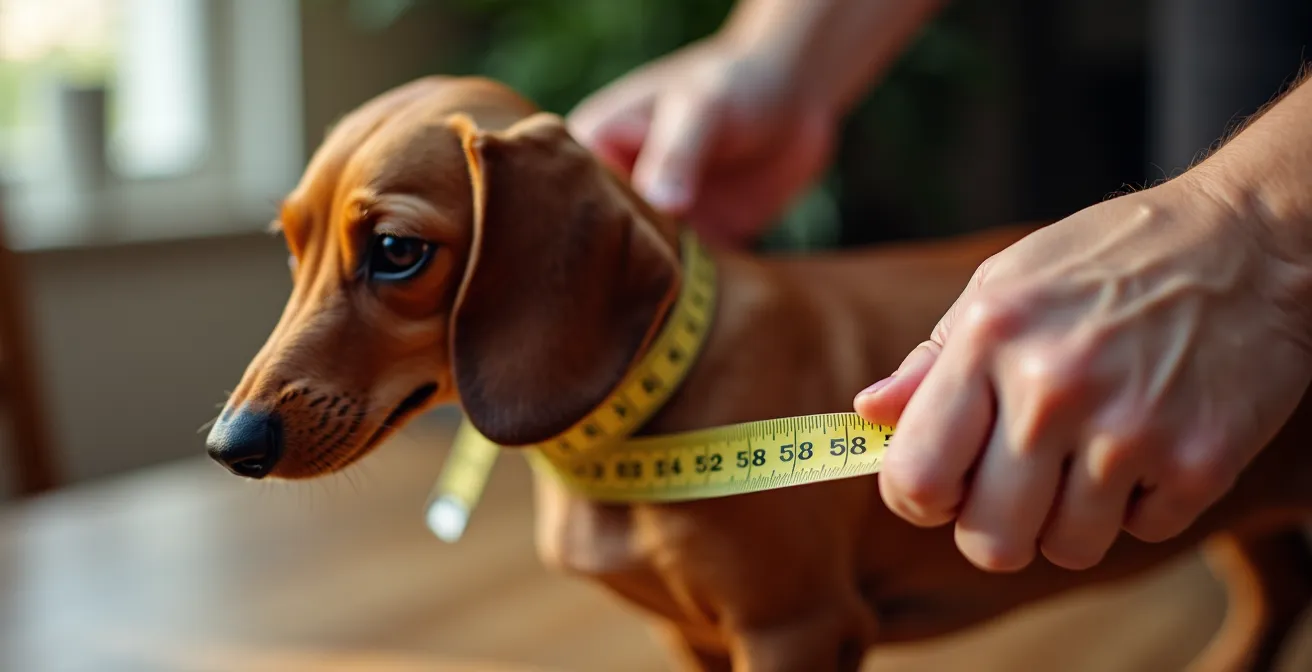
As you can see, following the actual contour of the spine is essential. A coat cut to this specific shape will lay flat and stay in place, providing consistent coverage without slipping or bunching, which is the foundation of a truly effective winter garment.
Velcro or Snaps: Which Lasts Longer in Snow and Fur?
The fastening system on a dog coat is a critical failure point, especially in demanding Canadian winters. While seemingly convenient, Velcro (hook-and-loop) is often the worst choice for outdoor gear. Its effectiveness plummets as it inevitably becomes clogged with dog fur, snow, and ice. The constant freeze-thaw cycles and debris collection degrade its grip over a single season.
As one expert analysis notes, this is a well-known issue with the material. In their review of winter dog coats, the team at Popular Mechanics highlights this exact problem:
Velcro is convenient and adjustable but tends to lose its clinginess as it gets clogged with lint and fur.
– Popular Mechanics, Best Winter Dog Coats of 2022
Buckles and snaps offer far superior durability and reliability in cold, wet conditions. However, not all buckles are created equal. High-quality, cold-rated buckles are essential. The following table breaks down the performance of common fastener types in typical Canadian winter conditions.
| Fastener Type | Snow/Ice Performance | Ease with Winter Gloves | Durability |
|---|---|---|---|
| Velcro | Gets clogged with snow and fur, loses effectiveness in freezing conditions | Quick to fasten but difficult to align with thick gloves | Degrades over time as it collects debris |
| Duraflex® Buckles | Performs well in all weather conditions | Can be operated with gloves once familiar | High durability, resistant to cold and salt |
| Metal Snaps | Maintains functionality in cold | Challenging with thick mittens | Can corrode from road salt over time |
Based on this analysis, clip-style buckles made from a durable, cold-resistant polymer like Duraflex® are the superior choice. They don’t clog, are largely unaffected by ice, and can be operated even with winter gloves on. While metal snaps are reliable in the cold, they can be difficult to manage with gloves and are susceptible to corrosion from road salt. For a coat that needs to perform day after day in a Canadian winter, investing in one with high-quality buckles is a smart choice.
The Armpit Rub: Why Leg Straps Cause Sores on Active Dogs
One of the most common and painful issues with ill-fitting dog coats is chafing, particularly in the sensitive armpit area. This “armpit rub” is almost always caused by a poor cut around the front legs. If the leg openings are too small, too far forward, or have thick, abrasive seams, every step your dog takes creates friction. For deep-chested breeds like Greyhounds, whose front legs are set relatively close together, this is a near-constant problem with generic coats.
Another major culprit is the use of rear elastic leg straps. While intended to keep the back of the coat from flapping up, these straps often do more harm than good on active dogs. As the dog runs and plays, the straps can rub against the delicate skin on the inner thighs, causing sores and hotspots. Many owners find they have to cut them off. A well-designed coat should not require leg straps to stay in place. If its topline cut is correct and its adjustability is dynamic, it will naturally hug the dog’s body without needing to be anchored at the legs.
Preventing chafing comes down to a proper biomechanical fit. The coat must allow for a full range of motion without any part of it pulling or rubbing against the skin. This means looking for coats with large, well-finished leg openings and a design that secures around the body’s core rather than relying on restrictive leg loops.
Your 5-Point Audit to Prevent Chafing and Sores
- Check the Leg Openings: When the coat is on, you should be able to comfortably slide two fingers between the edge of the armhole and your dog’s body. The seam should be soft and smooth, not thick or scratchy.
- Test the Range of Motion: Encourage your dog to walk, sit, and stretch while wearing the coat indoors. Watch for any pulling across the shoulders or bunching in the armpits.
- Inspect for Pressure Points: After 10 minutes of wear, remove the coat and check for any red marks or indentations on the skin, especially around the chest, withers, and under the front legs.
- Assess the Back End: Does the coat flap up when the dog moves? A coat that requires rear leg straps to stay down is likely a poor fit in its primary design.
- Evaluate After Activity: After your first real walk, check your dog’s skin thoroughly for any signs of irritation. Damp skin is more susceptible to friction, so this is the ultimate test.
How to Choose Coats with Reflective Piping for 5 PM Darkness?
In Canada, winter means short days and long nights. A walk at 5 PM is often a walk in the dark, making visibility a critical safety feature. A brightly coloured coat is a good start, but it does little under the low-light conditions of dusk, dawn, or overcast, snowy days. For true safety, a coat must incorporate high-quality reflective material.
Not all reflective elements are effective. Small, decorative patches offer minimal visibility. Look for coats with generous reflective piping or tape sewn along the main seams or across the sides. The best materials are professional-grade, like the kind used on safety uniforms for firefighters and road crews. For instance, some premium coat makers offer the option to add machine-sewn, one-inch wide 3M™ Scotchlite™ reflective safety tape. This material is designed to be intensely bright when hit by headlights, making your dog visible to drivers from a much greater distance.
Canadian manufacturer Chilly Dogs emphasizes that using materials like 3M Scotchlite™ piping increases safety and visibility on late-night or early-morning walks. This isn’t just a feature; it’s a piece of safety equipment. When choosing a coat, consider the placement and quantity of the reflective material. It should be visible from the front, sides, and rear to ensure 360-degree visibility, providing peace of mind during those inevitable dark winter outings.
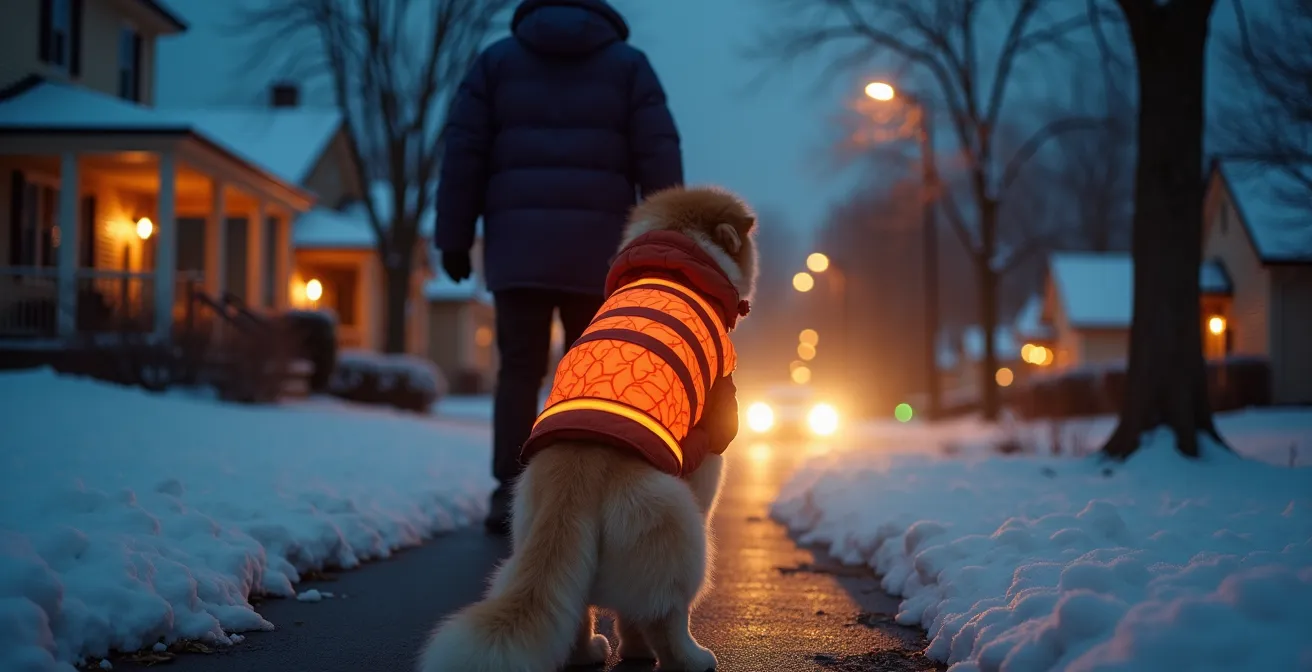
This simple feature can be the difference between being seen and not. For anyone walking their dog near roads in the city or suburbs, a coat with robust reflective elements is an essential investment in their pet’s safety.
Why Does -10°C Feel Like -20°C to a Small Dog Near the Ground?
The official air temperature reported by the weather network is measured about 1.5 meters above the ground. However, for a small dog like a Dachshund, their entire world exists in the first 30cm above the snow. This zone is subject to a phenomenon known as the “thermal gradient,” where the air is significantly colder than the official reading. Cold air is denser than warm air, so it sinks. This means a dog whose belly is just inches from the snow is moving through a microclimate that can be several degrees colder.
This effect is compounded by direct contact. As the American Veterinary Medical Association (AVMA) points out, this proximity is a major factor in how quickly they get cold. In their cold weather guidelines, they state:
Short-legged pets may become cold faster because their bellies and bodies are more likely to come into contact with snow-covered ground.
– American Veterinary Medical Association, Cold Weather Animal Safety Guidelines
This is why a -10°C day can feel like -20°C for a small dog. They are not only in a colder layer of air but are also losing body heat directly to the frozen ground and snow. For breeds with short hair and little body fat, like Greyhounds and Whippets, this heat loss is even more rapid. It’s not an exaggeration to say that for these dogs, an unprotected walk in Canadian winter temperatures can become dangerous very quickly. Veterinary guidelines indicate that when the temperature drops to -7°C and below, dogs are at a higher risk of hypothermia and frostbite, making a properly insulated coat an absolute necessity, not an accessory.
The "Wet Dog" Rub: Why Nylon Harnesses Cause Hotspots After Swimming
The “wet dog rub” is a term for the painful skin irritation, or hotspots, that can develop when wet material is left against a dog’s skin. While often associated with swimming, the same principle applies during winter. Snow melts against the dog’s body heat, and freezing rain soaks through inadequate materials. A coat with a standard fleece or cotton lining can act like a sponge, holding that cold moisture directly against the skin. This not only accelerates heat loss but also creates the perfect environment for chafing and bacterial skin infections.
The solution lies in a coat constructed with a multi-layer system. The outer shell should be water-resistant or waterproof to fend off snow and slush. But just as importantly, the inner lining should be made of a breathable, moisture-wicking material. Unlike standard fleece that traps moisture, a technical fleece or a specialized lining will pull moisture away from the dog’s skin and allow it to evaporate, keeping them drier and warmer. The combination of a water-resistant outer shell and a soft, moisture-wicking fleece lining is ideal for keeping even the shortest-haired dogs comfortable on a cold winter day.
Furthermore, post-walk care is critical. As the Canadian Veterinary Medical Association advises, always remove sweaters and coats once back indoors. This allows the dog’s skin to breathe and their body temperature to regulate naturally. It also gives you a chance to towel them dry and check for any irritation caused by dampness or trapped debris, such as road salt. Salt trapped between a dog’s toes can cause significant irritation, so carefully washing their feet after a walk is a key part of a Canadian winter care routine.
Key Takeaways
- A proper fit for long or deep-chested dogs is biomechanical, requiring measurements that follow the body’s curves, not just straight lines.
- Full belly coverage and high-quality, non-Velcro buckle fasteners are non-negotiable features for safety and durability in Canadian winters.
- Preventing chafing means choosing a coat with large arm openings and a design so precise it doesn’t need restrictive leg straps to stay in place.
How Cold Is Too Cold for Your Short-Haired Dog in Canadian Winters?
Determining when it’s “too cold” isn’t a simple matter of looking at a thermometer. The answer depends on the dog’s breed, size, coat thickness, and the specific weather conditions, which vary wildly across Canada. A rainy 2°C day in Vancouver presents a different challenge than a sunny but-25°C day in Winnipeg. The right coat is one that is adapted not just to your dog, but to your regional climate.
A dog’s size is a major factor in its ability to retain heat. Guidelines from the Tufts University School of Veterinary Medicine show that smaller dogs are at risk in much milder temperatures than larger dogs. For example, potential hazards for small breeds can begin at just 4°C, whereas large breeds may be comfortable down to 1°C. For any breed, temperatures below -7°C are universally considered dangerous without proper protection.
The best approach is to choose a coat with features tailored to your local winter. The following table offers recommendations based on regional Canadian weather patterns.
| Region | Primary Concerns | Recommended Features |
|---|---|---|
| Maritimes | Wet snow, freezing rain, high winds | 100% waterproof and windproof materials |
| Prairies | Extreme cold (-20°C to -40°C common) | Extreme insulation (down or high-loft synthetic), full-body coverage |
| Southern Ontario/Quebec | Road salt, slush, variable conditions | Salt-resistant materials, robust belly protection |
| West Coast | Rain, mild temperatures, dampness | Water-resistant shells, breathable materials |
Ultimately, finding the right coat is an investment in your dog’s health, safety, and comfort. By moving beyond generic sizing and focusing on a biomechanical fit, material integrity, and features tailored to your climate, you can finally end the frustrating search and give your long-backed or deep-chested companion the protection they truly need to enjoy a Canadian winter.
Evaluate your dog’s specific needs based on these principles and choose a coat that offers a true, comfortable, and safe fit for all your winter adventures.