
Bringing a second dog home shouldn’t feel like a gamble for your first dog’s happiness; it’s a manageable process that requires proactive leadership.
- Successful integration relies on managing the environment and dog interactions, not on hoping they’ll “work it out.”
- Key strategies include structured, neutral introductions (even in winter), clear household rules, and abandoning outdated “alpha” theories for modern cooperation.
Recommendation: Your goal isn’t just to prevent fights but to become a benevolent household leader who creates a predictable, secure environment for both dogs to thrive.
You love your dog. They are the center of your world, a perfect, furry companion who has settled into a comfortable life with you. But a part of you feels they might be lonely, or perhaps you simply have more love to give. The thought of bringing a second dog into your home is exciting, but it’s immediately followed by a wave of anxiety. Will it ruin the perfect bond you have with your first dog? Will your peaceful home turn into a chaotic warzone? For owners of a cherished “only dog,” this fear is completely valid.
Many people will tell you to just “let them meet on neutral ground” or “let them work it out.” While well-intentioned, this advice often fails to address the deep-seated fear of disrupting the established harmony. It overlooks the nuances of dog psychology and the specific challenges of a Canadian lifestyle, like introducing pets when it’s freezing outside. This hands-off approach can lead to tension, resource guarding, and fights, confirming your worst fears.
But what if the key wasn’t simply to avoid conflict, but to proactively build a healthy multi-dog relationship from the ground up? The secret lies in shifting your mindset from a worried owner to a confident household manager. This guide is built on one core principle: successfully adding a second dog is about skillfully managing your home’s emotional ecosystem. It’s about creating predictability, teaching cooperation, and providing benevolent leadership that makes both your current dog and your new dog feel secure.
We will walk you through the essential steps, from the very first meeting to establishing long-term peace. We’ll tackle common mistakes, debunk outdated myths, and provide you with the practical tools and checklists you need to guide your dogs toward a peaceful and lasting companionship. This is your roadmap to doubling the love, not the stress.
This comprehensive guide will walk you through the entire process, providing the structure and confidence you need. Here is what we’ll cover to help you build a harmonious multi-dog home.
Summary: How to Introduce a Second Dog Without Ruining Your First Dog’s Life?
- Why Are Two Female Dogs More Likely to Fight Than a Male-Female Pair?
- How to Introduce Dogs on Neutral Territory When It’s -20°C Outside?
- Parallel Walking: Why Is It Safer Than a Head-On Greeting?
- The Toy Sharing Mistake That Triggers Fights in Week 1
- When to Stop Crating and Allow Unsupervised Time Together?
- How to Zone Your Home to Keep Dogs and Cats Coexisting Peacefully?
- Why Does Inconsistent Rule Enforcement Cause More Stress Than Strictness?
- Why Being the “Alpha” Doesn’t Work: The Science of Family Cooperation
Why Are Two Female Dogs More Likely to Fight Than a Male-Female Pair?
One of the first considerations in choosing a second dog is their sex, and there’s a common observation among behaviour professionals that deserves your attention. While every dog is an individual, conflicts can be more intense and less easily resolved between two females. This isn’t a myth; in fact, animal behavior experts find that two females are the most likely pair to experience serious friction. A male-female pair is often the easiest combination, followed by two males.
Why does this happen? Unlike male-male scuffles, which are often noisy but brief displays to establish rank, female-female aggression can be more subtle, serious, and rooted in competition for status and resources. Once a serious fight breaks out between two females, the relationship can be permanently damaged, making management a lifelong, stressful task. This is often referred to as “sororal aggression,” and it can be particularly challenging because the triggers aren’t always obvious. It might not be over a toy, but over access to you or a prime resting spot.
This doesn’t mean you can never have two females. However, it does mean you must be an exceptionally vigilant and proactive manager. You need to become an expert at reading subtle signs of tension. Look for “hard stares,” body blocking, or one dog consistently controlling the other’s movement. Recognizing these early warning signs is critical to preventing an escalation. If you are considering a female-female pair, especially with a resident dog who is used to being the “queen of the castle,” you must be committed to implementing strict management protocols from day one.
Here are the subtle signals of tension you must learn to recognize:
- Watch for hard, focused eye contact, sometimes accompanied by lip licking.
- Notice if a dog’s body weight is shifted forward with obvious muscle tension.
- Look for body blocking behaviours around resources like toys, food bowls, or even you.
- Monitor for subtle competitive claiming of space, such as one dog always lying down between you and the other dog.
- Check for a stiff, erect tail and raised hackles during interactions.
How to Introduce Dogs on Neutral Territory When It’s -20°C Outside?
The classic advice is to introduce dogs on neutral territory, like a park. But for anyone living in Canada, this advice feels useless for half the year. When it’s -20°C with a biting wind, a leisurely park stroll is not an option. A bad first impression, especially for a shy dog, can be difficult to overcome. So, how do you create a positive, neutral first meeting during a harsh Canadian winter?
The key is to redefine “neutral territory.” It doesn’t have to be a park; it just has to be a place where neither dog feels a sense of ownership. Think outside the box. A neighbour’s fenced yard (that neither dog has been in), a quiet, covered parkade, or even a wide, empty hallway in a pet-friendly building can work. The goal is a space with enough room for the dogs to keep their distance initially, without the added stress of freezing temperatures cutting the introduction short. A short, successful meeting is far better than a long, stressful one.
For an indoor winter introduction, a friend’s basement or a rented indoor training facility for 30 minutes can be a perfect solution. If you must use a space like a parkade, go during off-peak hours. Use the large concrete pillars as natural barriers to break up sightlines and walk the dogs on opposite sides of the driving lane. The environment itself becomes part of your management toolkit, allowing for a controlled, calm experience away from the elements.
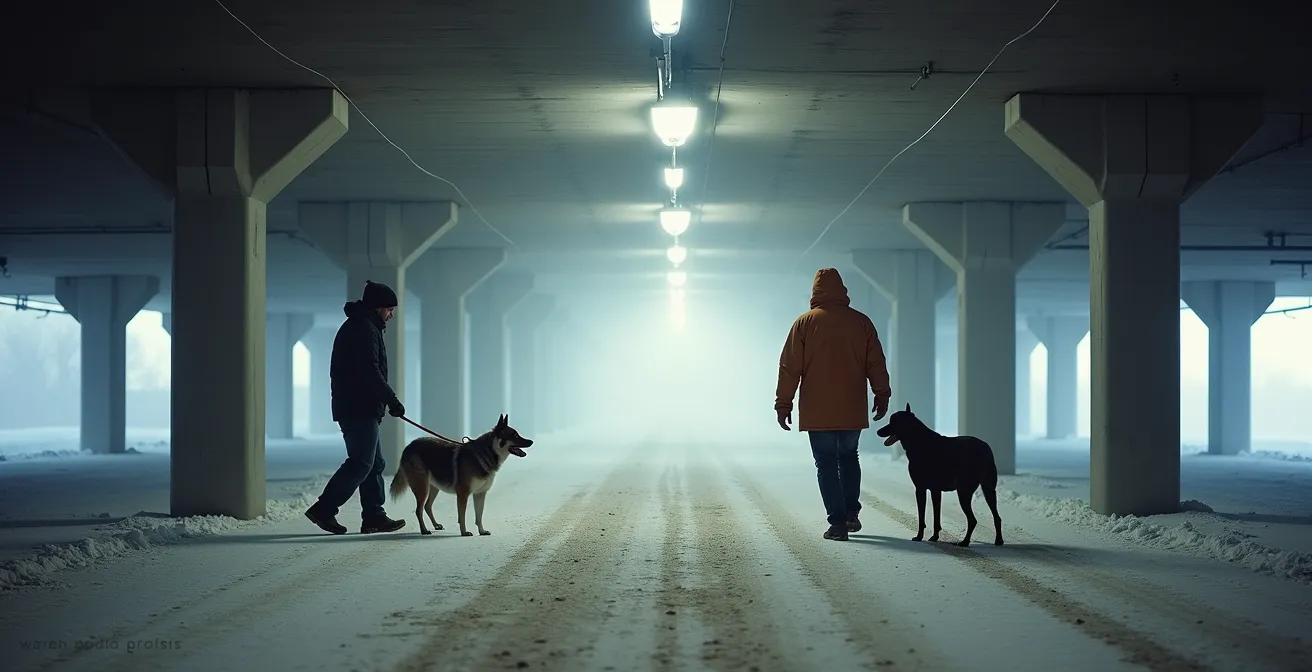
The image above perfectly illustrates this concept: two handlers, bundled for the cold, use the vast space of a covered parkade to conduct a controlled parallel walk. The distance and structural elements create a safe, neutral environment, proving that with a little creativity, a successful Canadian winter introduction is entirely possible. The focus remains on calm, controlled exposure, which sets the foundation for their entire future relationship.
Parallel Walking: Why Is It Safer Than a Head-On Greeting?
A head-on approach between two leashed dogs is one of the most common and dangerous mistakes owners make. In the canine world, walking directly toward another dog is a confrontational gesture. It forces eye contact and removes the dog’s ability to politely curve or turn away, which is their natural way of showing peaceful intentions. This forced, face-to-face meeting can create immediate tension and trigger a defensive or fearful reaction, setting a negative tone from the very first second.
This is where the Decompression Walk, or parallel walking, becomes your most powerful tool. It allows dogs to get used to each other’s presence and scent in a non-confrontational way. You and another handler start by walking the dogs in the same direction but on opposite sides of a street, about 15-20 feet apart. The dogs can see each other from the corner of their eyes, but they are focused on the shared activity of moving forward. This mimics how dogs in a loose group might move together, exploring the environment as a team rather than as adversaries.
As the Animal Humane Society wisely notes, first impressions are critical for dogs. This structured walk is your way of engineering a positive one.
When you’re introducing two dogs to each other, first impressions matter. How the dogs interact in their first few encounters can set the tone for their entire relationship, so follow these steps to set their relationship up for success.
– Animal Humane Society, How to successfully introduce two dogs
Gradually, over several minutes, you can decrease the distance between you, always watching for relaxed body language. If both dogs are calm—sniffing the ground, loose bodies, no hard staring—you can eventually let them briefly greet for a “three-second sniff” before calling them away and continuing the walk. This controlled, side-by-side activity drains arousal, builds positive association, and communicates safety, making it infinitely better than a tense, head-on standoff.
The Toy Sharing Mistake That Triggers Fights in Week 1
You’ve survived the introduction, and the dogs seem to be getting along. It’s tempting to scatter all your resident dog’s favourite toys on the floor, hoping they’ll share and play together. This is a critical mistake. To a dog, toys, bones, and even your lap are valuable resources. Expecting them to share these items with a stranger immediately is like expecting a child to happily hand over their most beloved teddy bear to a new sibling on day one. It’s a recipe for conflict.
It’s crucial to understand that resource guarding is a normal dog behavior, not a sign of a “bad” dog. It’s an instinctive need to protect valuable items. Your job as a household manager is not to punish this instinct but to prevent it from being triggered in the first place. During the first few weeks, all high-value items should be removed from shared spaces. This includes special chew bones, favourite squeaky toys, and even food bowls. Feed the dogs in separate rooms or in their crates to eliminate any sense of competition.
Instead of forcing them to share, you will reintroduce items slowly and under strict supervision. Start with lower-value resources. For example, you can have several generic tennis balls on the floor. If a dog picks one up, that’s fine. If the other dog approaches and the first dog freezes, stiffens, or growls, you calmly intervene and redirect. This initial “no-sharing” policy establishes a sense of abundance and security. It teaches the dogs that the new housemate is not a threat to their possessions, which is a cornerstone of building trust.
This table outlines a practical hierarchy for managing resources during the critical first month of integration.
| Resource Level | Examples | Accessibility First Month |
|---|---|---|
| High-Value | Favorite toys, bones, special treats, owner’s lap | Only in separate rooms/crates |
| Medium-Value | Regular toys, bedding, food bowls | Supervised only, remove when alone |
| Low-Value | Tennis balls, rope toys, water bowls | Can remain in shared spaces |
When to Stop Crating and Allow Unsupervised Time Together?
The ultimate goal for most owners is a home where both dogs can coexist peacefully, even when left alone. But graduating from constant supervision and crating to unsupervised freedom is the final and most critical step in the integration process. Rushing this can undo all your hard work and lead to a serious incident that shatters trust between the dogs and with you. So, when is it truly safe?
There is no magic timeline; it’s not about a number of weeks or months. It’s about consistently observing a specific set of behaviours that indicate a stable, respectful relationship. You are looking for signs of “peaceful coexistence,” not necessarily best friends who cuddle all day. This means they can comfortably ignore each other, rest in the same room without tension, and engage in polite, reciprocal play. Reciprocal play is key: you should see give-and-take, where dogs take turns chasing or being on top, with frequent pauses.
The process should be gradual. Start with short periods of supervised “down time” in the same room. Then, begin leaving them for very short intervals (30 seconds to a minute) while you step into another room. Use a pet camera to monitor their interactions when you’re out of sight. This allows you to gather real data on their behaviour without your presence influencing them. If you see any signs of stress, bullying, or resource guarding, you’ve moved too fast. Go back a step and continue building a foundation of positive experiences.

The scene in the camera lens above is your goal: two dogs, resting peacefully in their own space within the same room. They are not interacting, but they are relaxed in each other’s presence. This state of calm neutrality is the true indicator that you are ready to begin trusting them with more freedom. Only after weeks of observing this kind of behaviour consistently should you consider longer unsupervised periods.
How to Zone Your Home to Keep Dogs and Cats Coexisting Peacefully?
While our primary focus is on integrating two dogs, the principles of household management extend to all pets. If your “only child” is a dog and you’re adding another dog to a home that also has a cat, creating a zoned environment is absolutely essential for safety and harmony. The core concept is to provide each animal with a secure territory where they can decompress without feeling threatened. For cats, this means vertical space is non-negotiable.
Before the new dog even arrives, you should establish “cat highways” and “safe zones.” This means installing tall cat trees, clearing off the tops of sturdy bookshelves, and even adding dedicated wall shelves. A cat needs to be able to navigate a room without ever touching the floor. This empowers them to observe the newcomer from a safe vantage point. Furthermore, use baby gates to create dog-free zones, such as an upstairs area or a specific room. A great tip for this is to raise the baby gate a few inches off the floor—enough for the cat to slide under, but too low for the dog to pass.
An effective introductory technique, which can also be used for two dogs, is “scent soaking.” Before the first visual meeting, you swap their bedding for a few days. This allows them to get used to each other’s smell in a non-threatening context. For example, placing a towel the new dog has slept on near the cat’s feeding area helps the cat associate the new smell with something positive (food). This is a simple but powerful way to lay the groundwork for a peaceful introduction.
This zoning blueprint provides a clear, practical plan for structuring a Canadian home to accommodate multiple pets, drawing on accessible items from stores like IKEA or RONA.
| Zone Type | Location | Setup Requirements |
|---|---|---|
| Cat Safe Zone | Upper floor/bedrooms | Baby gate at stairs, cat tree near window |
| Dog Territory | Main floor living areas | Dog beds, toys, water stations |
| Neutral Zone | Hallways, entryway | No resources, clear pathways |
| Cat Highways | Wall shelves throughout | 5+ feet high, 12-inch deep shelves from IKEA/RONA |
| Feeding Stations | Kitchen counter (cat), floor corner (dog) | Separated by vertical space and distance |
Why Does Inconsistent Rule Enforcement Cause More Stress Than Strictness?
As a loving owner, you might think “being strict” is mean. You let your resident dog on the couch, so it seems unfair to deny the new dog the same privilege. This line of thinking, while kind-hearted, is a primary source of stress and conflict in a new multi-dog household. Dogs do not crave equality; they crave predictability. Inconsistent rules create a chaotic emotional ecosystem where dogs are constantly unsure of what is expected of them, leading to anxiety, competition, and conflict.
When one dog is allowed to do something but the other isn’t, you’re not just being “unfair”—you’re creating a resource. The couch, the bed, or the privilege of jumping up becomes something one dog has and the other wants. This forces the dogs to negotiate the rules between themselves, and their negotiation tactics often involve growling, snapping, or fighting. Strict, clear, and universally applied rules, on the other hand, remove this burden from the dogs. When both dogs know that “no dogs on the couch” is a firm household law, the couch ceases to be a point of contention.
As Canadian dog training expert Shannon Viljasoo points out, we often forget that a new dog starts from zero, regardless of our existing dog’s behaviour.
The truth is, every new dog is a completely blank slate. All too often, a second dog joins the household and the expectation is that they will behave as the existing dog in the home does, so they are often given the same freedom right off the bat.
– Shannon Viljasoo, When One is Not Enough – McCann Professional Dog Trainers
The best approach is to start with a “new household, new rules” policy. For the first few months, implement a stricter set of rules for *both* dogs. No dogs on the furniture, both must wait at the door, both must perform a sit for their food. This resets expectations and establishes you as the clear, benevolent leader. Once the dogs have settled into a stable, respectful relationship, you can choose to relax some of these rules—but you do it for both dogs, at the same time.
Your Household Constitution: A 7-Point Action Plan
- Dogs wait for a release cue before eating (applies to both dogs, every single meal).
- Establish a clear rule for furniture (e.g., no dogs on furniture, or only by invitation).
- Both dogs must sit and wait for permission before going through doorways.
- Toys are managed and put away after supervised playtime to prevent conflicts.
- Each dog has designated quiet time in a crate or separate room daily to decompress.
- Conduct training sessions individually to build your personal bond with each dog.
- Ensure all human family members enforce the exact same rules consistently.
Key Takeaways
- Proactive Management is Everything: Your role is to be the household manager, preventing conflict by controlling the environment, not just reacting to fights.
- Predictability Creates Security: Consistent rules and routines are not “mean”; they are the foundation of a low-stress environment where dogs feel safe.
- Leadership Over Dominance: A successful multi-dog home is built on a foundation of benevolent leadership and cooperation, not on outdated “alpha” theories.
Why Being the “Alpha” Doesn’t Work: The Science of Family Cooperation
For decades, the prevailing advice for dog owners was to establish themselves as the “alpha” or “pack leader.” This theory, based on flawed studies of captive, unrelated wolves, suggested that you needed to dominate your dog through physical corrections and displays of power to earn respect. This approach is not only outdated and scientifically disproven, but it is also deeply damaging to your relationship with your dogs and counterproductive in a multi-dog home.
Modern canine science has shown that domestic dogs do not form rigid, linear hierarchies like those once thought to exist in wolf packs. A dog household functions more like a human family, with complex relationships, friendships, and fluid dynamics. As behaviour experts from the Animal Humane Society confirm, dominance isn’t a factor when dogs socialize and live together. Trying to be the “alpha” by using force or intimidation only creates fear and anxiety. This anxiety can then be redirected toward the other dog, causing aggression and making the situation worse.
The alternative is to embrace the role of a benevolent leader and teacher. Your authority doesn’t come from force; it comes from being the provider of all good things and the creator of a predictable, safe world. You control the resources—food, toys, affection, access to outdoors—and you teach your dogs the polite behaviours required to get them. You reward calm, cooperative behaviour with praise, treats, and privileges. You redirect unwanted behaviour, not punish it. This positive-reinforcement-based approach builds trust and encourages your dogs to look to you for guidance, rather than trying to sort things out themselves through conflict.
Instead of focusing on dominance, focus on being a reliable manager of the home. This means teaching and rewarding a solid “wait” cue, managing the environment to prevent conflicts before they start, and establishing predictable routines. If you need professional help, seek out certified trainers who use modern, science-based methods. In Canada, look for certifications like CCPDT (Certification Council for Professional Dog Trainers) or IAABC (International Association of Animal Behavior Consultants).
By shifting your perspective from one of dominance to one of benevolent leadership, you provide the security and clarity both dogs need to thrive. The journey of adding a second dog is a chance to deepen your understanding of canine behaviour and become the confident, capable household manager your dogs deserve. Start today by implementing these strategies to build a foundation of trust and respect for a lifetime of peaceful companionship.