
The key to preventing painful panosteitis isn’t restricting your puppy’s life, but mastering the science of controlled growth to build a robust skeletal scaffolding.
- Overfeeding and high-impact exercise create excessive biomechanical stress on open growth plates, causing inflammation and lameness.
- Nutrient density, particularly calcium and protein levels, must be precisely managed, not just minimized.
Recommendation: Shift from following generic advice to actively managing your puppy’s growth curve, diet, and exercise based on their specific developmental stage.
The sight is distressing for any owner of a large breed puppy: one day your energetic German Shepherd or Great Dane is fine, and the next they are limping, clearly in pain. This intermittent, shifting leg lameness is often the first sign of panosteitis, or “growing pains.” Many well-intentioned owners immediately turn to common advice: feed less, switch foods, or stop all activity. While these intuitions hint at the solution, they miss the underlying physiological reality. The problem isn’t just about calories or exercise; it’s about the intense, complex process of skeletal construction happening within your puppy.
Most advice focuses on *what* to do, but fails to explain *why*. Preventing panosteitis requires a shift in perspective. It’s not a matter of simply avoiding mistakes, but of becoming an active manager of your puppy’s development. The true key is not just to prevent rapid growth, but to ensure controlled, steady growth. This means understanding the delicate interplay between nutrition, hormones, and biomechanical stress on a skeletal system that is still a fragile, developing framework. It’s about providing the right materials at the right rate, without overloading the construction site.
This guide moves beyond generic rules. We will dissect the science behind each critical factor, from the myth of “power feeding” to the precise timing for neutering and the real dangers of a simple jog. By understanding the mechanisms at play within your puppy’s open growth plates, you can make informed, strategic decisions to build a foundation for a lifetime of healthy, pain-free mobility.
This article will provide a structured, evidence-based approach to safeguarding your puppy’s joints. Explore the detailed sections below to master each aspect of their developmental health.
Summary: Preventing Growing Pains in Large Breed Puppies
- Why Does “Power Feeding” Puppies Destroy Their Joints Long-Term?
- How to Track Your Puppy’s Weight Curve Against Breed Standards?
- Calcium Supplements: Necessary Boost or Bone-Deforming Danger?
- The Jogging Mistake: Why Running with a Puppy Damages Growth Plates
- When to Neuter a Giant Breed: Why Waiting 18 Months Protects Hips
- Large Breed Puppy Food: Why Is Lower Protein Density Crucial for Joints?
- Why Must You Wait Until 14 Months for Full Height Jumps?
- Does Your Condo Dog Really Need High-Protein “Ancestral” Kibble?
Why Does “Power Feeding” Puppies Destroy Their Joints Long-Term?
The term “power feeding” refers to the practice of providing a high-calorie diet to encourage rapid growth, with the goal of achieving a large, impressive size quickly. From a veterinary orthopedic standpoint, this is one of the most detrimental practices for a large breed puppy. Rapid weight gain doesn’t build a stronger dog; it builds a heavier dog on an immature skeletal scaffolding that is not yet equipped to bear the load. The excess weight exerts constant, abnormal pressure on soft, open growth plates and developing joints, leading to micro-trauma, inflammation, and conditions like panosteitis.
The problem is exacerbated in certain breeds. For instance, German Shepherds are a breed known for their susceptibility to developmental orthopedic diseases. The pressure to grow them “big” can have severe consequences.
Case Study: German Shepherd Predisposition in Canada
A Canadian study from the University of Prince Edward Island’s Canine Inherited Disorders Database highlights this risk, reporting that German Shepherds are significantly predisposed to panosteitis. The condition most often affects males during their rapid growth phase between 6 and 18 months. This underscores that for predisposed breeds, managing growth rate isn’t just a recommendation; it’s a clinical necessity to prevent predictable pain and potential long-term joint damage.
Instead of focusing on the number on the scale, owners must learn to assess their puppy’s Body Condition Score (BCS). A puppy should be lean, with a visible waist and palpable ribs under a thin layer of fat. This lean condition is the single most important factor in promoting healthy, controlled growth and protecting vulnerable joints from the damaging effects of excess weight.
Your Action Plan: Body Condition Score Assessment for Canadian Dog Owners
- Visual Check (Top-Down View): Look at your puppy from above. You should see a clear, hourglass-shaped waistline just behind the rib cage. A straight or bulging line indicates excess weight.
- Visual Check (Side View): Observe your puppy from the side. The abdomen should tuck up from the ribcage towards the hind legs. A sagging belly line is a red flag.
- Palpation Check (Ribs): Place your thumbs on your puppy’s backbone and spread your fingers across the rib cage. You should be able to feel the individual ribs easily with only a thin layer of fat.
- Comparison Check (Knuckle Test): Compare the feeling of the ribs to your own hand. An ideal weight feels like the back of your knuckles when your hand is resting flat. If it feels like your palm, there’s too much fat.
- Scoring: Use a 9-point scale. For a growing large breed puppy, the ideal Body Condition Score is a lean 4 or 5 out of 9. Consistently scoring 6 or higher indicates a need to adjust caloric intake.
Maintaining this lean body condition through controlled feeding is not about stunting growth; it is about allowing the skeleton to develop at a pace it can structurally support, ensuring a healthier, more robust adult dog.
How to Track Your Puppy’s Weight Curve Against Breed Standards?
While Body Condition Score provides a crucial hands-on assessment, systematically tracking your puppy’s weight provides objective data to ensure they are following a healthy controlled growth curve. The goal is not to hit the maximum weight for their age, but to ensure steady, predictable gains that align with the lower-to-mid range of their breed standard. This data-driven approach allows you to make small, proactive adjustments to their food portions rather than reactive changes once they are already overweight.
Weekly weigh-ins are recommended for the first 8-10 months. Use a consistent scale and record the weight in a journal or spreadsheet. You can then plot this on a growth chart specific to your breed (often available from reputable breeders or kennel clubs). A sudden, sharp spike in the growth curve is a warning sign that caloric intake is outpacing skeletal development. This disciplined tracking is your primary tool for managing the rate of growth and mitigating the risk of panosteitis.
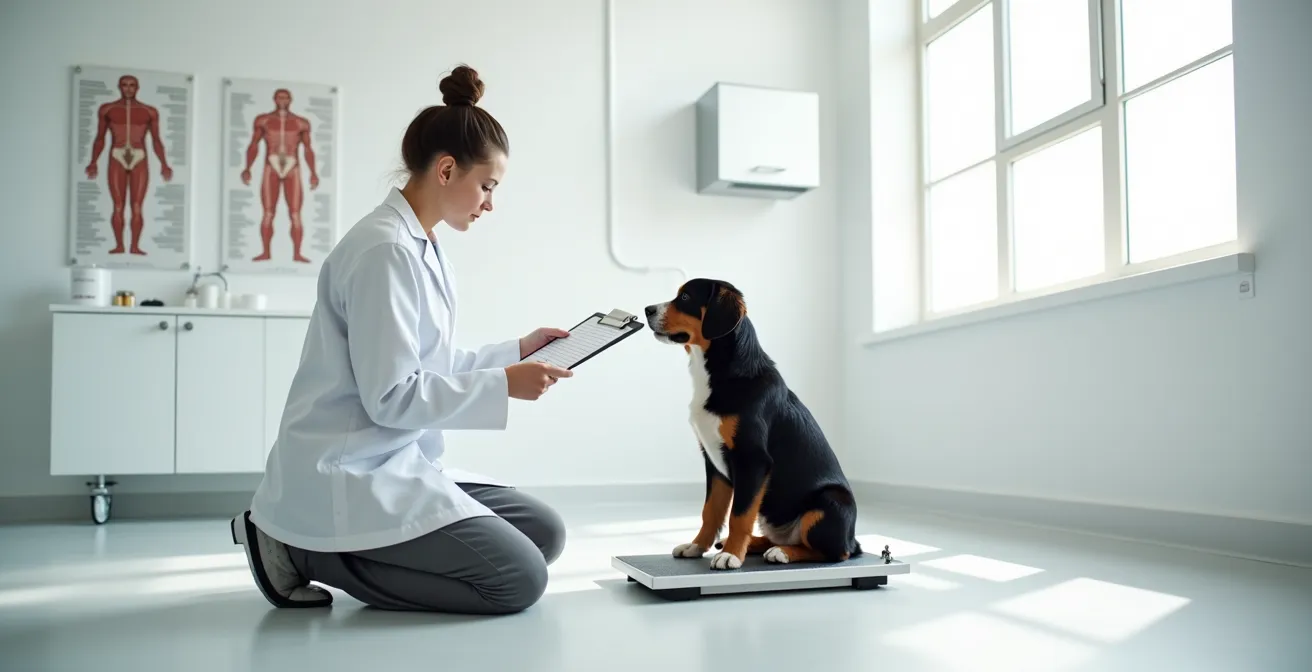
This monitoring is especially critical during the key developmental windows when the puppy’s growth plates are most active and vulnerable. Understanding when these growth plates close is fundamental to managing both nutrition and exercise throughout their adolescence.
The following timeline provides a general guide for when a large breed puppy’s skeletal system matures. It highlights the high-risk period for panosteitis and helps contextualize why activity must be restricted until skeletal maturity is reached.
| Age Range | Growth Plate Status | Developmental Milestone | Exercise Recommendations |
|---|---|---|---|
| 2-6 months | All plates open | Rapid growth phase begins | 5-minute rule: 5 min walk per month of age, twice daily |
| 6-12 months | Smaller plates closing | Peak panosteitis risk period | Controlled leash walks, no jumping |
| 12-18 months | Major plates closing | Sexual maturity developing | Gradual increase in activity |
| 18-24 months | Final plates close | Skeletal maturity reached | Full activity permitted |
Ultimately, a healthy growth curve is smooth and steady, not a race to the top. This careful monitoring ensures the puppy’s musculoskeletal system can mature correctly without being overloaded.
Calcium Supplements: Necessary Boost or Bone-Deforming Danger?
One of the most dangerous myths in puppy nutrition is the idea that a growing large breed needs extra calcium for “strong bones.” In reality, supplementing calcium in a puppy fed a balanced, commercial large-breed diet is a direct path to skeletal malformation. The core issue lies in a puppy’s immature physiology. Unlike adult dogs, puppies under 5-6 months of age cannot effectively regulate how much calcium they absorb from their gut. They will absorb a percentage of whatever amount is provided, regardless of their body’s actual needs.
Puppies younger than 5 months are not able to adjust the absorption of calcium in response to intake, therefore an oversupply or undersupply can be harmful.
– Wikipedia Contributors, Puppy Nutrition
When an owner adds calcium supplements, cottage cheese, or yogurt to an already-balanced diet, they create a state of calcium excess. This disrupts the carefully calibrated calcium-to-phosphorus ratio, a critical factor for bone development. This imbalance can accelerate bone growth in some areas and retard it in others, leading to conditions like osteochondrosis (cartilage defects) and hypertrophic osteodystrophy (HOD), in addition to contributing to panosteitis. A quality commercial food formulated for large breed puppies is designed with a precise nutrient profile. Trust the science behind the formulation. Clinical studies confirm that for these puppies, optimal 1.0% to 1.5% calcium levels with a Ca:P ratio between 1:1 and 2:1 are essential for healthy bone development.
The message from an orthopedic perspective is unequivocal: do not add calcium to a balanced large breed puppy diet. The risk of causing permanent skeletal damage far outweighs any perceived benefit. The right amount of calcium is already in the bag.
Your role is not to be a chemist, but to be a gatekeeper, ensuring your puppy receives only the balanced nutrition they require and nothing more.
The Jogging Mistake: Why Running with a Puppy Damages Growth Plates
A common mistake well-meaning owners make is taking their large breed puppy for sustained jogs or runs, believing they are helping to “burn off energy.” However, this type of high-impact, repetitive exercise is one of the most damaging activities for a developing skeleton. The problem lies with the growth plates—soft areas of cartilage at the ends of long bones where bone growth occurs. These plates are the weakest part of the skeletal scaffolding and are highly susceptible to injury until they close, which can be as late as 18-24 months in giant breeds.
Sustained running on hard surfaces like pavement creates significant, repetitive biomechanical stress on these open plates. This can lead to inflammation, micro-fractures, and improper bone formation, directly contributing to the pain of panosteitis and increasing the risk of more severe, lifelong conditions like elbow and hip dysplasia.
Impact of High-Impact Exercise on Developing Joints
The American Kennel Club warns that for growing large- and giant-breed puppies, high-impact activities impose excessive strain on their developing structures. The repetitive concussive force from activities like sustained running or jumping before growth plates have fused can directly cause or exacerbate a range of developmental orthopedic diseases. It is not the activity itself that is bad, but the timing and intensity relative to the puppy’s skeletal maturity.
Safe exercise for a growing puppy should be low-impact and self-regulated. This includes gentle play on soft surfaces like grass, short, controlled leash walks, and importantly, swimming. Swimming is the ideal exercise as it builds muscle and cardiovascular fitness without any impact on the joints.

The rule is simple: no forced running or jogging until they have reached full skeletal maturity. Let them play at their own pace and choose low-impact activities to build a strong body on a healthy frame.
When to Neuter a Giant Breed: Why Waiting 18 Months Protects Hips
The decision of when to spay or neuter a large or giant breed dog has become a significant topic of discussion in veterinary medicine, moving beyond population control to include orthopedic health. The hormones produced by the testes and ovaries—testosterone and estrogen—play a crucial role in regulating the closure of the growth plates. Removing these hormones by neutering a puppy before its skeleton is fully mature can cause a delay in growth plate closure. This results in the long bones growing for a longer period, leading to altered conformation and joint angles.
This altered geometry, particularly in the hip and knee (stifle) joints, can increase the risk of orthopedic problems later in life, including hip dysplasia and cruciate ligament tears. While the direct link to panosteitis is less clear, the overall principle of allowing the skeleton to develop under normal hormonal influence is critical for sound conformation. For this reason, many orthopedic specialists and veterinary organizations now advise waiting until large and giant breeds are skeletally mature before neutering. This timing ensures the growth plates have closed naturally, guided by the puppy’s own hormones.
The general consensus, according to the American Kennel Club, is that large and giant breed dogs may not reach skeletal maturity until 18-24 months of age. Waiting until this milestone is a key strategy in long-term orthopedic risk management.
This recommendation is now widely acknowledged within the Canadian veterinary community, even when it presents logistical challenges for owners.
The Canadian Veterinary Medical Association acknowledges the ongoing debate within the veterinary community about optimal neutering age. While population control remains important, many Canadian veterinarians now recommend waiting until growth plate closure in large breeds to minimize orthopedic risks, even if this means paying higher municipal licensing fees for intact animals.
– Canadian Veterinary Medical Association
This patient approach allows the puppy’s skeletal scaffolding to be completed according to its natural hormonal blueprint, leading to a more robust and stable adult structure.
Large Breed Puppy Food: Why Is Lower Protein Density Crucial for Joints?
While excess calcium is a well-known danger, the role of protein and overall calorie density in large breed puppy food is equally critical but often misunderstood. It’s a common misconception that high protein equals better muscle growth. While protein is essential, excessively high levels in a puppy food formulation often correlate with higher overall calorie density. It’s this high caloric content that drives rapid growth, which in turn places stress on the developing skeleton and contributes to panosteitis.
The goal is not to find a “low protein” food, but rather one with a moderate, controlled level of protein and fat. This ensures a lower overall calorie density. This formulation provides all the necessary building blocks for healthy development without supplying the excess energy that fuels dangerously rapid growth. A food specifically designed for large breed puppies has been carefully balanced to support a slower, steadier growth rate. These formulas are the result of extensive nutritional research aimed at minimizing orthopedic risk.
Excess calcium can cause skeletal malformations and mineralization of other tissues. Puppy foods specifically formulated for growth of large and giant breed dogs have a calcium, phosphorus, and calcium to phosphorus ratio that is different from foods for small and medium-sized puppies.
– VCA Animal Hospitals
When selecting a food in Canada, it’s vital to read the label carefully and look for specific indicators of a suitable formula, beyond just the brand name. Even premium Canadian brands like Acana or Orijen offer specific “Large Breed Puppy” formulas for this reason; their “All Life Stages” diets may be too calorically dense for a growing giant.
Checklist: How to Select Proper Large Breed Puppy Food in Canada
- Check Protein and Fat Levels: Look for foods with approximately 30% protein and 9% fat on a dry matter basis.
- Verify Calcium Content: Ensure calcium is around 1.5% (or 3 grams per 1,000 kcal).
- Look for the AAFCO Statement: The packaging must state the food is formulated to meet the nutritional levels established by the AAFCO Dog Food Nutrient Profiles for “growth of large-size dogs (70 lbs or more as an adult)”. This is a non-negotiable indicator.
- Check the Ca:P Ratio: The calcium to phosphorus ratio should be between 1:1 and 1.3:1.
- Choose Breed-Specific Formulas: For Canadian brands known for high protein (e.g., Acana, Orijen), select their specific “Large Breed Puppy” formulas, not their standard puppy or “all life stages” options.
- Avoid “All Life Stages” Foods: These are often too rich in calcium and calories for a large breed puppy’s controlled growth needs.
By choosing a food with the right caloric balance, you are directly managing your puppy’s growth rate and providing the best nutritional defense against developmental orthopedic disease.
Why Must You Wait Until 14 Months for Full Height Jumps?
The allure of agility, dock diving, or simply a vigorous game of fetch is strong for owners of athletic breeds. However, engaging in activities that involve high-impact jumping before the puppy’s skeleton is mature is a significant risk. The forces exerted on the joints during the take-off and landing phases of a jump are immense—many times the dog’s body weight. When these forces are applied to open growth plates, the result can be catastrophic.
The soft cartilage of the growth plate can be crushed or fractured, leading to inflammation, pain, and potentially the premature closure of the plate. This can cause the bone to stop growing, resulting in limb deformities that require extensive surgical correction. This is why a strict “no jumping” rule is enforced for young, growing large breeds. This includes not just formal sports but also repetitive jumping on and off furniture or out of a vehicle.
Growth Plate Vulnerability in Jumping Activities
Veterinary Partner, a trusted resource for veterinary professionals, explains that adolescent large breed dogs presenting with long bone lameness are at risk for numerous developmental bone diseases. These include not only panosteitis but also more severe conditions like hypertrophic osteodystrophy and osteochondrosis dissecans (OCD). The intense pressure exerted on growth plates during jumping activities before they fuse (around 18-24 months) can directly contribute to tissue death and inflammation, precipitating these painful, and often permanent, conditions.
Managing a puppy’s activity level requires providing safe outlets for their energy while diligently avoiding unsafe ones. This is especially true for Canadian dog owners, who must also contend with challenging winter conditions that can increase the risk of slips and falls on ice.
The following table outlines appropriate versus inappropriate activities at different stages of development, with specific considerations for a Canadian climate.
| Age Range | Safe Activities | Activities to Avoid | Canadian-Specific Considerations |
|---|---|---|---|
| 2-6 months | Short controlled walks, gentle play, swimming | Jumping, stairs, sustained running | Focus on indoor play during harsh winter months to avoid icy surfaces. |
| 6-12 months | Longer walks, basic obedience, swimming | Agility jumps, dock diving, intense fetch | Avoid icy sidewalks. Use pet-safe traction aids or boots if walks are necessary. |
| 12-18 months | Gradual conditioning, flat agility work (tunnels, weaves) | Full height jumps, repetitive ball throwing (causes hard stops/twists) | Controlled play in soft snow is generally safe; watch for hidden ice. |
| 18+ months | Full activity including jumps and sports | None – skeletal maturity is reached. | Eligible for Canadian Kennel Club (CKC) agility competitions. |
Patience during the first 18 months pays lifelong dividends in the form of sound, healthy joints.
Key Takeaways
- Controlled Growth is Key: The primary goal is not to grow a big puppy fast, but to grow a healthy puppy slowly. A lean body condition is the number one protective factor.
- Nutrition is Precision Science: Use a food specifically formulated for large breed puppies. Never add calcium supplements, and focus on moderate calorie density, not just high protein.
- Protect the Growth Plates: Avoid all high-impact, forced exercise (like jogging and jumping) until the puppy reaches skeletal maturity, typically around 18-24 months.
Does Your Condo Dog Really Need High-Protein “Ancestral” Kibble?
The marketing for “ancestral” or “biologically appropriate” high-protein diets is compelling, painting a picture of our dogs as modern-day wolves thriving on meat-heavy regimens. While the quality of these foods is often excellent, their application to the modern, urban large breed dog—especially a growing puppy living in a condo—requires critical thought. A high-protein diet is invariably a high-calorie diet. For a working sled dog, this energy density is essential. For a Great Dane puppy whose primary exercise is a few leashed walks a day and indoor play, it’s a recipe for caloric surplus.
This surplus is the primary driver of the rapid growth and excess weight that leads to panosteitis and other orthopedic diseases. The reality for most companion dogs in Canada is a relatively sedentary lifestyle, which makes them prone to weight gain. In fact, the Association for Pet Obesity Prevention found that 59% of dogs were classified as clinically overweight or obese in 2022. Feeding a diet designed for an elite athlete to a dog with a low activity level is a mismatch that puts their health at risk.
For a condo-dwelling puppy, the focus should shift from high-energy food to high-engagement activities. Mental stimulation is a powerful tool to tire a puppy out without stressing its developing joints. Puzzle feeders, scent work, and short training sessions can burn as much mental energy as a long run, but with zero biomechanical stress.
Checklist: Condo-Friendly Mental Stimulation for Puppies
- Utilize Puzzle Feeders: Use interactive toys and puzzle feeders for all meals. This slows eating and makes the puppy work for their food.
- Practice Scent Work: Hide small, high-value treats in different rooms and encourage your puppy to “find it.” This engages their most powerful sense.
- Incorporate Short Training Sessions: Practice new commands and tricks for 5-10 minutes several times a day. This builds your bond and works their brain.
- Rotate Interactive Toys: Keep a selection of 3-4 interactive toys and rotate them weekly to maintain novelty and prevent boredom.
- Build Indoor Obstacle Courses: Use pillows, boxes, and blankets to create a simple, low-impact obstacle course for them to navigate.
The most “biologically appropriate” diet is one that matches your individual dog’s energy expenditure, age, and developmental needs—not one based on a romanticized image of their ancestors. For the modern large breed puppy, that means controlled calories, balanced nutrients, and a focus on mental enrichment over high-impact exercise.
Frequently Asked Questions about Panosteitis in Puppies
How long do panosteitis episodes typically last in large breed puppies?
According to VCA Canada, each episode of lameness should last no longer than 3 weeks, with the condition completely resolving by 18-24 months of age.
Can panosteitis shift from one leg to another?
Yes, shifting leg lameness is a hallmark of panosteitis. The pain often shifts from leg to leg, with periods of improvement between episodes.
What breeds are most commonly affected in Canada?
German Shepherds are most commonly affected, followed by Great Danes, Golden Retrievers, Labrador Retrievers, Rottweilers, and Doberman Pinschers.