
A reliable recall in a busy Canadian park isn’t about having the best treats; it’s about systematically overriding your dog’s hardwired prey drive.
- Prey drive operates in stages; training must intercept the “chase” instinct before it fully engages.
- Your tools (long line, whistle) must be chosen for performance in Canadian weather, not just convenience.
Recommendation: Stop trying to be more “fun” than a squirrel and start training for automatic, voluntary check-ins that build a pattern of safety.
That heart-stopping moment is familiar to many urban dog owners in Canada. Your dog, who was just trotting happily beside you, suddenly freezes. Their body goes rigid, eyes locked on a flash of grey fur darting up a maple tree. In that instant, every command you’ve ever taught them evaporates. They are deaf to your calls, and your only thought is of the busy street just beyond the park’s edge. That flash of terror is real, and it’s a sign that your current training strategy is failing against a force far more powerful than simple disobedience.
You’ve likely tried the common advice: waving a piece of cheese, squeaking a favourite toy, or yelling “Come!” with increasing desperation. But these methods are often just a feeble negotiation against a deeply ingrained biological program. When your dog sees a squirrel or a flock of Canada geese taking flight, their brain isn’t weighing the pros and cons of your treat versus the chase. It’s running a primal script that has ensured survival for millennia.
The solution isn’t a better bribe; it’s a better strategy. This guide moves beyond the platitudes and into the realm of a distraction specialist. Effective recall is not about being more “interesting” than a squirrel. It’s about understanding the predatory sequence happening in your dog’s brain and using environment-proofed tools and techniques to build a response so deeply ingrained it becomes an automatic reflex. It’s about rewiring, not reasoning.
This article will deconstruct the science behind the chase, guide you in selecting and mastering equipment that functions in real-world Canadian conditions, and provide a clear framework to build a recall you can trust, even when faced with the ultimate park distractions. We will explore everything from the neurology of prey drive to the practical physics of tracking collars in the vast Canadian wilderness, giving you a complete system for safety and confidence.
Summary: Building a Squirrel-Proof Recall in Canada
- Why Does Cheese Fail When a Squirrel Runs By?
- How to Handle a 30-Foot Long Line Without Burning Your Hands?
- Whistle Recall or Voice Command: Which Carries Further in Windy Weather?
- The “Come” Mistake: Why Calling Your Dog for a Bath Ruins the Command
- How to Train Voluntary Check-Ins Every 2 Minutes Without Asking?
- Wood Fence or Electric Wire: Which Actually Stops Prey Drive?
- Why Do Bear Bells Often Fail to Deter Grizzlies from Dogs?
- GPS Collar vs. Bluetooth Tag: Which Works in Canadian Wilderness?
Why Does Cheese Fail When a Squirrel Runs By?
The reason a piece of cheddar stands no chance against a fleeing squirrel lies in your dog’s neurochemistry. When a dog sees prey, its brain is flooded with dopamine and adrenaline, initiating the predatory sequence: a hardwired chain of behaviours that includes searching, stalking, chasing, grabbing, and beyond. Your “come” command, backed by a treat, is a learned request. The chase is a biological imperative. You are trying to reason with an instinct, and instinct almost always wins.
Professional dog training observations confirm that it can take over 100 successful repetitions in low-distraction settings for a recall command to even begin competing with this powerful drive. The mistake most owners make is trying to interrupt the sequence when it’s already at its peak—the “chase” phase. At that point, the dog is in a state of flow, and your voice is just background noise.
The specialist’s approach is to understand and work with this sequence, not against it. Training must focus on building a reflexive response at the earliest stages—the “search” or “stalk”—before the chase is fully triggered. This involves a systematic process of desensitization and counter-conditioning. The goal isn’t to bribe your dog into coming back, but to make the act of disengaging and returning to you a more practiced, more reinforced behaviour than the act of chasing. It’s a battle of habits, and the one you practice most will prevail.
How to Handle a 30-Foot Long Line Without Burning Your Hands?
A long line is not a leash; it’s your most critical piece of safety equipment during the “rewiring” process. It allows your dog the freedom to make a choice (like chasing a squirrel) while ensuring you retain ultimate control and prevent a tragedy. However, a 30-foot line can quickly become a tangled, hand-burning nightmare if not managed correctly. Mastery of this tool is non-negotiable.
Forget simply letting the line drag. Professional trainers use specific management techniques like the “accordion method” or the “butterfly coil,” which involve gathering the line in clean loops in one hand. This allows you to smoothly release the line as the dog moves away and gather it back in without creating knots or friction burns. The key is to always maintain a light tension and never let the line wrap around your fingers or other objects.
Choosing the right material is just as important, especially in a four-season Canadian climate. Nylon and cotton become heavy, frozen, and abrasive when wet, making them dangerous in fall and winter. As a detailed analysis of long line handling shows, material choice is paramount for safety and effectiveness.
| Material | Cold Weather Performance | Wet Conditions | Hand Safety |
|---|---|---|---|
| Biothane | Stays flexible to -20°C | Waterproof, doesn’t absorb moisture | Smooth surface, minimal friction |
| Nylon | Stiffens in freezing temps | Absorbs water, becomes heavy | Can cause rope burn |
| Cotton Rope | Freezes when wet | Heavy when wet, slow to dry | Rough texture, high friction |
For Canadian owners, Biothane is the superior choice. Its waterproof, smooth surface won’t absorb water or freeze, and it glides through your hands with minimal friction, drastically reducing the risk of rope burn when your dog makes a sudden bolt. Mastering a Biothane line is a fundamental skill for any serious distraction training program.
Whistle Recall or Voice Command: Which Carries Further in Windy Weather?
In a wide-open, windy Canadian park, your voice is an unreliable tool. Panic, frustration, and even the wind direction can change its pitch and volume, sending a confusing signal to your dog. A voice command is laden with emotion; a whistle is pure, consistent data. This consistency is the foundation of a reliable emergency recall.
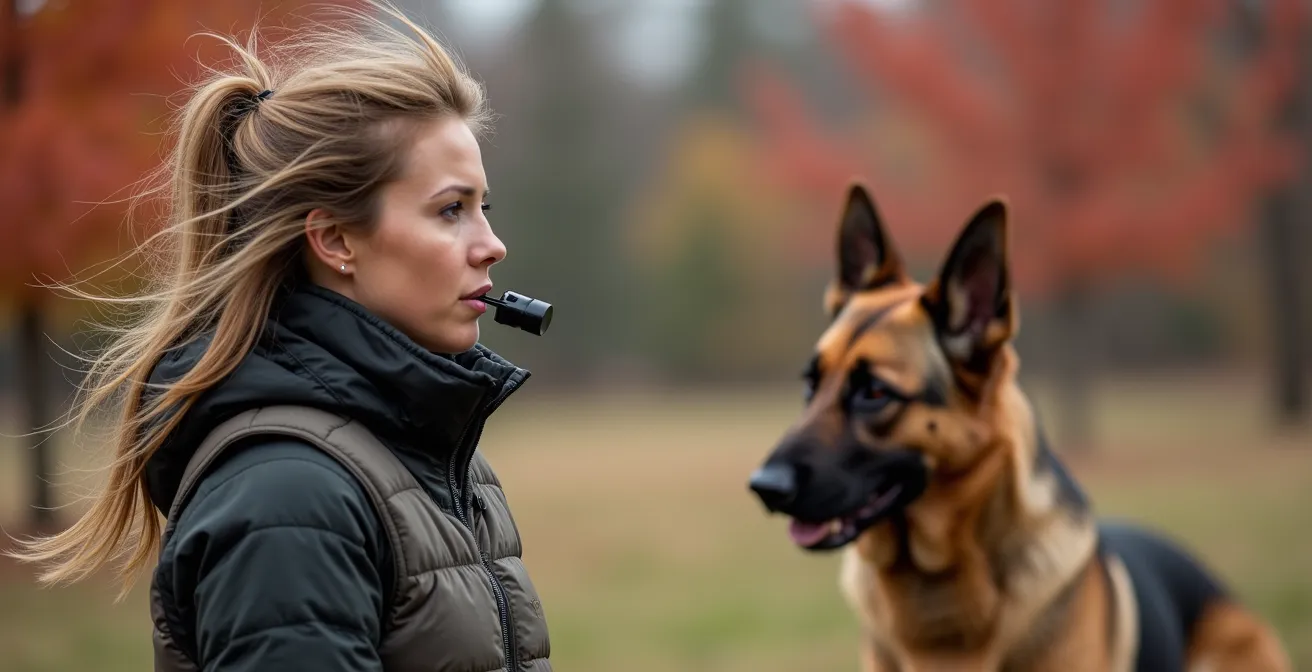
The physics are simple. A human voice struggles to cut through ambient noise and is easily scattered by wind. In contrast, as recommended by BC SPCA trainers, high-frequency whistles (like the Acme 211.5 model) produce a sound that travels farther and remains distinct against the rustle of leaves and city traffic. Your dog can hear this clear signal from a much greater distance, giving you a crucial advantage when every second counts.
Furthermore, a whistle cue is unique. Your dog hears their name and the word “come” dozens of times a day in various contexts. A specific whistle tone is used for one thing and one thing only: returning to you immediately for a high-value reward. This creates an unambiguous and powerful association. As professional dog trainer Saundra Clow states in the BC SPCA’s guide:
A whistle is a sound that carries well and will be consistent for your dog
– Saundra Clow, BC SPCA Emergency Recall Training Guide
By using a whistle, you are removing emotional interference and replacing it with a clear, long-distance signal. You are communicating like a specialist, using the right tool to overcome the environmental challenges of a blustery Canadian park.
The “Come” Mistake: Why Calling Your Dog for a Bath Ruins the Command
One of the most common and damaging mistakes owners make is “cue devaluation.” This happens when you predominantly use your recall command (“Come!”) for activities your dog dislikes, such as leaving the park, getting a bath, or having their nails trimmed. Your dog isn’t stupid; they quickly learn that “Come!” means the fun is over. The command becomes a signal for an undesirable outcome, and they begin to ignore it.
An effective recall must be associated with overwhelmingly positive experiences. To counteract cue devaluation, specialists employ a strategy often called the “10-for-1 Rule.” For every one time you use the recall to end an activity, you must use it at least ten times just for fun. You call your dog, give them a jackpot reward (a very high-value treat), praise them enthusiastically, and then immediately release them back to play with a cue like “Go play!”.
If your current recall cue is already “poisoned”—meaning it has a strong negative association—the best course of action is to start fresh. Choose a completely new word (“Here!”, “Close!”) or, even better, a unique whistle tone. You must then treat this new cue like gold, building its value from scratch with hundreds of positive repetitions before ever using it in a high-stakes situation.
Action Plan: Implementing the 10-for-1 Recall Rule
- Practice 10 “fun” recalls during a park visit where your dog is immediately released back to play.
- Call your dog using your positive recall cue, reward generously with a high-value treat, then excitedly say “Go play!” and let them return to their activity.
- Repeat this pattern throughout all your off-leash activities; recall should predict reward and continued freedom, not the end of fun.
- Only after establishing this strong positive history should you use the recall to leave the park, and even then, maintain the 10:1 ratio.
- Create a separate, neutral “end of fun” cue, like “Let’s go home” or “All done,” for departures, protecting the value of your emergency recall cue.
How to Train Voluntary Check-Ins Every 2 Minutes Without Asking?
The pinnacle of reliable off-leash behaviour isn’t a dog that comes back when called; it’s a dog that chooses to stay close and connected on their own. This is the concept of the voluntary check-in. Instead of constantly managing your dog with commands, you create a dog that reflexively looks back at you or returns to your side every couple of minutes, simply to ensure the team is still together. This habit is the ultimate safety net.

This behaviour isn’t magic; it’s the result of specific training. Research from the Absolute Dogs training methodology shows that dogs engaged in consistent, reward-based training develop a pattern of checking in voluntarily every 30 to 120 seconds. You can build this habit using “Pattern Games.” The idea is to make the environment, and you within it, more predictable and rewarding than any distraction.
A simple pattern game involves creating “check-in stations” on your regular routes. This could be a specific park bench, a large maple tree, or a fire hydrant. Every time you approach this landmark, you reward your dog for simply being near you. After a few repetitions, your dog will begin to anticipate the reward and actively seek you out at that spot. You are building a powerful habit of orientation towards you. Over time, the dog generalizes this behaviour, creating a “scalloping” pattern of movement where they run out, then automatically loop back to your position before heading out again. This proactive training is far more powerful than any reactive command.
Wood Fence or Electric Wire: Which Actually Stops Prey Drive?
For owners with yards, containment is the first line of defense. The debate between a physical fence (like wood or chain-link) and an “invisible” electric fence is common. However, from a prey drive perspective, the question is flawed. As the specialists at Journey Dog Training expertly put it:
Neither ‘stops’ prey drive. A physical fence contains the dog, while an invisible fence punishes the dog for acting on its drive
– Journey Dog Training, How To Control Dogs With High Prey Drive
This distinction is critical. A physical fence acts as a barrier, preventing the chase from ever beginning. It manages the environment. An invisible electric fence, on the other hand, allows the dog to see the squirrel, initiate the chase, and then delivers a painful shock as they cross the boundary. For a highly motivated dog, the adrenaline of the chase can be enough to make them endure the shock, run through the boundary, and then be unwilling to cross back in to receive another shock.
The Canadian climate adds another layer of complexity to this choice, affecting the reliability and maintenance of each system.
| Fence Type | Winter Performance | Prey Drive Effectiveness | Maintenance Needs |
|---|---|---|---|
| 6ft Wood Fence | Frost heave can create gaps | Physical barrier, but dogs can climb | Annual inspection for rot/gaps |
| Electric Wire | Can be buried by 30cm+ snow | Motivated dogs will take the shock | Battery changes in cold weather |
| Chain Link 6ft | Stable in all seasons | See-through increases frustration | Minimal, check for rust |
For containing a dog with a high prey drive, a solid, 6-foot physical fence is the only truly reliable option. While it requires maintenance to check for gaps caused by frost heave, it provides an unambiguous barrier that doesn’t rely on punishing an innate biological drive. An electric fence, particularly when its wire can be buried by deep snow, offers a false and potentially dangerous sense of security.
Why Do Bear Bells Often Fail to Deter Grizzlies from Dogs?
Venturing out of the city and into the trails of the Canadian Rockies or provincial parks introduces a far more dangerous form of wildlife: bears. A common but dangerously misguided piece of advice is to put a “bear bell” on your dog’s collar. The theory is that the tinkling sound will alert bears to your presence and scare them away. The reality is the opposite.
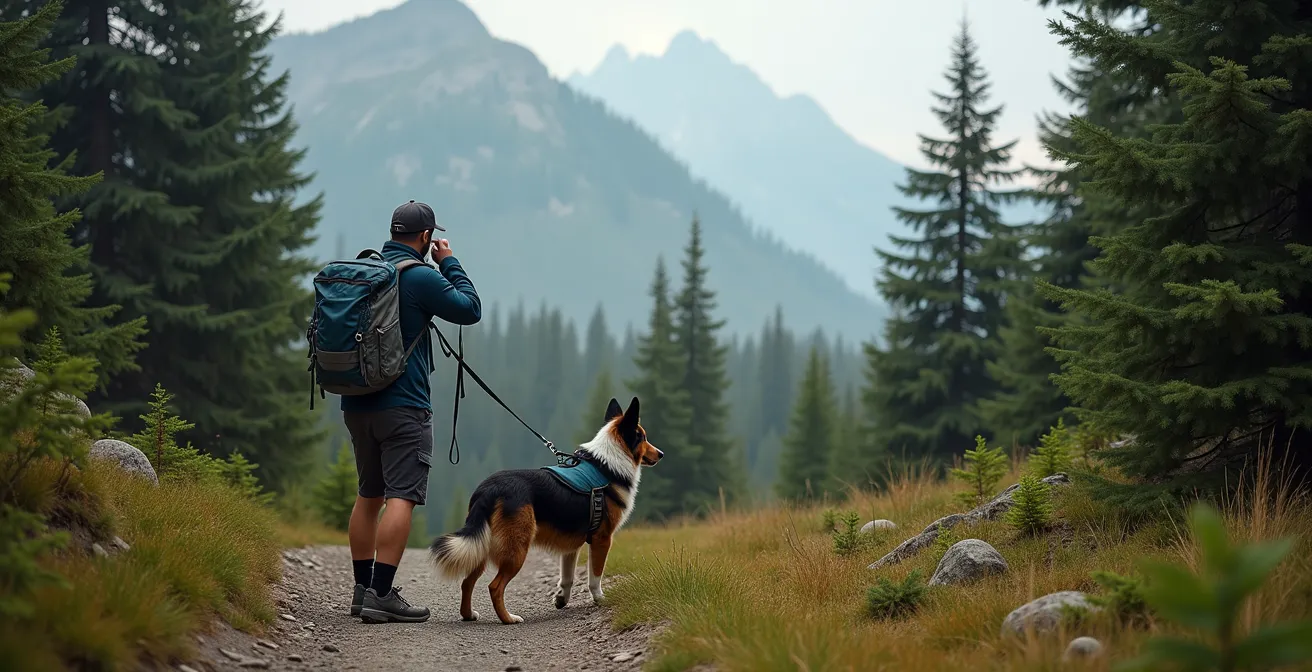
As Parks Canada, the foremost authority on Canadian wildlife safety, explicitly warns, the sound of a small bell is not something bears associate with humans. It’s a novel, quiet sound in the forest. In their official advisory, they note that curiosity is a common bear trait.
Bears do not associate the tinkling sound with humans and their curiosity may even be piqued
– Parks Canada, Bear Safety Advisory
Instead of deterring a bear, a bell might actually attract a curious one to investigate the source of the sound—leading it directly to you and your dog. The only sound proven to be an effective deterrent is the human voice, used loudly and clearly. Proper protocol in bear country is not about stealth or subtle warnings; it’s about making your presence known in an unambiguous way.
The BC SPCA outlines the correct procedure for dog owners in bear country, which prioritizes prevention and control:
- Keep dogs on-leash at all times in bear country. Off-leash dogs are the number one cause of negative human-bear encounters, often by provoking or chasing a bear and then running back to their owner with the bear in pursuit.
- Make noise with your voice by periodically yelling “Hey Bear!” while hiking. This identifies you as human.
- If you see a bear, do not let your dog bark at or chase it. Control your dog immediately.
- Back away slowly while facing the bear and keeping your dog close and calm.
- Never run, as this can trigger a chase instinct in both the bear and your dog.
Key Takeaways
- Recall training is about rewiring instinct, not offering a better bribe. It requires hundreds of positive repetitions.
- Your tools must be “environment-proofed” for Canadian weather; a Biothane long line and a high-frequency whistle are superior to nylon ropes and voice commands in wind and cold.
- A recall cue must be protected. Use a 10-to-1 ratio of “fun” recalls to “end of fun” recalls to preserve its positive association.
GPS Collar vs. Bluetooth Tag: Which Works in Canadian Wilderness?
Even with the best training, a determined dog with a high prey drive can disappear in seconds. For an urban owner, the fear is traffic. For an owner hiking in the vast Canadian wilderness, the fear is a dog lost in a million acres of forest. In this scenario, technology becomes your last line of defense, but choosing the wrong tech is as dangerous as having none at all.
The market is flooded with tracking devices, but they fall into two distinct categories: Bluetooth tags (like Apple AirTags) and true GPS collars (like those from Garmin or Tractive). A Bluetooth tag is a proximity device. It works by pinging a signal to a nearby phone in its network. This is effective in a dense urban area with thousands of phones. In a place like Algonquin Park, it is utterly useless as there is no cell network to relay its position.
A true GPS collar, conversely, communicates directly with satellites. It does not depend on a cellular network to find its location. This is the only technology that functions reliably in the backcountry. A coverage analysis of tracking technologies found that GPS collars maintain tracking ability in 95% of Canadian wilderness areas, compared to less than 5% for Bluetooth-based devices. The difference is stark, and in a lost-dog scenario, life-threatening.
| Feature | GPS Collar (Garmin/Tractive) | Bluetooth Tag (AirTag) |
|---|---|---|
| Range | Unlimited with satellite | 30-100ft without phone network |
| Works in Algonquin Park | Yes – satellite connection | No – no phone network |
| Battery at -20°C | 2-3 days with cold rating | Severely reduced |
| Waterproof Rating | IPX7 or higher available | IP67 standard |
| Monthly Cost | $10-15 satellite subscription | No subscription |
For any dog owner venturing outside of major urban centres in Canada, a Bluetooth tag provides a dangerously false sense of security. The investment in a true GPS collar with a satellite subscription is not a luxury; it is an essential piece of safety equipment. It is the only reliable answer to the question, “What if?”
Building a reliable recall is a journey of understanding, patience, and consistent application of the right techniques with the right tools. It’s about moving from a position of fear to one of confident control. The next step isn’t to hope for the best on your next park visit; it’s to start building your dog’s new, reflexive habit of safety, one positive repetition at a time. Begin implementing these strategies today to transform your dog’s recall and your peace of mind.