In summary:
- Passive supervision is not enough; you need a multi-layered defensive fortress combining environmental and personal protection.
- Visual deterrents like reflective tape must be rotated dynamically to exploit predator psychology and prevent habituation.
- Protective vests with puncture-resistant materials like Kevlar offer active armoring that can be the difference between life and death.
- Creating a netted, weather-proof “sky-kennel” provides a secure zone for unsupervised potty breaks, especially during high-risk twilight hours.
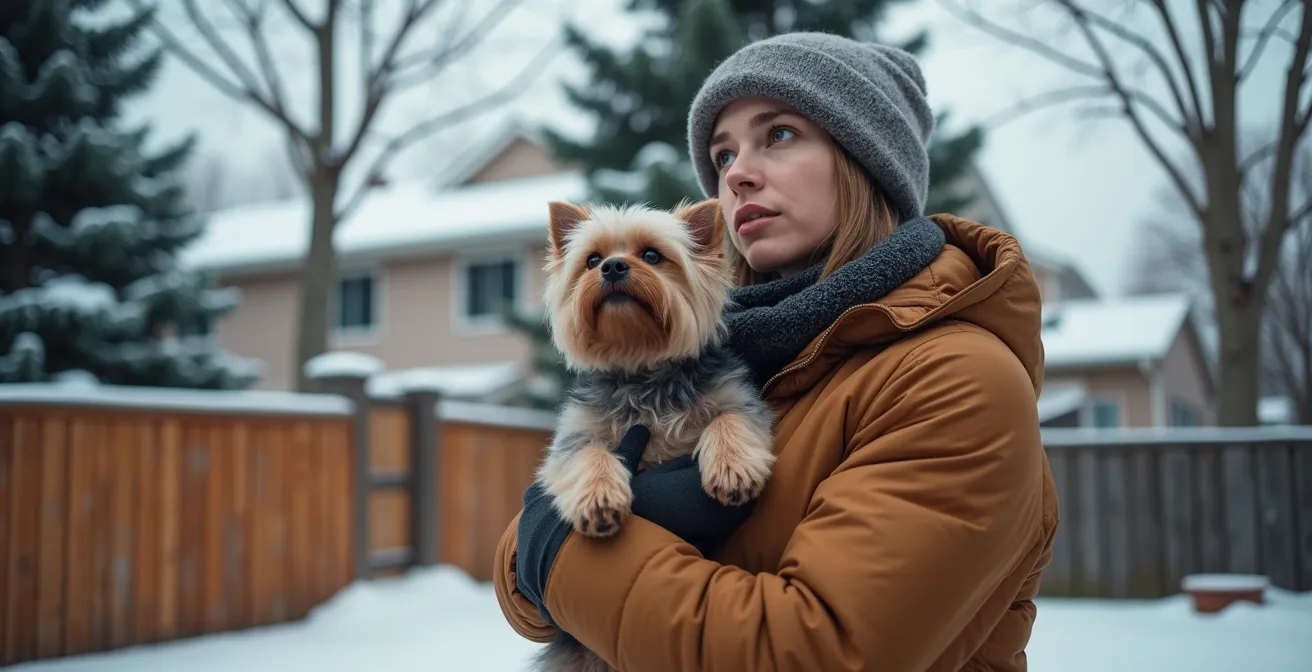
The chilling sight of a hawk circling overhead is a primal fear for any owner of a small dog in suburban Canada. You know the standard advice: “never leave them unattended,” “keep them on a leash.” But these passive measures often feel inadequate against the silent, swift reality of an aerial predator. What happens in that split second when you turn to grab the mail? This fear forces many to limit their pets’ freedom, turning the backyard from a playground into a source of anxiety.
Most online tips focus on simple scare tactics—hanging old CDs or making loud noises. While not entirely useless, these are flimsy single-points-of-failure against a determined hunter. The truth is that relying on one-off tricks is a gamble. A raptor’s hunting strategy is far more sophisticated than we give it credit for, and our defense must be too. The key isn’t just to scare a hawk away once, but to make your pet and your property fundamentally unattractive and difficult targets.
This guide moves beyond the platitudes. We will build a comprehensive defensive fortress for your small dog. The strategy is based on a professional, layered approach: first, understanding the predator’s mindset to counter it; second, hardening your environment with physical and psychological barriers; and third, actively armoring your pet for the worst-case scenario. This system is designed not just to react to threats, but to proactively manage risk, giving you peace of mind and your dog its freedom back.
This article will detail each layer of this defensive system, providing practical, Canadian-specific advice. From the science behind deterrents to the engineering of a winter-proof enclosure, you will learn how to construct a robust shield against aerial attacks.
Summary: A Layered Defence Strategy Against Canadian Raptors
- Why Are Great Horned Owls Targeting Pets in Residential Neighborhoods?
- Why Do Birds Still Get Caught Even If Your Cat Wears a Bell?
- How to Use Reflective Tape and Decoys to Scare Off Hawks?
- How to Net Your Chicken Run to Prevent Aerial Attacks Effectively?
- How to Insulate a Rabbit Hutch for -20°C Weather Safely?
- Coyote Vest or Leash: Which is More Reliable Against an Eagle Strike?
- Coyote Vest or Leash: Which is More Reliable Against an Eagle Strike?
- The Twilight Risk: Why Small Pets Should Never Be Out Alone at Sunset
Why Are Great Horned Owls Targeting Pets in Residential Neighborhoods?
The unsettling increase in pet attacks in suburban areas isn’t random; it’s a result of habitat overlap and predator pressure. As Canadian cities expand, they encroach on the natural territories of powerful raptors like the Great Horned Owl. These birds are not malicious; they are opportunistic hunters adapting to a changing landscape. A small, bustling dog can be mistaken for their typical prey, such as a rabbit or squirrel. This is especially true in communities where natural food sources may be dwindling.
The Great Horned Owl is a formidable predator. While a common misconception is that they can carry away heavy animals, their danger lies in their attack itself. They can easily injure or kill a dog weighing 10-15 pounds on the ground. The presence of these birds in urban settings is well-documented. For instance, as noted by Jocelyn Thrasher-Haug, Manager of Environment Planning for Strathcona County, “We have been aware of several owls in the urban area within Sherwood Park. For a number of years we’ve been watching them. Great horned owls are the most common,” which is supported by a CBC report on urban owl encounters.
Furthermore, broader ecological trends play a role. According to Environment Canada data, the Great Horned Owl population has seen a 50% decline since 1970, now estimated at around 830,000 individuals. While this may sound counterintuitive, a decline can increase competition for resources, making an easy meal in a backyard more tempting. Understanding this isn’t about vilifying the owls, but about recognizing the seriousness and predictability of the risk. Your backyard is a shared ecosystem, and building your defensive fortress starts with acknowledging the capabilities of its wild inhabitants.
This reality check forms the foundation of our strategy: we must assume a threat exists and build our defenses accordingly.
Why Do Birds Still Get Caught Even If Your Cat Wears a Bell?
A common but dangerously flawed piece of advice is to put a bell on a pet’s collar to warn prey—or, in this case, to scare away predators. This logic fundamentally misunderstands the predator psychology of a raptor. Hawks, owls, and eagles are primarily visual hunters. They rely on their incredibly sharp eyesight to spot movement from hundreds, if not thousands, of feet in the air. By the time a faint jingle reaches them, it’s far too late.
The sheer speed of an attack renders auditory warnings useless. Research shows that hawks can swoop in at a 120 miles per hour dive speed, a velocity that makes a bell’s tinkle completely irrelevant. The predator has already locked onto its target and committed to the attack long before it’s within hearing range. As one study on the subject highlights, passive deterrents like bells are often ineffective because individual predators can become familiar with a pet’s habits, learning to ignore such predictable sounds. The core issue is that hawks hunt by sight, making auditory signals a weak and unreliable layer of defense.
This is where the concept of visual disruption becomes paramount. Instead of trying to be heard, the goal is to be seen in a way that is confusing or alarming to the bird. As a wildlife management expert cited in the Wag Walking Pet Safety Guide explains:
Hawks rely on their eyesight for hunting, and a sudden flash of light from a reflective surface will put them off and scare them away.
– Wildlife Management Expert, Wag Walking Pet Safety Guide
This principle is the cornerstone of effective environmental hardening. We must shift our strategy from sound to sight, from passive warning to active visual disruption. The failure of the bell theory teaches us a vital lesson: to protect our pets, we must think like a predator and exploit their biological traits, not our human assumptions.
Therefore, the first active layer of our defensive fortress will focus on manipulating what the hawk sees.
How to Use Reflective Tape and Decoys to Scare Off Hawks?
Now that we understand hawks are visual hunters, we can weaponize this knowledge through “environmental hardening.” The goal is to make your yard a visually confusing and unsettling place for a circling raptor. Reflective tape, scare-eye balloons, and decoys are the tools for this, but their effectiveness hinges on a key principle: dynamic placement. A static deterrent is a dead deterrent; predators are smart enough to recognize a threat that never moves.
Reflective tape works by catching sunlight and creating unpredictable flashes of light that startle and disorient a hawk on its approach. For maximum effect, install strips of tape 6-7 feet above the ground on fences, tree branches, or poles around the perimeter of your yard. The movement and flashing mimic a warning signal the hawk cannot easily process. However, you must rotate their positions every few days, especially during nesting season in the spring, to prevent habituation. An owl decoy can be similarly effective, but only if it’s perceived as a real threat. Place it on a prominent perch like a rooftop and move it every 3-4 days.
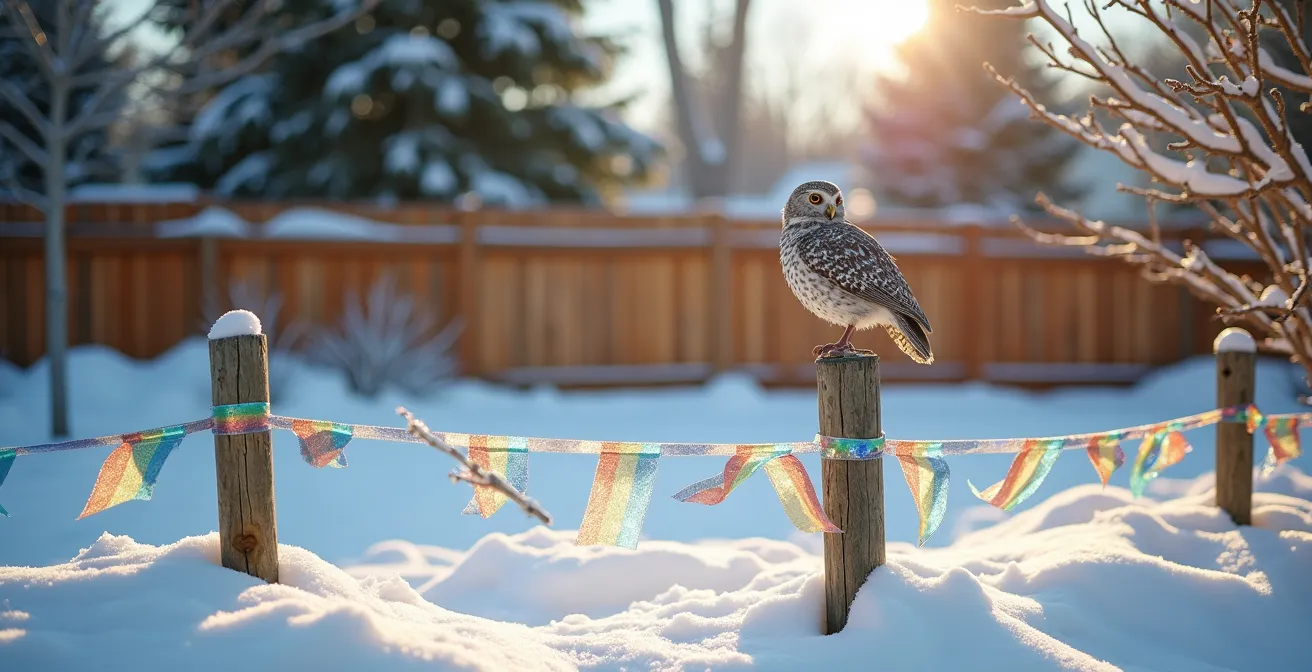
The effectiveness of these tools varies by predator and condition, making a combined approach the most robust. In the Canadian context, weather resistance is a crucial factor. The following table provides a clear comparison of common deterrents against Canadian raptors.
| Deterrent Type | Red-tailed Hawks | Great Horned Owls | Weather Resistance |
|---|---|---|---|
| Reflective Tape | Highly Effective (daytime) | Not Effective (nocturnal) | Withstands -30°C and snow |
| Owl Decoys | Moderately Effective | Not Effective | Requires securing in wind |
| Ultrasonic Devices | Moderately Effective | Effective | Battery life reduced in cold |
As the data shows, reflective tape is a powerful daytime tool against hawks and holds up in extreme cold, but it’s useless against a nocturnal Great Horned Owl. This is why a layered defense system is critical. Combining visual deterrents for daytime with ultrasonic repellents for twilight and night hours creates a 24/7 shield. Remember to replace tape after heavy snow or ice storms to ensure its reflectivity isn’t compromised.
While environmental deterrents form an excellent first line of defense, they are not foolproof. The next layer of protection involves creating an impenetrable physical barrier.
How to Net Your Chicken Run to Prevent Aerial Attacks Effectively?
While the title mentions a chicken run, the principle applies directly to creating a secure, netted enclosure—or “sky-kennel”—for your small dog. This is the ultimate form of environmental hardening, creating a physical barrier that makes an attack impossible. This is not about caging your pet, but about providing a guaranteed safe zone for them to enjoy the outdoors, especially for quick potty breaks when constant supervision might lapse. In the Canadian climate, building such a structure requires specific engineering to handle snow and ice.
The key is to use materials rated for heavy winter conditions. Opt for a strong wire mesh or heavy-duty netting designed to support snow loads of up to 40 pounds per square foot. The design of the roof is equally critical. A flat roof will collapse under wet snow. Instead, construct an A-frame or pitched roof with a minimum 30-degree angle to allow snow to shed naturally. Support posts should be installed every 8 feet to ensure structural integrity against both heavy snow and strong winds.
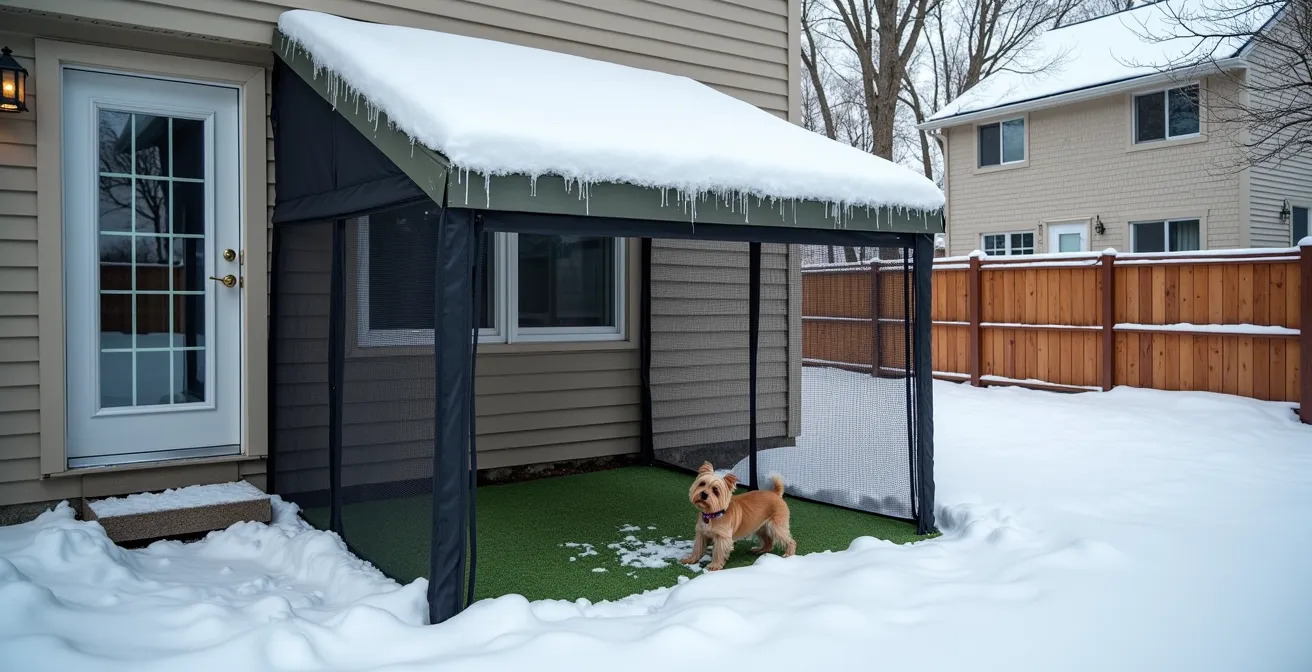
Material choice is also vital for longevity in a country where road salt is prevalent. Choose galvanized or powder-coated metals for all hardware and posts to prevent rust and corrosion. A well-designed sky-kennel can also include practical features for year-round use, such as removable panels. These allow for easier snow removal from inside the enclosure if needed and can be taken off in the summer to improve ventilation. This structure represents a permanent and reliable layer in your defensive fortress, offering total peace of mind.
With the environment secured, the next logical step is to turn our attention to protecting the animal itself, applying similar principles of layered defense directly to your pet.
How to Insulate a Rabbit Hutch for -20°C Weather Safely?
At first glance, insulating a rabbit hutch seems unrelated to protecting a Yorkie from a hawk. However, the underlying concept—what we can call the “Hutch Principle”—is directly relevant to the next layer of our defensive fortress: active armoring. A hutch protects a stationary prey animal from the elements and ground predators through layered construction. It uses insulation like non-toxic styrofoam for thermal protection and a hard outer shell for weather resistance. We can apply this exact thinking to protective pet gear.
Just as a hutch has different layers for different functions, a high-quality protective vest for a dog is not just a single piece of fabric. It is an engineered system. The outer shell, often made of durable Cordura fabric, provides the first layer of defense against weather and minor abrasions. Beneath that lies the critical component: puncture-resistant material. This is where the analogy to a hutch’s hard walls becomes clear.
The most effective vests use advanced materials to serve this protective function. Understanding how these materials compare is crucial for making an informed choice, especially for the harsh Canadian climate.
| Material | Hutch Application | Pet Vest Application | Canadian Winter Performance |
|---|---|---|---|
| Non-toxic Styrofoam | Wall insulation R-value 4-5 | Not applicable | Maintains effectiveness to -40°C |
| Kevlar Layers | Not applicable | Puncture resistance | Remains flexible in cold |
| Cordura Fabric | Weather covering | Outer shell protection | Water/snow resistant |
This table illustrates the point perfectly. While styrofoam insulates a static hutch, Kevlar provides puncture resistance for a mobile animal, and it crucially remains flexible even in extreme cold. The “Hutch Principle” teaches us to think of a protective vest not as clothing, but as a wearable, multi-layered shelter designed to withstand a direct assault. It is a piece of personal protective equipment (PPE) for your pet.
With this principle in mind, we can now assess the real-world reliability of such vests against a predator’s strike.
Coyote Vest or Leash: Which is More Reliable Against an Eagle Strike?
A leash offers control, but it offers zero protection against the instantaneous, violent force of a raptor strike. An eagle or a large hawk attacks with its talons, which are designed to puncture and crush. A standard leash and harness do nothing to mitigate this. This is where the concept of “active armoring” through a protective vest becomes the only reliable option when a pet is exposed. A leash restrains, but a vest defends.
The most effective vests are not just brightly colored jackets; they are engineered with ballistic-grade materials. The CoyoteVest, for example, is a well-known brand that has pioneered this space. It is built on the “Hutch Principle” of layered defense. The core of its protection is a material that a simple harness could never offer. CoyoteVest’s HawkShield testing demonstrates that its triple-layer Kevlar protection is rated to withstand immense pressure, providing a barrier that a raptor’s talons cannot easily penetrate. This smooth, stab-resistant fabric is designed to deflect the force of an attack, turning a potentially lethal blow into a failed attempt.
This approach transforms your pet from a soft, easy target into a difficult, unappealing one. A predator’s attack is a calculation of energy spent versus reward. When a hawk’s initial strike is met with an unexpectedly tough and impenetrable surface, it disrupts the attack sequence. This moment of confusion and failure is often enough to make the predator abandon the attempt and seek an easier meal. A leash only tethers a target; a vest makes the target itself a fortress.
The theoretical protection offered by materials like Kevlar is impressive, but the ultimate test is its performance in real-world encounters.
Coyote Vest or Leash: Which is More Reliable Against an Eagle Strike?
While the technical specifications of a protective vest are crucial, its real-world reliability is proven by the experiences of pet owners. In the debate between a vest and a leash, the evidence from the field is overwhelmingly in favor of the vest as the more reliable defense against a sudden aerial attack. A leash is a tool of prevention through proximity, but it is helpless during an actual strike. A vest, however, is a tool of active, continuous defense that functions independently of human reaction time.
The design of many modern vests incorporates both puncture resistance and visual deterrence. The Vlkaviva Dog Deterrent Vest, for example, features prominent spikes along the back. This design borrows from nature’s own defensive strategies, like those of a porcupine. It presents a clear visual signal to a predator that this is not easy prey. This visual deterrent is often enough to stop an attack before it even begins.
Canadian Pet Owner Reviews of Protective Vests
The Vlkaviva Dog Deterrent Vest offers spike protection and high visibility, making it an effective deterrent against coyotes, hawks, and owls. Canadian pet owners report that hawks have swooped down, taken one look at the spikes, and immediately changed direction without attempting an attack.
This testimony is powerful. It demonstrates that the vest works on two levels of predator psychology: it creates doubt on a visual assessment, and it promises a painful and difficult struggle if the attack proceeds. A leash offers none of this. It cannot prevent the initial impact and may even contribute to injury by tethering the dog during a struggle. Therefore, for true reliability against a sudden strike, a well-engineered protective vest is unequivocally the superior choice. It is the final layer of personal armor in your dog’s defensive fortress.
Even with the best environmental and personal protection, one final element of the defensive strategy remains: managing time and behavior.
Key Takeaways
- Raptors like the Great Horned Owl hunt by sight and at incredible speed, making auditory deterrents like bells completely ineffective.
- A successful defense is a layered “fortress”: harden your yard with dynamic visual deterrents, create a secure physical barrier with netting, and armor your pet with a protective vest.
- In Canada, all defensive measures must be chosen for their resilience to extreme cold, snow, and wind to remain effective year-round.
The Twilight Risk: Why Small Pets Should Never Be Out Alone at Sunset
The final, and perhaps most critical, layer of your defensive fortress is not a physical object, but a behavioral one: understanding and respecting the twilight risk. Many raptors, particularly the formidable Great Horned Owl, are crepuscular hunters. This means they are most active during the low-light hours of dawn and dusk. For a pet owner, these are the highest-risk periods of the day. Letting a small dog out unsupervised during these times, even in a fenced yard, is a significant gamble.
The power of these predators is staggering. Great Horned Owls, most active at dawn and dusk, possess a talon clutching force of up to 500 PSI, comparable to the bite of a large guard dog. This immense power means an attack is instantaneous and devastating. Your personal supervision, combined with all the other layers of defense, is most crucial during these specific windows. The changing seasons in Canada directly impact these high-risk times, making a seasonal schedule essential for vigilant pet owners.
By understanding the predator’s schedule, you can adapt your own. This proactive time management is the intelligent culmination of our defensive strategy. It ensures that even with the best physical protections in place, you are adding the unbeatable layer of active, informed supervision when it matters most.
Your Canadian Seasonal Twilight Safety Schedule
- Winter (Dec-Feb): High risk is concentrated between 4:30 PM – 5:30 PM and 7:00 AM – 8:00 AM.
- Spring (Mar-May): As days lengthen, the risk shifts to 6:30 PM – 8:00 PM and 5:30 AM – 7:00 AM.
- Summer (Jun-Aug): Longest days mean the danger zone is late, from 8:00 PM – 9:30 PM and very early, from 4:30 AM – 6:00 AM.
- Fall (Sep-Nov): As light fades, the risk moves earlier again, to 6:00 PM – 7:30 PM and 6:00 AM – 7:30 AM.
- Year-Round Rule: Always use bright outdoor lighting for the last potty break of the night, regardless of the season.
Building a complete defensive fortress for your pet is an active process. It requires understanding the threat, hardening your environment, armoring your pet, and adapting your behavior. By implementing this multi-layered system, you can confidently and safely restore your small dog’s freedom to enjoy its own backyard.