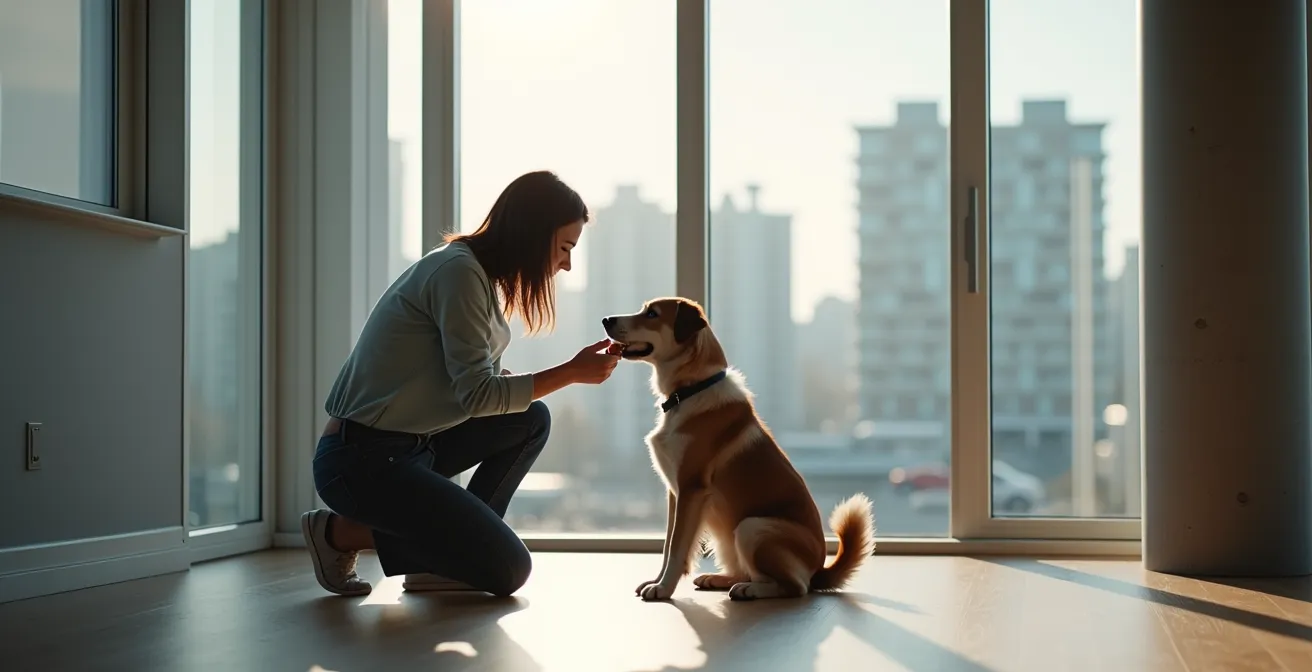
The constant fear of a noise complaint isn’t solved by silencing your dog, but by understanding their overwhelming sensory world.
- Your dog hears high-frequency sounds from elevators and chargers that you can’t, causing what seems like “unexplained” reactivity.
- Shouting back actually reinforces the barking; your dog perceives it as you joining their “alarm system.”
Recommendation: Shift from punishment to environmental management. Start by diagnosing your condo’s unique sound triggers and creating an “acoustic moat” for your dog.
The thin walls of a Toronto high-rise or a Vancouver condo complex can feel like they’re closing in when you have a dog that barks. Every ding of the elevator, every footstep in the hall, brings a fresh wave of anxiety. You’ve probably received “the notice” or at least a few pointed glares from neighbours. The common advice—”exercise them more” or “just get a bark collar”—feels hollow because it ignores the reality of your living situation. It treats the symptom, the bark, without ever diagnosing the cause.
This cycle of barking, complaints, and stress creates a tense environment for both you and your dog. But what if the problem isn’t a “bad dog,” but a dog with a sensory system on overdrive? The key to resolving nuisance barking in a condo isn’t about achieving perfect silence through force. It’s about becoming an architect of your dog’s environment. It’s about understanding the concept of trigger stacking—where small, seemingly insignificant sounds accumulate until your dog’s sensory budget is depleted, forcing them to react.
This guide moves beyond simplistic solutions. We will explore the hidden acoustic triggers in your building, design strategies to create a sensory buffer, and implement training protocols that address the root emotional cause of the barking. We will shift the focus from punishing the bark to preventing the need for it. By the end, you’ll have a concrete, defensible plan to present to your condo board and, more importantly, a path toward a quieter, more peaceful life with your canine companion.
This article provides a step-by-step plan for urban dog owners facing this exact challenge. Below, you will find a summary of the key strategies we’ll cover to transform your dog’s reactivity and restore peace in your home.
Summary: A Behaviorist’s Plan for Condo Barking
- Why Does Your Dog React to Elevator Sounds You Can’t Even Hear?
- How to Layer Soundscapes to Mask Hallway Triggers Effectively?
- Anti-Bark Collars or Desensitization: Which Solves the Root Cause?
- The “Shouting Back” Error: Why Yelling at Your Dog Increases Barking
- How to Teach “Quiet” by First Teaching “Speak”?
- Airline Kennel or Wire Crate: Which Reduces Visual Stimulation Better?
- The “Guilty Look” Myth: Why Your Dog Isn’t Actually Sorry for Peeling the Couch
- How to Conduct a “Sniffari” Walk in a Busy Neighborhood?
Why Does Your Dog React to Elevator Sounds You Can’t Even Hear?
Before you can address the barking, you must first understand what your dog is hearing. The human ear is surprisingly limited. While we perceive sounds in a certain range, your dog is living in a much wider, more detailed acoustic world. Comprehensive research on canine hearing abilities shows that dogs can hear frequencies between 67-45,000 Hz, while humans are typically capped at 23,000 Hz. This isn’t just a fun fact; it’s the fundamental reason your dog seems to bark at “nothing.”
That “nothing” is often a high-frequency sound that is completely inaudible to you. The whine of an elevator motor, the buzz of a neighbour’s phone charger through the wall, or the ultrasonic components in an Enterphone system are all potential triggers. In a dense condo building, your dog is bombarded by a constant stream of these signals. This phenomenon, known as trigger stacking, is where multiple minor stressors accumulate until the dog’s threshold for tolerance is breached, resulting in an explosive bout of barking.
Your first step as an urban canine behaviorist is to become an environmental detective. You must perform an environmental diagnosis to identify these hidden triggers. This involves systematically checking your home and the immediate vicinity for sources of high-frequency noise that could be contributing to your dog’s sensory overload. Only by identifying the true source of the problem can you begin to build an effective management plan.
Understanding this sensory mismatch is the first step toward empathy. Your dog isn’t being “bad”; they are simply reacting to a reality you can’t perceive. Your job is to help them navigate it.
How to Layer Soundscapes to Mask Hallway Triggers Effectively?
Once you’ve identified the potential sound triggers, the next step is to create an “acoustic moat” around your dog’s primary living space. You can’t eliminate the sounds of your neighbours or the building’s mechanics, but you can control the acoustic environment within your own unit. The goal is to layer different types of sounds and physical barriers to dampen or mask the sharp, sudden noises from the hallway that often trigger alert barking.
This strategy involves more than just turning on the radio. It requires a thoughtful combination of sound absorption and sound masking. Sound absorption involves using soft materials to reduce echo and prevent sound from bouncing around your unit. This includes area rugs (especially on concrete or laminate floors), heavy curtains, and even strategically placed bookshelves filled with books against shared walls. Sound masking, on the other hand, uses a consistent, broad-spectrum sound to make triggering noises less perceptible. A white noise machine is the gold standard here, as its consistent hum can effectively cover up the “ding” of an elevator or the click of a neighbour’s door.
The placement of these elements is critical. Position the white noise machine between your dog’s resting area and the source of the noise (usually the front door). Think of it as creating a buffer of gentle, predictable sound. This acoustic layering helps to manage your dog’s sensory budget, preventing the constant barrage of external noises from causing a state of hyper-vigilance.

As you can see in this setup, decorative acoustic panels can also be a stylish and effective addition. Placed on walls shared with hallways or neighbours, they absorb sound waves before they can become a problem. This multi-pronged approach transforms your condo from a source of stress into a predictable, calming sanctuary for your dog.
By actively managing the soundscape, you’re not just stopping barking; you’re proactively creating an environment where your dog feels secure enough that they don’t feel the need to bark in the first place.
Anti-Bark Collars or Desensitization: Which Solves the Root Cause?
When facing a noise complaint, the temptation to reach for a quick fix like an anti-bark collar is strong. These devices, which deliver a spray, vibration, or static shock, are marketed as an easy solution. However, from a behavioral perspective, they are a deeply flawed approach. Aversive tools punish the symptom (the bark) without addressing the underlying emotional cause, which is often fear, anxiety, or over-stimulation. This can lead to a dangerous phenomenon called “fallout,” where the dog suppresses the bark but the anxiety manifests in other ways, such as destructive behaviour, aggression, or learned helplessness.
The far more effective and humane approach is desensitization and counter-conditioning (DSCC). This is a scientific, systematic process of changing your dog’s emotional response to a trigger. Desensitization involves exposing your dog to a trigger (e.g., the sound of the elevator) at such a low intensity that they don’t react. Counter-conditioning involves pairing that low-level trigger with something the dog loves (like a high-value treat). Over time, the dog’s association with the sound changes from “That’s scary!” to “That sound predicts something wonderful is about to happen!”
This method empowers the dog and builds their confidence, rather than simply suppressing a behaviour out of fear. It is a core tenet of modern, ethical training, as emphasized by leading Canadian trainers. As Bark Busters Canada explains in their official philosophy:
Bark Busters uses dog-friendly methods based on how dogs communicate with each other, avoiding harsh punishment while focusing on praise and guidance to the correct behaviour
– Bark Busters Canada, Bark Busters Canada Official Training Philosophy
This approach is not only more effective in the long run, but it also provides you with a defensible, structured plan to show your condo board. A detailed log of your DSCC sessions, as outlined by training experts like Emily Larlham of Dogmantics in her protocols for solving barking at noises, demonstrates your proactive commitment to resolving the issue responsibly.
By investing in desensitization, you’re not just stopping a bark; you’re healing the anxiety that causes it, leading to a calmer, more resilient dog.
The “Shouting Back” Error: Why Yelling at Your Dog Increases Barking
In a moment of frustration, when your dog erupts in a frenzy of barking at the door, the most natural human reaction is to yell “No!”, “Stop!”, or “Quiet!”. It feels like you’re correcting the behaviour, but from your dog’s perspective, you’re doing the exact opposite. To a dog, you’re not reprimanding them; you’re simply joining in on the alarm. You’ve become part of the barking chorus.
This creates a powerful and counterproductive feedback loop. Your dog, in a state of high arousal, perceives your loud, intense vocalizations as confirmation that there is indeed something to be alarmed about. You are, in effect, validating their anxiety and escalating the situation. Telling your dog off can make them more anxious or confused, which can encourage them to bark even more. For some dogs, your shouting is even interpreted as a form of social participation—a fun, noisy game. In either case, the outcome is the same: more barking, not less.
The solution is to do the opposite of what your instincts scream at you to do. Instead of adding energy to the situation, you must calmly remove it. A far more effective strategy is a “pattern interrupt.” This involves making a calm, unexpected sound (like a quiet “oops” or a soft clap) just as your dog is about to bark. The goal is not to startle them, but to gently break their focus on the trigger and redirect their attention to you. Once you have their attention, you can ask for an alternative, calm behaviour, like “sit” or “go to your mat.” This approach has been shown to be incredibly effective; in fact, recent training methodology studies demonstrate that one such technique reduced barking episodes by 80% within just a few days.
By changing your own behaviour from reactive to proactive, you model the calm response you want to see in your dog, effectively becoming the thermostat for your home’s emotional climate, not just another thermometer.
How to Teach “Quiet” by First Teaching “Speak”?
It sounds counterintuitive, but one of the most effective ways to teach a dog the “Quiet” command is to first teach them to “Speak” on cue. This method works because it’s nearly impossible to teach a dog the “off switch” for a behaviour if you can’t first turn that behaviour “on” reliably. By putting the bark itself under your control, you can then clearly define its opposite: silence.
The process starts by capturing the bark. Find a trigger that reliably elicits a single bark (like a knock on the door). The moment your dog barks, mark the behaviour with a “Yes!” and give them a treat. After a few repetitions, add the cue “Speak” just before you present the trigger. Soon, your dog will associate the word “Speak” with the act of barking. For condo living, it’s crucial to be considerate: practice in short sessions during low-impact times, like mid-afternoon on a weekday, and aim to capture quiet “huffs” or “boofs” instead of full-throated barks to start.
Once “Speak” is reliable, you can introduce “Quiet.” Ask for a “Speak.” After one bark, present a very high-value treat in front of your dog’s nose. They will have to stop barking to sniff and eat the treat. In that moment of silence, say “Quiet” and give them the treat. The sequence is: “Speak” -> Bark -> “Quiet” -> Silence -> Treat. Over time, you can extend the duration of the silence before rewarding. This teaches your dog that barking gets a small reward, but being quiet after being asked gets a fantastic one.

Using a clear hand signal, like the one shown, alongside the verbal cue helps your dog learn faster. This structured protocol is not only effective but also provides excellent evidence for a condo board, demonstrating a committed, methodical approach to solving the noise issue. Creating a training binder with video clips of your progress can be an invaluable tool in these discussions.
By teaching both commands, you transform barking from an uncontrollable reaction into a behaviour you can manage and direct, giving both you and your dog a clear language for communication.
Airline Kennel or Wire Crate: Which Reduces Visual Stimulation Better?
A crate should be a dog’s safe haven—a den where they can relax, free from the pressures of the outside world. In a visually busy condo environment, where movement in the hallway or shadows under the door can be a trigger, choosing the right type of crate is a critical part of your management plan. The two most common options, a wire crate and a plastic airline-style kennel, serve very different functions in managing sensory input.
For the specific challenge of reducing visual and auditory stimulation in a Canadian condo, the airline kennel is unequivocally superior. Its solid, opaque walls create an immediate visual barrier, blocking out the sight of passing feet, flickering lights, or other hallway activity that can provoke barking. This enclosed design also provides a significant degree of sound dampening, muffling the sharp, triggering noises that travel so easily through modern buildings. For dogs sensitive to visual triggers, this enclosed space can dramatically reduce their need to be “on guard.”
A wire crate, by contrast, offers virtually no visual or acoustic barrier. While some owners use a blanket to cover a wire crate, this can be a safety hazard if the dog pulls the fabric inside, and it rarely provides the same sense of security as a solid-walled kennel. The open design of a wire crate leaves the dog fully exposed to the sensory information of the room. The following comparison breaks down the key differences for a condo setting.
| Feature | Airline Kennel | Wire Crate |
|---|---|---|
| Sound Dampening | Superior – plastic walls absorb sound | Poor – sound passes through |
| Visual Blocking | Excellent – solid walls | Requires additional cover |
| Winter Heating Retention | Better insulation for Canadian winters | Poor heat retention |
| Placement Flexibility | Best away from party walls | Needs strategic positioning |
| Ventilation Control | Good with proper vent placement | Maximum airflow |
Ultimately, by providing a true sanctuary like an airline kennel, you give your dog the ability to “turn off” the environment and decompress, a vital need for any dog living in the constant sensory stimulation of a city high-rise.
The “Guilty Look” Myth: Why Your Dog Isn’t Actually Sorry for Peeling the Couch
One of the most common misinterpretations in the human-dog relationship is the “guilty look.” You come home to a shredded cushion or a scratched door, and your dog averts their gaze, lowers their head, and tucks their tail. It’s easy to project human emotions onto this posture and assume they “know they did something wrong.” However, behavioural science tells a different story. That look isn’t guilt; it’s appeasement. It’s a response to *your* anger and disappointment, not a reflection on their past actions.
Dogs are masters of reading our body language and tone. The “guilty” posture is a collection of calming signals—behaviours designed to de-escalate a tense social situation. They are essentially saying, “I see you are upset, and I would like to avoid conflict.” This is a crucial distinction, because if you believe your dog is feeling guilty, you might believe punishment is an effective teacher. It isn’t. Punishing a dog hours after an infraction is useless, as they cannot connect the punishment to the past act.
This misinterpretation is especially dangerous in cases of anxiety-based behaviours, like barking. What you perceive as guilt might actually be signs of acute stress. For instance, dogs experiencing distress from ultrasonic sounds may walk with their tail between their legs, show jaw tension, and pin their ears back—the very signs we often label as guilt. By learning to read your dog’s body language accurately, you can shift from reacting to their “bad” behaviour to proactively identifying their discomfort *before* it escalates. The key is to watch for the subtle pre-barking cues.
Action Plan: Pre-Barking Body Language Audit
- Watch for stiff body posture indicating alertness and focus on a trigger.
- Notice ‘whale eye’ (when the whites of the eyes are visible) signaling anxiety.
- Check for forward-pricked ears that are locked onto a specific sound source.
- Observe for slight trembling or muscle tension in the body and legs.
- Look for a sudden “freezing” behaviour right before the vocalization begins.
When you can spot these early warning signs, you can intervene with a calming technique or a redirection, preventing the bark before it even starts. This is the essence of proactive, empathetic dog ownership.
Key takeaways
- Your dog’s hearing is a superpower, not a flaw. Identify ultrasonic triggers in your building to understand the root cause of reactivity.
- Layering sound (white noise, music) and physical barriers (rugs, furniture) creates an “acoustic moat” that effectively dampens hallway triggers.
- Desensitization training solves the root emotional cause of barking by changing your dog’s feelings about a trigger; punishment collars often worsen anxiety.
How to Conduct a “Sniffari” Walk in a Busy Neighborhood?
In a bustling urban environment like Toronto or Vancouver, we often think of walks as purely physical exercise—a brisk march around the block to “tire the dog out.” But this approach completely misses the most important function of a walk for a dog: mental decompression. A “sniffari” (a portmanteau of “sniff” and “safari”) reframes the walk’s purpose. It is a walk where the dog is in charge of the pace and direction, and their primary goal is to explore the world through their nose.
A dog’s sense of smell is their primary sense, and allowing them to engage it fully is as draining and satisfying as a full-out run. This mental exercise is crucial for managing a dog’s sensory budget. As veterinary behaviorists confirm, dogs with adequate physical and mental exercise are far more likely to rest quietly when left alone. A 20-minute sniffari, where your dog is allowed to deeply investigate every scent on a patch of grass, can be more tiring than a 40-minute forced-pace walk.
Conducting a sniffari in a busy neighbourhood requires a shift in mindset and some practical adaptations, especially during harsh Canadian winters. It means seeking out quiet pockets of sensory interest. This could be an industrial area after 6 PM, a quiet university campus on a Sunday morning, or even a covered parkade for some indoor sniffing on a rainy day. Using a long line (15-30 feet, where bylaws permit, like in some Toronto ravines) gives your dog the freedom to explore without you hovering. Remember to protect their paws with balm against salted sidewalks and use reflective gear for visibility on dark winter mornings.
- Apply a quality paw balm before and after walks on salted sidewalks.
- Use high-visibility reflective gear, easily found at stores like Canadian Tire, for dark winter mornings and evenings.
- Find indoor or covered “sniff spots” like pet-friendly hardware stores or underground parking garages during poor weather.
- Explore quiet university campuses or office parks on weekends for low-traffic exploration.
- Use a 15-30 foot long line in designated off-leash friendly areas or during off-peak hours to give your dog freedom to explore scents.
- Document these enrichment walks—duration and location—as part of your management plan for your condo board.
To effectively advocate for you and your dog, start documenting your management and training plan today. A detailed log is your most powerful tool when communicating with your condo board.