
Contrary to common belief, preventing feline diabetes isn’t just about feeding less; it’s about resetting your cat’s metabolism by changing the hormonal signals their food and activity send to their body.
- A high-protein, low-carbohydrate diet is critical for managing blood sugar, as it aligns with a cat’s natural physiology as an obligate carnivore.
- Structured, high-intensity play that mimics hunting is far more effective at boosting metabolism than infrequent, low-energy activity.
Recommendation: Shift your focus from simple calorie restriction to precise “energy accounting” by calculating your cat’s specific daily needs and providing both physical and mental enrichment to burn that energy effectively.
As a feline internal medicine specialist, I see a concerning trend in urban pets, especially those living in condos: a slow, silent metabolic decline that puts them on a direct path to type 2 diabetes. Many well-intentioned owners in Canada notice their indoor cat is gaining weight, but they often resort to the two most common pieces of advice: “feed them less” and “make them play more.” While not entirely wrong, this advice is dangerously simplistic. It overlooks the fundamental biology of a feline and the subtle environmental cues that govern their metabolism.
The truth is, a cat is not a small dog. Their body is that of an obligate carnivore, designed to process protein and fat for energy, not carbohydrates. When their diet and lifestyle deviate from this blueprint, their hormonal signalling goes haywire. Insulin resistance begins to build, fat accumulates, and the pancreas works overtime. This is the pre-diabetic state, and it is largely reversible. However, reversing it requires a more sophisticated approach than simply cutting portion sizes, which can even be dangerous.
This guide will not rehash generic tips. Instead, we will delve into the science of the feline metabolic reset. We’ll explore why seasonal changes affect your cat’s weight, how to accurately assess their body condition, and why the *type* of food and play matters more than the quantity. By understanding the “why” behind the “how,” you can make precise, effective changes to pull your companion back from the brink of a chronic, life-altering disease.
This article will guide you through a proactive strategy, from identifying seasonal risks to implementing specific dietary and activity plans. Discover the science-backed steps you can take today to safeguard your cat’s long-term health.
Summary: A Vet’s Guide to Reversing Early Metabolic Damage
- Why Do Canadian Pets Gain 10% More Weight Between November and March?
- How to Measure Your Cat’s Body Condition Score Accurately at Home?
- High Protein or High Fiber: Which Diet Best Regulates Metabolism?
- The Fatty Liver Risk: Why Starving a Fat Cat Can Be Fatal in 48 Hours
- How to Boost Your Cat’s Metabolism with 15 Minutes of Interval Training?
- Why Does 15 Minutes of Brain Games Equal 1 Hour of Walking?
- How to Calculate Exactly How Many Calories Your Cat Needs (Not What the Bag Says)?
- Does Your Condo Cat Really Need High-Protein “Ancestral” Kibble?
Why Do Canadian Pets Gain 10% More Weight Between November and March?
If you’ve noticed your indoor cat seems to pack on a few extra ounces during the colder, darker months, you’re not imagining it. This phenomenon, often called seasonal weight gain, is a significant factor for pets in Canada. It’s a physiological holdover from their ancestors, an instinct to bulk up for a winter that, for a condo cat, never truly involves scarcity. Their internal clock tells them to eat more and conserve energy, leading to a dangerous metabolic downshift when their environment is providing abundant food and limited opportunity for activity.
The hormonal drive to eat increases, even when caloric needs are decreasing due to less activity. In fact, research has shown that cats may naturally increase their food intake during winter. One study highlighted that this can result in 15% more calories consumed during winter months. For an indoor cat whose environment doesn’t demand this extra energy, this surplus is stored directly as fat. This fat isn’t benign; it’s metabolically active tissue that secretes inflammatory hormones and contributes directly to insulin resistance, the precursor to diabetes.
Understanding this seasonal trigger is the first step in proactive management. It means being extra vigilant with portion control and enrichment from November to March. It’s not about fighting your cat’s instincts but about managing their modern environment to prevent those instincts from leading to disease. This period of heightened risk is precisely when a structured plan for diet and activity becomes most critical.
How to Measure Your Cat’s Body Condition Score Accurately at Home?
The bathroom scale can be misleading. A cat’s weight in pounds or kilograms doesn’t tell the whole story, as it fails to distinguish between lean muscle and harmful fat. The most reliable tool for a pet owner is the Body Condition Score (BCS). This is a tactile, hands-on assessment that veterinary professionals use to gauge a cat’s level of fat reserves. Learning to perform this check at home allows you to catch subtle changes in body composition long before they become a major health crisis. It’s your best early-warning system for metabolic trouble.
The BCS is typically measured on a 9-point scale, where a score of 5 is ideal, 1 is emaciated, and 9 is severely obese. The goal is to feel your cat’s ribs with only a slight fat covering, see a clear waistline when viewed from above, and observe an abdominal tuck from the side. You are not just looking; you are feeling for key anatomical landmarks.
To help you perform this vital check, the illustration below demonstrates the correct hand placement for palpating the ribcage. This technique is the cornerstone of an accurate BCS assessment.
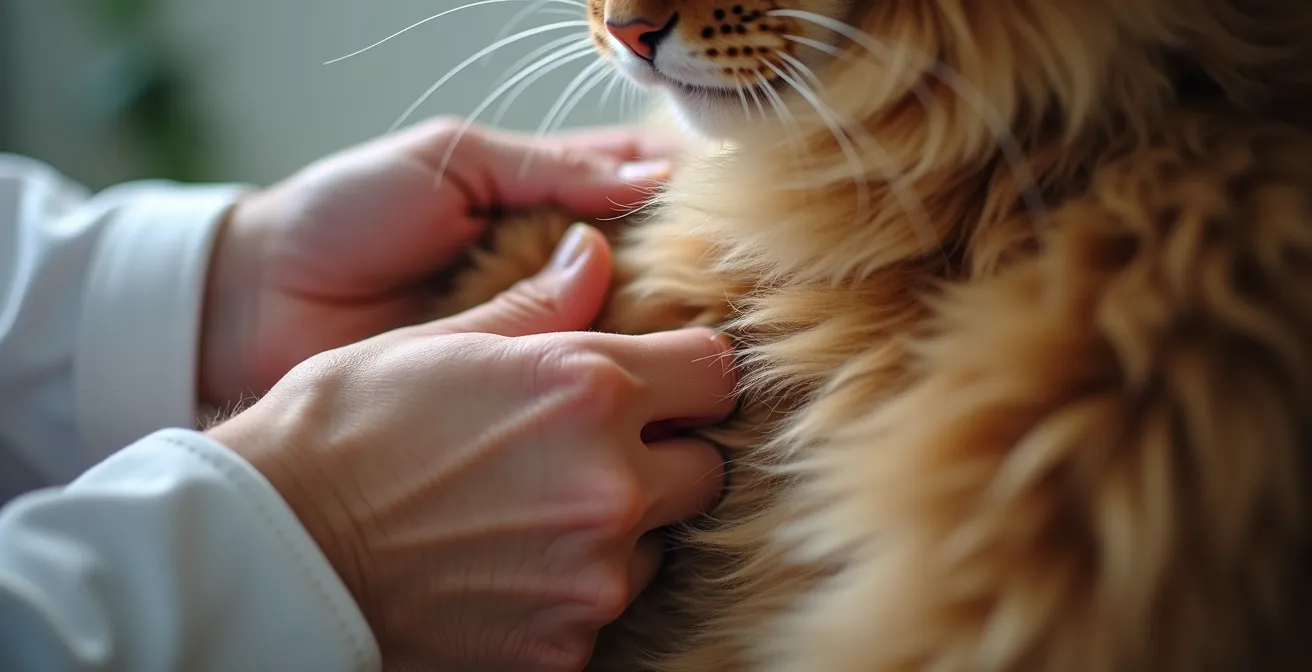
As you can see, the pressure should be gentle but firm, similar to feeling the bones on the back of your hand. If the ribs feel like the knuckles of your clenched fist, the cat is too thin. If you cannot feel them at all without pressing hard, there is too much fat coverage. Regularly performing this check will empower you to track progress and make informed decisions.
Action Plan: Your Home Body Condition Score Audit
- Top-Down View: Have your cat stand and look down at them from above. Can you see an “hourglass” figure or a visible waistline just behind the ribcage?
- Rib Palpation: Gently run your hands along both sides of your cat’s chest. You should be able to easily feel individual ribs with a slight pressure, without them feeling sharp.
- Spine and Hip Check: Run your hand along their spine and over their hips. The bones should be palpable under a thin layer of fat but should not be sharp or protruding.
- Side View Assessment: Look at your cat from the side. The abdomen should tuck up from the ribs to the hind legs, not hang straight down or bulge outwards.
- Assign a Score: Using the 1-9 scale (with 5 being ideal), give your cat an honest score. This number is your baseline for tracking metabolic health.
High Protein or High Fiber: Which Diet Best Regulates Metabolism?
The pet food aisle presents a confusing choice: should an overweight cat be on a high-protein diet to build muscle or a high-fiber diet to feel full? From a metabolic standpoint, the answer is clear. Cats are obligate carnivores. Their entire system is optimized to derive energy from protein and fat through a process called gluconeogenesis. Carbohydrates, the main ingredient in many commercial dry foods, are poorly metabolized and lead to rapid blood sugar spikes and subsequent fat storage. This is why obese cats are up to four times more likely to develop diabetes; their bodies are in a constant state of fighting off a carbohydrate overload.
A high-protein, low-carbohydrate diet is the cornerstone of preventing and managing feline diabetes. Protein provides the essential amino acids needed to maintain lean muscle mass, which is metabolically active and helps burn calories. Crucially, protein has a minimal impact on blood sugar levels, preventing the insulin spikes that drive fat storage. While fiber can help with satiety (the feeling of fullness) and slow glucose absorption, it should not be the primary strategy. A diet overloaded with fiber at the expense of protein can lead to muscle loss, which ultimately lowers a cat’s overall metabolic rate.
This table breaks down the metabolic impact of these key dietary components, based on current veterinary nutritional science.
| Diet Component | High Protein | High Fiber | Impact on Metabolism |
|---|---|---|---|
| Primary Benefit | Maintains muscle mass | Increases satiety | Both support weight management |
| Blood Sugar Control | Minimal glucose spike | Slows glucose absorption | Protein slightly superior |
| Caloric Density | Higher calories/gram | Lower calories/gram | Fiber aids calorie restriction |
| Recommended % | 40-45% dry matter | 10-15% dry matter | Balance is key |
The ideal diet, therefore, is not about choosing one over the other but about prioritizing protein. Look for foods where a high-quality animal protein source is the first ingredient and the carbohydrate content is minimized. This approach provides the correct hormonal signalling to your cat’s body, promoting stable blood sugar and the utilization of fat for energy.
The Fatty Liver Risk: Why Starving a Fat Cat Can Be Fatal in 48 Hours
After identifying that their cat is overweight, many owners make a critical, and potentially fatal, mistake: they drastically cut food intake or switch to a new diet too quickly. When an overweight cat’s body senses starvation (which can happen after just 24-48 hours of not eating), it begins to mobilize large amounts of fat from its reserves to the liver to be converted into energy. A cat’s liver, however, is not equipped to handle this massive influx. The fat overwhelms the liver cells, leading to a life-threatening condition called hepatic lipidosis, or fatty liver disease.
This condition causes acute liver failure, characterized by jaundice (yellowing of the skin and eyes), severe lethargy, and vomiting. It is a medical emergency that requires intensive and expensive veterinary intervention, and it is often fatal. This is why you must never, under any circumstances, “starve” a cat into losing weight. Any diet change, especially for a cat who is a picky eater, must be done gradually and with careful monitoring.
The key is a slow, controlled metabolic adjustment. The goal is to create a small caloric deficit that encourages the body to use fat stores gradually, without triggering a panic response. In my clinical practice, I advise that safe and sustainable weight loss should ideally be gradual at 0.5-1% of body weight per week. For a 15-pound cat, that’s a loss of only 1-2.5 ounces per week. It may seem slow, but it’s the only way to ensure the weight being lost is fat, not muscle, and that the liver remains healthy.
It is absolutely essential to recognize the warning signs of hepatic lipidosis, as immediate action can save your cat’s life. Here are the red flag symptoms:
- Complete loss of appetite lasting more than 24-48 hours
- Yellowing of the eyes, ears, or gums (jaundice)
- Extreme lethargy and weakness
- Vomiting with inability to keep food down
- Drooling or signs of nausea
How to Boost Your Cat’s Metabolism with 15 Minutes of Interval Training?
For a sedentary indoor cat, simply leaving toys on the floor is not exercise. To have a meaningful metabolic impact, activity must tap into their innate predatory drive. A cat’s natural hunting behavior isn’t a steady-state jog; it’s a sequence of stalking, waiting, and then explosive, short bursts of energy to make a “kill.” This is, in essence, high-intensity interval training (HIIT), and it’s far more effective at boosting metabolism than prolonged, low-level activity. This is what I call simulated hunting.
Fifteen minutes of structured, interactive play that mimics this hunt-catch-kill sequence can do more to reset your cat’s metabolism than an hour of half-hearted batting at a stationary toy. The goal is to get their heart rate up and engage their muscles in powerful movements. This type of play not only burns calories during the session but also increases their resting metabolic rate for hours afterward. It triggers the release of hormones that favor muscle maintenance and fat burning.
The Cornell University College of Veterinary Medicine reinforces this concept, emphasizing structured play as a primary tool for diabetes prevention.
Case Study: The Power of Simulated Hunting
Research from Cornell’s Feline Health Center highlights that maintaining a healthy weight through physical activity is the single most important action an owner can take to reduce diabetes risk. Their work shows that even sedentary indoor cats can significantly improve insulin sensitivity when owners engage them in structured play sessions. The key is using toys like feather wands or laser pointers to simulate the movements of prey, encouraging a cycle of stalking, chasing, and pouncing that fulfills their natural predatory instincts and provides significant metabolic benefits.
The image below captures the athletic intensity of a cat engaged in this type of high-energy, simulated hunt, a far cry from passive play.

To implement this, schedule two 7-10 minute sessions per day, perhaps before meals to tap into their natural pre-meal hunting drive. Use a wand toy to make it dart, hide, and flutter like a bird or skitter like a mouse. The key is to make the cat run, jump, and pounce. Always end the session by letting them “catch” the toy, followed by a small, high-protein treat to complete the satisfying predatory cycle.
Why Does 15 Minutes of Brain Games Equal 1 Hour of Walking?
When we discuss “energy accounting,” we often focus solely on physical calorie burning. This is a mistake. The brain is an incredibly energy-hungry organ. For a bored indoor cat, mental stimulation—or enrichment—is not just a cure for behavioral problems; it’s a legitimate way to burn calories and reduce stress. The concentration and problem-solving required for a “brain game” can be just as tiring, and thus as metabolically significant, as a session of physical play. While the “1 hour of walking” comparison is more applicable to dogs, the principle holds true for felines: cognitive effort is work.
Food puzzle toys are the easiest way to implement this. Instead of feeding your cat from a bowl, you make them work for their meal. This simple change achieves several critical goals simultaneously. First, it slows down their eating, which improves digestion and allows their brain’s satiety signals to register, preventing overeating. Second, the mental effort of figuring out the puzzle burns calories. Third, it provides a crucial outlet for their foraging and problem-solving instincts, reducing the stress and boredom that can lead to comfort-eating.
Even short bursts of mental engagement add up. A combination of physical play and mental challenges is the ideal strategy to keep your cat’s metabolic engine running. You don’t need expensive toys to get started; many effective brain games can be made from items you already have at home.
Here are a few simple, DIY brain games to turn mealtime into a metabolic workout:
- The Muffin Tin Game: Place a few kibbles in each cup of a muffin tin and cover them with toys or tennis balls that your cat has to move to get the food.
- Cardboard Box Challenge: Create a simple maze by taping together a few cardboard boxes with holes cut between them, hiding treats or kibble inside.
- Toilet Paper Roll Puzzle: Take an empty toilet paper roll, place some treats inside, and fold the ends to create a simple puzzle feeder.
- Paper Bag Foraging: Crumple up a few paper bags (with handles removed) and hide kibble inside for your cat to find.
How to Calculate Exactly How Many Calories Your Cat Needs (Not What the Bag Says)?
The feeding guidelines printed on pet food bags are a notorious contributor to feline obesity. They are, at best, a generic starting point, calculated for active, intact animals. They fail to account for the reality of your specific cat: an indoor, spayed or neutered companion living a relatively sedentary life in a condo. To truly manage their health, you must move from these vague suggestions to a precise system of energy accounting. This begins by calculating your cat’s Resting Energy Requirement (RER).
The RER is the number of calories a body needs to perform basic functions at rest, such as breathing and digestion. The formula is: RER (in kcal/day) = 70 x (your cat’s ideal body weight in kg)^0.75. For a more straightforward calculation, you can use a simplified formula: RER = 30 x (ideal body weight in kg) + 70. For example, a cat with an ideal weight of 5 kg (11 lbs) would have an RER of approximately 220 kcal/day.
This RER is then adjusted by a multiplier based on their life stage and activity level. For a typical neutered, indoor adult cat, this multiplier is 1.2. So, our 5 kg cat’s daily caloric need would be 220 x 1.2 = 264 kcal. For weight loss, the target is often set at 0.8 to 1.0 times RER. This precise number, not the scoop size recommended on the bag, should be your daily target. The general guideline is that adult cats typically need about 25-35 calories per pound of body weight, but calculating the RER is far more accurate.
Once you know the target number of calories, you must read the food label to see how many kcal are in each cup or can. Then, you can measure out the exact portion with a kitchen scale for accuracy. This methodical approach removes all guesswork and ensures you are creating the slight, consistent caloric deficit required for safe weight loss and long-term maintenance.
Key Takeaways
- Metabolic health is not about weight alone; it’s about body composition. Use the Body Condition Score (BCS) for accurate at-home assessment.
- A high-protein, low-carbohydrate diet is non-negotiable as it aligns with a cat’s obligate carnivore biology and helps stabilize blood sugar.
- A metabolic reset requires a holistic approach: a precise diet, high-intensity “simulated hunting” play, and cognitive enrichment through puzzle feeders.
Does Your Condo Cat Really Need High-Protein “Ancestral” Kibble?
The marketing for “ancestral” or “wild” diets is compelling. It paints a picture of your domestic cat as a miniature tiger, deserving of a diet mimicking what it would eat in the wild. While this marketing correctly identifies the importance of a high-protein, low-carbohydrate diet, it often misses a crucial piece of the puzzle: the massive difference in energy expenditure. Your condo cat is not patrolling a multi-kilometer territory hunting for every meal. Their lifestyle is profoundly sedentary compared to their wild ancestors.
This disconnect is highlighted in Canadian research. A landmark study from the Ontario Veterinary College at the University of Guelph emphasizes that the marketing claims behind many commercial diets overlook the vastly different energy requirements of modern indoor cats. Feeding a highly calorie-dense “ancestral” diet without accounting for a sedentary lifestyle can ironically accelerate weight gain and metabolic disease. The protein is right, but the energy density is often far too high.
This is where nuance becomes critical. As Dr. Thomas Graves of the University of Illinois College of Veterinary Medicine notes, the evidence supports a specific nutritional profile, not necessarily a brand’s marketing story.
There are some commonly held beliefs, based on a handful of clinical studies, that support the use of low-carbohydrate diets in helping diabetic cats control their blood sugar better.
– Dr. Thomas Graves, University of Illinois College of Veterinary Medicine
The takeaway is not to dismiss high-protein foods but to be a discerning consumer. The solution is to pair the correct nutritional philosophy (high protein, low carb) with the correct energy accounting. Choose a food that fits the nutritional profile, but then diligently apply your cat’s calculated RER to determine the precise portion. The “ancestral” label is irrelevant; the nutritional facts panel and your measuring cup are what truly matter for your cat’s metabolic health.
By shifting your perspective from generic advice to a precise, science-backed metabolic strategy, you can effectively intervene. The next logical step is to consult with your veterinarian to formulate a specific diet and activity plan tailored to your cat’s individual needs and get them started on the path to a healthier, longer life.