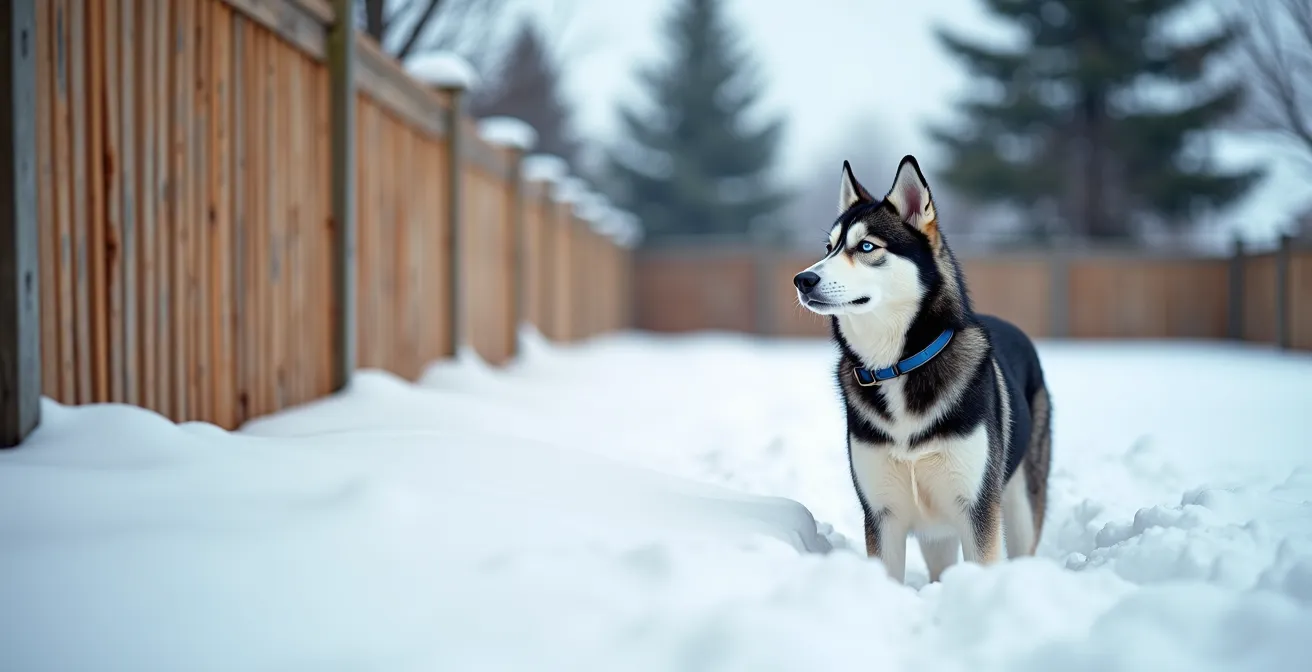
Your Husky isn’t just jumping the fence; it’s exploiting a compromised security system where the Canadian winter is its primary tool.
- Snow accumulation effectively lowers your fence height, creating an escape ramp.
- The freeze-thaw cycle (frost heave) warps posts and gates, creating structural weak points.
Recommendation: Shift your mindset from ‘dog-proofing’ to ‘perimeter security’. You must engineer a system that actively neutralizes environmental threats, not just contains a pet.
As a containment specialist, I’ve seen it all, especially in the harsh climates of Quebec and Alberta. A frantic call in the middle of February from a Husky owner is a seasonal guarantee. They’ve built a six-foot fence, trained their dog, and done everything “by the book,” yet their clever escape artist is roaming the neighbourhood again. The mistake is always the same: they secured their yard against their dog, but not against the Canadian winter. When four-foot snow banks pile up, your six-foot fence becomes a two-foot hurdle.
The common advice—build a taller fence or supervise your dog—is inadequate. It fails to address the core issue. Your Husky’s greatest accomplice is the environment itself. The snow becomes a ladder, the frozen ground compromises your fence’s foundation, and the increased presence of winter wildlife triggers a prey drive that no amount of basic training can overcome. This isn’t just about a stubborn dog; it’s a systemic failure of perimeter security.
The solution requires a contractor’s mindset. We don’t just patch holes; we analyze threat vectors and reinforce the entire system against every potential point of failure. This guide is built on that principle. We will deconstruct your fence system piece by piece—from the latch mechanism compromised by frost to the very boards that become a climbing wall—and provide engineered solutions to secure your perimeter, no matter how much snow falls.
This article provides a systematic approach to fortifying your enclosure. We will cover the specific vulnerabilities created by winter and detail the professional-grade solutions required to defeat them, ensuring your Husky remains safe and secure all year round.
Summary: A Contractor’s Guide to Winter Fence Security
- Why Do Gate Latches Misalign in February and Let Dogs Out?
- How to DIY Coyote Rollers to Prevent Climbing Escapes?
- Wood Fence or Electric Wire: Which Actually Stops Prey Drive?
- The Ladder Effect: Why Horizontal Fence Boards Are a Gift to Escaping Dogs
- How to Install an L-Footer to Stop Dogs Digging Under the Fence?
- Hardware Cloth or Chicken Wire: Which Actually Stops a Raccoon?
- Why Does Cheese Fail When a Squirrel Runs By?
- How to DIY Coyote Rollers to Prevent Climbing Escapes?
Why Do Gate Latches Misalign in February and Let Dogs Out?
The first point of failure in any fence system is almost always its weakest mechanical component: the gate latch. In a Canadian winter, the root cause isn’t a faulty latch but a compromised foundation. The phenomenon is known as frost heave, and it’s the invisible force turning your secure gate into an open door. As water in the soil freezes and expands, it exerts immense upward pressure on fence posts.
This isn’t a minor shift. According to fence maintenance experts, the freeze-thaw cycle can cause up to 6 inches of vertical movement in improperly set fence posts. When the post holding your gate and the post holding your latch move at different rates—or one moves and the other doesn’t—the perfectly aligned latch you installed in the fall is now off by a critical inch or more. A smart dog, especially a Husky, will test the gate daily. The moment that misalignment creates a gap, they will apply pressure and exploit the weakness.
To a security contractor, this is a predictable system failure. Standard post depths that work in milder climates are insufficient here. Posts for gates, which bear more mechanical stress, must be sunk below the regional frost line (often 4 feet or deeper in many parts of Canada) and set in concrete with a bell-shaped base to resist the upward pressure. Without this foundational integrity, your gate latch is a ticking time bomb, set to fail with the first deep freeze.
How to DIY Coyote Rollers to Prevent Climbing Escapes?
Once snow banks provide a launchpad, the top of your fence becomes the final barrier. An athletic dog like a Husky can easily get its paws over the top of a four or five-foot fence. The solution is to make the top rail impossible to grip. This is where a coyote roller system comes in. It’s a simple but brilliant mechanical deterrent: a length of pipe is mounted on a wire or rod along the top of the fence, designed to spin freely. When a dog attempts to get a purchase, the roller spins, and they slide right off.
While commercial kits are available, a DIY approach can be highly effective and budget-friendly, a key consideration for securing long fence lines. The core components are simple: PVC pipe, heavy-gauge galvanized steel wire, and mounting brackets. The system’s effectiveness relies on minimizing friction so the pipe spins at the slightest touch.
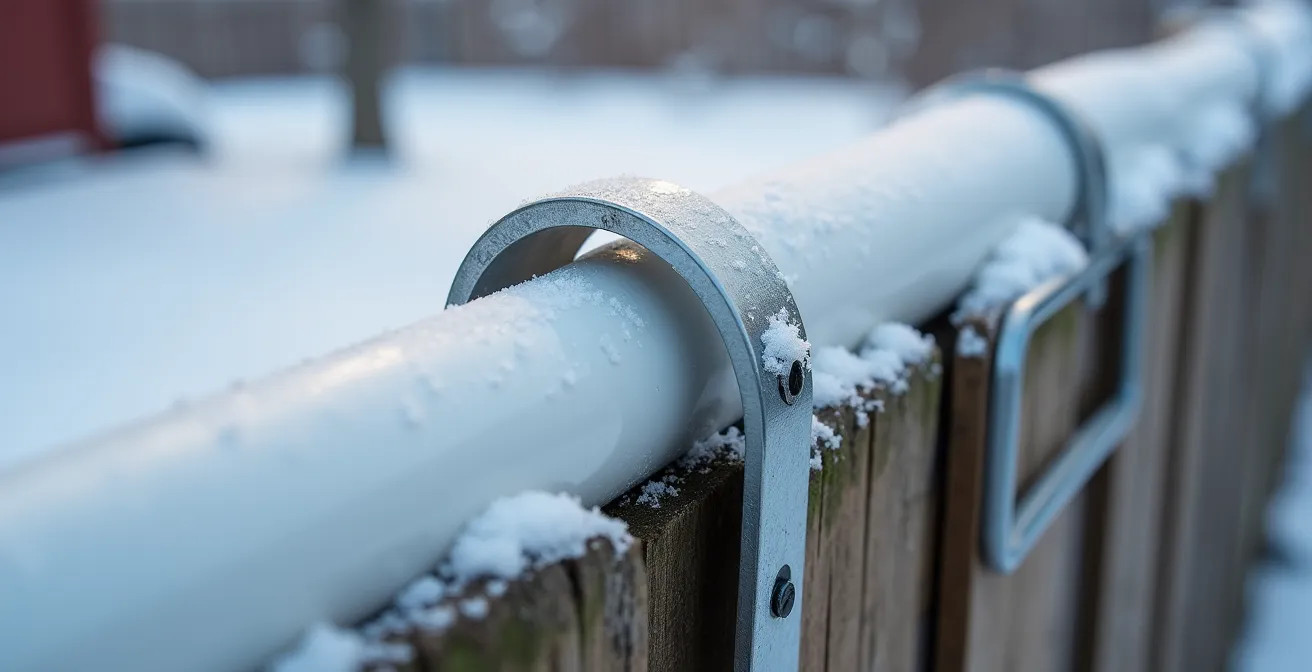
For Canadian owners, a cost-benefit analysis is crucial. A DIY system provides robust security for a fraction of the cost of commercial options, though it requires an investment of time. The following table breaks down the typical costs and materials, demonstrating the clear financial advantage of a well-executed DIY project.
| Option | Cost (CAD) | Materials | Time |
|---|---|---|---|
| DIY Coyote Roller | $150-250 | PVC pipe, steel wire, L-brackets | Weekend project |
| Commercial Kit | $1,168-1,500 | Aluminum rollers, professional brackets | 2-3 hours install |
The data, sourced from a comparative analysis of roller components, shows that investing a weekend in a DIY installation yields significant savings without compromising the effectiveness of the anti-climb barrier.
Wood Fence or Electric Wire: Which Actually Stops Prey Drive?
When dealing with a high-prey-drive breed like a Husky, the debate between a physical barrier and a psychological one (like an electric fence) is critical. A Husky is not just a dog; it’s a world-class athlete. In fact, research on Husky athletic abilities shows they possess a remarkable 4-6 feet vertical jump capability from a standstill. When that athleticism is fueled by the instinct to chase a squirrel or a rabbit, pain becomes a secondary concern.
An electric fence delivers a shock—a negative stimulus. For many dogs, this is enough. But for a Husky in the throes of prey drive, the adrenaline and instinctual reward of the chase can easily override the discomfort of the shock. They will often breach the wire, accept the momentary pain, and then be unwilling to cross back into the yard to receive another shock. This turns your containment system into a one-way gate to freedom.
A physical barrier works on a different principle: frustration, not pain. A tall, solid fence removes the trigger itself. If the dog cannot see the squirrel, the chase instinct is less likely to engage at a high intensity. This was the exact solution found by dog owners in Alberta, who were struggling with their two escape-artist Huskies, Achilles and Maximus. They successfully contained them only after upgrading from a 4-foot fence to a 6-foot solid wood privacy fence. This change eliminated the visual triggers from wildlife, effectively disarming the prey drive that had motivated all previous escape attempts.
The Ladder Effect: Why Horizontal Fence Boards Are a Gift to an Escaping Dog
Modern fence design often favors aesthetics over security, and the popular horizontal board fence is a prime example of this failure. From a containment specialist’s perspective, this design is a structural liability. Each horizontal board acts as a rung on a ladder, providing perfect footholds for a clever and agile dog to scale the fence. When you add a snow bank to the base, you’ve effectively given your Husky a step-stool to the first rung of their escape ladder.
Siberians can crawl through microscopic holes, scale five-foot fences with a ballerina’s grace, break tie-out chains and slip collars so skillfully even Houdini would be amazed.
– Delaware Valley Siberian Husky Rescue, Official rescue organization statement
This “Houdini”-like ability, as described by rescue organizations, means we must view our fences through the dog’s eyes. The “ladder effect” is a critical vulnerability. If you already have a horizontal fence, replacing it is not always feasible. The solution lies in retrofitting the interior face to remove these footholds. The goal is to create a smooth, sheer surface that offers no purchase.
Here are several effective retrofit solutions specifically for neutralizing the ladder effect on horizontal fences during a Canadian winter:
- Install smooth polycarbonate sheets: Attach large, clear sheets to the interior of the fence. This is the most effective method, creating a surface that is impossible to climb.
- Add bamboo rolls or mesh: Fasten rolled bamboo fencing or heavy-duty mesh tightly against the inside of the fence to cover the “rungs.”
- Mount inward-facing toppers: Install fence toppers or extenders that angle inwards at a 45-degree angle. This creates an overhang that a climbing dog cannot get past.
- Plant dense Canadian shrubs: Use nature as a barrier by planting dense, hardy shrubs like Juniper or Dogwood along the fence line to block access.
- Clear the launch zone: Routinely remove any objects near the fence—woodpiles, benches, large decorative rocks—that your dog can use as a launching pad, especially as snow levels rise.
How to Install an L-Footer to Stop Dogs Digging Under the Fence?
A determined Husky who can’t go over a fence will try to go under it. Deep snow can paradoxically make this easier, as it insulates the ground and can hide the dog’s efforts. A simple dirt backfill is no match for powerful paws. The professional solution is an L-Footer, an underground barrier that stops digging cold.
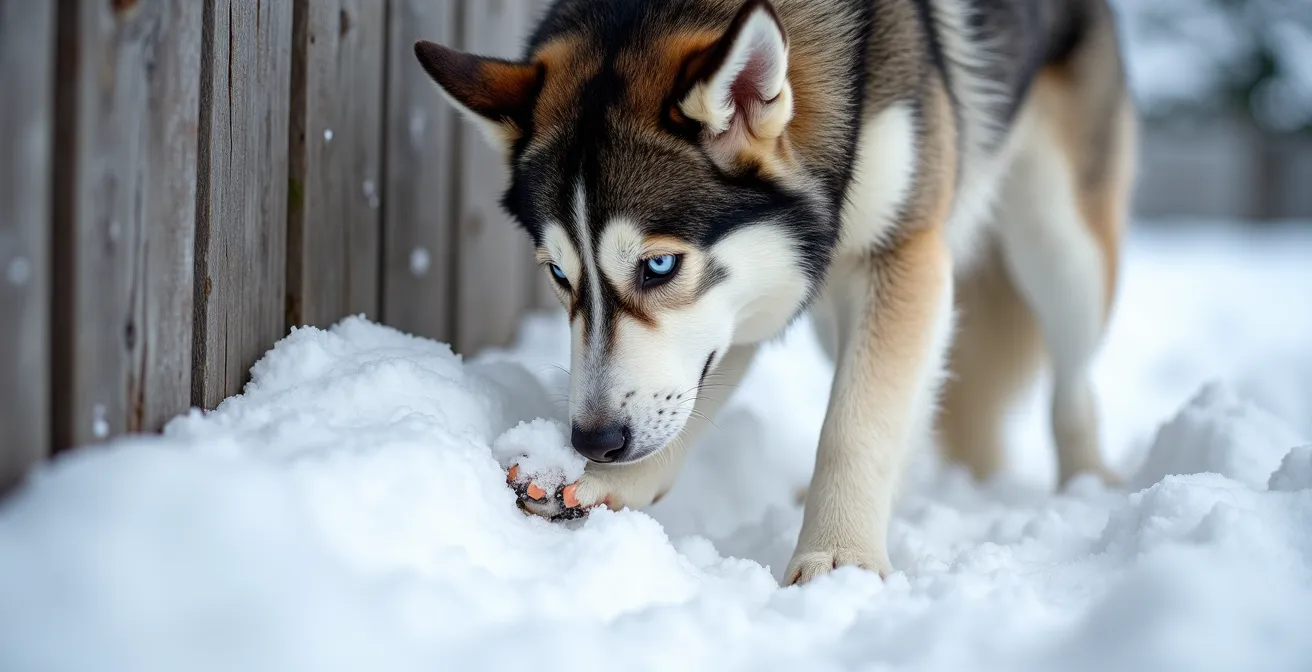
The principle is simple: a section of heavy-duty wire mesh is laid in an “L” shape, extending from the bottom of the fence down into the ground and then horizontally into the yard. When the dog tries to dig at the fence line, their paws hit an impenetrable steel barrier. The horizontal portion prevents them from simply digging farther back and tunneling under the mesh. In Canada, the timing of this installation is as critical as the method itself.
Action Plan: Fall L-Footer Installation for the Canadian Climate
- Schedule for the Fall: Aim to complete the installation in September or October, well before the first hard ground freeze makes digging impossible.
- Dig the Trench: Excavate a trench 12-18 inches deep directly along the interior perimeter of your fence line.
- Install the Hardware Cloth: Place a 24-36 inch wide roll of heavy-gauge, galvanized hardware cloth into the trench, bending it to form an “L” shape. The vertical part runs up the fence base, and the horizontal part extends into the yard.
- Choose the Right Material: Use galvanized hardware cloth (not chicken wire) for its superior strength and rust resistance, which is essential to withstand winter salt and moisture.
- Secure and Backfill: Secure the mesh to the fence base with galvanized staples and backfill the trench. The dog’s own weight will help hold the horizontal section down when they stand on it to dig.
This information is based on best practices from sources like the Lost Dogs of Wisconsin secure-yard guide, adapted for the specific challenges of a Canadian climate. Installing an L-Footer is a one-time, permanent solution to the threat of digging.
Hardware Cloth or Chicken Wire: Which Actually Stops a Raccoon?
When reinforcing a fence, particularly with an L-Footer or by covering gaps, the choice of mesh material is a critical security decision. The common mistake is to grab cheap chicken wire, assuming it’s “good enough.” It is not. The question isn’t just about stopping your dog, but about stopping the wildlife that might lure your dog out. While the title mentions raccoons, a key insight for Canadian winters is that squirrels remain highly active, while raccoons often enter periods of torpor. A squirrel can squeeze through a surprisingly small opening, and the flimsy nature of chicken wire is no match for their sharp teeth or a Husky’s determined claws.
The professional standard is galvanized hardware cloth. It is a welded wire mesh, typically with a smaller grid pattern (1/2 inch or 1/4 inch) and made from a heavier gauge of steel than the twisted, thin wire of a chicken-wire hex grid. The galvanization process also provides superior rust and corrosion resistance, which is absolutely essential in a Canadian winter with its constant moisture and potential exposure to road salt.
The following analysis compares the two materials on the factors that matter most for a durable, all-season security barrier:
| Material | Winter Durability | Rust Resistance | Wildlife Deterrent |
|---|---|---|---|
| Galvanized Hardware Cloth | Excellent | High (multi-year) | Effective against all sizes |
| Chicken Wire | Poor | Low (rusts with salt/moisture) | Only larger animals |
As this breakdown of fence materials confirms, investing in hardware cloth is a long-term security upgrade. It provides a robust barrier that won’t degrade after one or two seasons of harsh weather, ensuring the integrity of your perimeter against both determined dogs and the small, persistent wildlife that provokes them.
Why Does Cheese Fail When a Squirrel Runs By?
Many owners believe that a high-value treat is the ultimate tool for recall and control. But when a Husky’s prey drive is triggered, their entire system of valuation changes. A piece of cheese is a reward; chasing a squirrel through fresh snow is a fulfillment of their deepest genetic programming. In that moment, the instinctual reward is simply of a higher order than the food reward.
For a Husky, the instinctual reward of running and hunting in the snow is often a higher value than any food reward.
– Professional Dog Training Expert, Husky behavior analysis
This isn’t a failure of training; it’s a failure to compete with the prey drive threshold. The solution is not to find a “better” treat, but to proactively manage and channel that incredible drive. If a Husky’s need for intense physical and mental work isn’t met, they will create their own job—and that job is often “perimeter testing and escape.” An enrichment plan, especially in winter, is not about “playing”; it’s a crucial part of your security protocol. It lowers the dog’s motivation to breach the perimeter in the first place.
Here is a contractor’s approach to a winter enrichment plan, designed to satisfy a Husky’s core drives:
- Engage in Canicross or Skijoring: Harness their desire to pull and run. Activities on local winter trails provide a structured outlet for their stamina and work ethic.
- Use Flirt Poles for Structured Chase: A flirt pole (a long pole with a lure on a string) allows you to simulate a chase in a controlled environment, satisfying the hunt instinct without the risk of escape.
- Schedule Exercise Before Peak Wildlife Activity: A tired, satisfied dog is less likely to react with high intensity. Conduct your main exercise session in the early morning before squirrels are most active.
- Use High-Scent, High-Value “Jackpot” Rewards: In the cold, scent is diminished. Use intensely aromatic treats like freeze-dried salmon or warm boiled chicken from a thermos for recall training, saving them only for that purpose.
–
Key Takeaways
- System Integrity First: Your fence is a security system. A single weak point, like a misaligned latch or a gap under the base, compromises the entire perimeter.
- Neutralize the Environment: The Canadian winter is an active threat. You must engineer solutions against snow accumulation (ladders) and frost heave (structural damage).
- Manage the Drive: A physical barrier is essential, but it must be paired with proactive enrichment that channels your Husky’s innate prey drive, reducing their motivation to escape.
How to DIY Coyote Rollers to Prevent Climbing Escapes?
Beyond the basic installation, deploying a coyote roller system in a Canadian climate requires advanced considerations to ensure all-season system integrity. A DIY system that works perfectly in July can fail in January if the materials and design are not chosen with extreme cold in mind. As a security specialist, my focus is on long-term reliability and minimizing points of failure.
First, consider the roller material itself. While standard PVC pipe is cost-effective, it can become brittle in the deep cold (below -20°C), potentially cracking under the impact of a large, determined dog. For maximum durability in regions like the Prairies or Northern Ontario, consider using a thicker-walled Schedule 40 PVC or, for a premium DIY solution, sourcing aluminum tubing. It costs more but offers superior impact resistance and longevity in freeze-thaw cycles.
Second, every piece of hardware is a potential failure point. All brackets, wires, and fasteners must be hot-dip galvanized or stainless steel. Standard zinc-plated hardware will corrode and fail rapidly when exposed to moisture and road salt spray. Furthermore, the design must account for ice buildup. Ensure there is enough clearance between the roller and the mounting brackets so that a layer of ice or snow does not jam the spinning mechanism. Regular inspection after an ice storm is a critical maintenance task.
Finally, the tension of the wire is paramount. The wire should be taut enough to prevent sagging, which a dog could exploit, but have just enough play to allow the roller to spin with minimal friction. A wire that is too tight will increase friction and hinder the spinning action, defeating the purpose of the device. A regular “spin check” should be part of your perimeter inspection routine throughout the winter.
Your next step is to conduct a full audit of your own fence line with this contractor’s mindset. Examine the posts, test the latch, assess the materials, and look for environmental threats. Securing your perimeter begins with a thorough inspection.