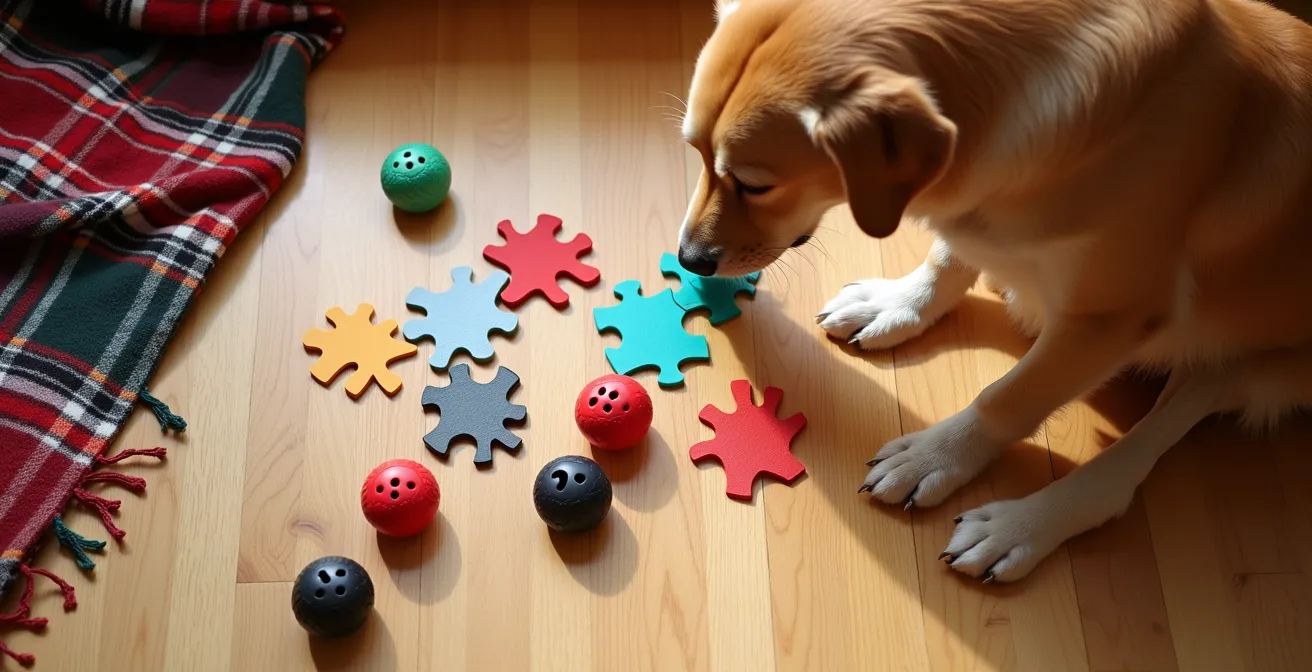
For hyper-intelligent dogs, puzzle toy value isn’t just duration, but the system’s ability to resist “failure modes” like frustration-flipping, destructive chewing, and rapid swallowing.
- Kong’s natural rubber offers superior material integrity for power chewers, representing a lower risk of catastrophic failure.
- Nina Ottosson’s hard plastic designs provide better cognitive scalability through complex, multi-step mechanisms.
Recommendation: The optimal solution is an integrated system. Combine freezable Kongs for durability with advanced Ottosson puzzles to build a comprehensive enrichment plan that outsmarts your genius dog.
You’ve seen it before: you unbox a brand-new, “expert level” puzzle toy, fill it with your dog’s favourite high-value treats, and place it on the floor. Thirty seconds later, the puzzle is empty, your dog is looking at you for the next challenge, and you’re left wondering if you just wasted $50. For owners of hyper-intelligent dogs—the Border Collies, the Poodles, the Shepherds who seem to operate on a different cognitive plane—this is a familiar frustration. The common advice to “freeze it” or “start easy” feels insulting to a canine mind that seems to view puzzles not as a challenge, but as a minor inconvenience.
This cycle of rapid-fire solving isn’t just a drain on your wallet; it can lead to boredom and frustration for your dog. When a puzzle is too easy, it fails to provide meaningful mental exercise, and according to some Canadian canine wellness data, this lack of stimulation is a significant issue. But what if the problem isn’t the dog’s intelligence, but our approach to selecting the toys? What if the real question isn’t just “Kong versus Nina Ottosson,” but a more fundamental engineering problem of material science, component security, and scalable difficulty?
This analysis moves beyond a simple product comparison. As durability testers, we will dissect these puzzle toys through the lens of “failure mode analysis,” a concept borrowed from engineering. We will examine why dogs “cheat” by flipping boards, assess the material integrity of rubber versus plastic under the force of a determined chewer, and analyze the choking risk posed by loose components as a critical system flaw. We are not just looking for a toy; we are looking for an enrichment system that delivers a genuine return on investment for Canada’s smartest dogs.
This guide provides a complete systems analysis, breaking down the mechanical and cognitive challenges each toy type presents. We will explore how to engineer a more robust enrichment strategy, from hacking simple puzzles to building a complete meal-feeding system within the confines of a Canadian condo, ensuring your brilliant companion gets the mental workout they truly need.
Summary: A Durability Tester’s Guide to Puzzle Toys
- Why Does Your Dog Flip the Puzzle Board Instead of Solving It?
- How to “Hack” Simple Puzzles to Make Them Harder for Genius Dogs?
- Rubber Chewable or Hard Plastic: Which is Safer for Destructive Chewers?
- The Choking Risk: Why Loose Puzzle Pieces Are Dangerous for Swallowers
- How to Feed the Entire Meal Through Enrichment Without Losing Track?
- Why Does 15 Minutes of Brain Games Equal 1 Hour of Walking?
- Anti-Bark Collars or Desensitization: Which Solves the Root Cause?
- How to Exhaust a Border Collie Inside a Condo During a Blizzard?
Why Does Your Dog Flip the Puzzle Board Instead of Solving It?
When a smart dog flips over a Nina Ottosson board, spilling the kibble everywhere, it’s not a sign of cheating; it’s a sign of a system failure. This “system bypass” behavior is often a direct result of frustration or an unstable environment. If the puzzle is too difficult for its initial introduction or if it slides around on a slippery floor like Canadian maple hardwood, the dog’s logical conclusion is that brute force is more efficient than finesse. The toy’s design has failed to properly constrain the problem, prompting an “out-of-the-box” solution that defeats the purpose of the enrichment.
This frustration can quickly lead to disinterest or even destructive habits. Research indicates that under-stimulation is a significant driver of problem behaviors; a 2025 Canadian study found that 67% of understimulated dogs develop destructive behaviors. A puzzle that is too easily “hacked” by flipping it doesn’t provide stimulation; it reinforces the idea that the rules don’t apply. The key is to re-establish the rules of the game by controlling the environment and managing the dog’s initial experience to guarantee success and build engagement.
To prevent this, you must engineer a better setup. This involves securing the puzzle and introducing it in a way that guides the dog toward the intended solution, making the “correct” path the most rewarding one. A structured introduction protocol is not about dumbing down the challenge, but about clearly defining its parameters for your intelligent dog.
Action Plan: A Proper Puzzle Introduction Protocol
- Start with the puzzle on a non-slip surface, like a yoga mat or a specific non-slip mat from a store like Canadian Tire, to prevent it from sliding on hardwood or tile floors.
- Use high-value, aromatic Canadian treats, such as freeze-dried liver from a brand like Big Country Raw, to maximize motivation.
- Begin with the puzzle’s sliding compartments or pieces already partially open to ensure the dog experiences immediate success and understands the mechanics.
- Supervise the entire session, offering gentle guidance with a finger if needed, but never forcing the interaction. Let the dog’s natural curiosity lead the way.
- Gradually increase the difficulty over a period of two to three weeks as your dog’s confidence and understanding of the game grow.
How to “Hack” Simple Puzzles to Make Them Harder for Genius Dogs?
For a truly intelligent dog, a single puzzle toy, even a “Level 3,” is a finite problem. Once solved, its challenge diminishes rapidly. The standard advice—freezing food inside a Kong—is merely a time delay, not a cognitive escalation. To genuinely challenge a genius dog, you must move from thinking about a single toy to designing an enrichment system. This involves creating multi-step, chained challenges where one puzzle unlocks another, forcing the dog to think sequentially and problem-solve on a higher level.
This “puzzle hacking” approach combines the strengths of different toys. For instance, a frozen Kong isn’t the end goal; it’s the key. The dog must first work to get the contents out of the Kong, and those contents can then be used to “bait” a more complex Nina Ottosson puzzle. This creates a nested problem that significantly extends engagement time and increases the cognitive load. The visual below demonstrates how different toys can be staged to create a progressive challenge, perfect for long Canadian winters when indoor activity is paramount.

This method of combining and sequencing toys is not just about making things harder; it’s about creating a more dynamic and unpredictable enrichment experience. By varying the combinations, you prevent the dog from simply memorizing a solution and force them to adapt their strategy each time, which is the hallmark of true mental stimulation. This approach is particularly effective for high-energy breeds confined indoors during harsh weather.
Case Study: The Canadian Winter Challenge Progression Plan
Dog trainers across Canada have refined a systematic three-week winter program that effectively combines Kong and Nina Ottosson puzzles. During Week 1, the focus is on mastering frozen Kongs filled with locally sourced Canadian ingredients. Week 2 introduces Level 1 Nina Ottosson puzzles, but with some compartments filled with frozen broth to add a new textural challenge. By Week 3, trainers create complex, multi-step scenarios where a dog must first manipulate a Kong to release treats onto a larger mat, which they can then use to engage with a Level 2 or 3 puzzle board. Trainers report that this progressive system leads to 30-minute engagement sessions that mentally exhaust high-energy dogs, an effect they equate to a 90-minute outdoor walk.
Rubber Chewable or Hard Plastic: Which is Safer for Destructive Chewers?
From a durability tester’s perspective, the choice between a rubber Kong and a hard plastic Nina Ottosson puzzle is a question of material integrity and failure mode. It’s not about which is “stronger,” but about how each material behaves under extreme stress from a powerful chewer. Hard plastic, while rigid, is often brittle. Under the focused pressure of a dog’s jaw, it can experience catastrophic failure—shattering into multiple sharp, jagged pieces that pose a significant risk of internal injury if swallowed.
Natural rubber, like that used in the Kong Extreme line, has high tensile strength and elasticity. Its failure mode is fundamentally different and safer. When a power chewer eventually compromises a Kong, it tends to tear or break off in larger, more flexible chunks. While still a hazard that requires supervision, this “graceful failure” is far less likely to produce the sharp, piercing shards that can result from broken hard plastic. The choice of material is therefore a critical safety consideration, especially for dogs who mix solving with destructive chewing.
When evaluating puzzle toy safety, consider that the thoracic limb holds 60% of a dog’s bodyweight during play, making material durability crucial for preventing injury from broken pieces.
– Dr. Cristina Hansen, Frontiers in Veterinary Science, 2024
For a dog that might try to chew through a puzzle out of frustration, a durable rubber toy like a Kong is the safer foundation for your enrichment system. The Nina Ottosson puzzles, with their intricate plastic parts, should be reserved for strictly supervised sessions where the focus is purely on cognitive problem-solving, not on chewing. The rule is simple: if the dog’s goal might shift from “solve” to “destroy,” rubber is the only acceptable material.
The Choking Risk: Why Loose Puzzle Pieces Are Dangerous for Swallowers
Beyond material failure, the second critical safety flaw in puzzle toys is component security. Many advanced puzzles, particularly from the Nina Ottosson line, feature small, loose pieces that a dog must manipulate. For most dogs, this is part of the challenge. But for a “gulper” or a dog prone to swallowing non-food items, these small components represent a significant choking or obstruction hazard. An emergency vet visit for foreign body ingestion is a traumatic and expensive experience, and data shows it’s not an uncommon one; according to the Canadian Hospitals Injury Reporting database, 4.5% of emergency vet visits in Canada involve foreign body ingestion.
The danger is that a smart dog may determine it’s easier to simply pick up and swallow a piece to get it out of the way. Therefore, a key part of the durability test is assessing the size, shape, and “swallowability” of every component. A useful, if informal, Canadian metric is the “Timbit Test”: if a puzzle piece is small enough to be comparable in size to a Timbit, it could pose a risk for a medium-to-large breed dog. Toys with integrated, non-removable parts or single-body construction like the classic Kong are inherently safer for dogs with a history of swallowing objects.

This image provides a clear visual reference for assessing risk. Before purchasing any puzzle toy with multiple parts, evaluate each component. If you have a known “swallower,” you must either avoid toys with loose pieces entirely or commit to 100% active supervision, ready to intervene at a moment’s notice. For these dogs, the ROI of a multi-part puzzle might be too low when weighed against the potential vet bill.
How to Feed the Entire Meal Through Enrichment Without Losing Track?
Switching from bowl-feeding to 100% enrichment-based meals is a powerful way to provide daily mental stimulation. However, for owners in smaller spaces like a typical Canadian condo, it presents a logistical nightmare: how do you portion out an entire meal across multiple toys without losing track of calories or creating a huge mess? The solution lies in creating a centralized portioning system and a designated “feeding station.” This turns a chaotic process into a simple, repeatable daily routine.
First, you must precisely measure your dog’s daily kibble or raw food portion according to the guidelines for their specific Canadian food brand (like Acana, Orijen, or Boréal). Instead of dumping it in a bowl, you divide this total amount into several smaller containers. Each container corresponds to a specific puzzle toy in your rotation. For example, one-third for a frozen Kong, one-third for a Nina Ottosson puzzle, and one-third for a snuffle mat. This ensures your dog gets their full daily ration without over-or under-feeding.
Action Plan: The Canadian Condo Meal Portioning System
- Use the official measuring cup for your dog’s Canadian food brand (e.g., Acana, Orijen) to measure their exact daily portion.
- Divide the full portion into thirds, pre-allocating one-third for Kong toys, one-third for Nina Ottosson puzzles, and one-third for a snuffle mat or other toy.
- Establish a feeding station using a large, waterproof MESSY MATS® or similar product from a Canadian pet store to contain spills and make cleanup easy.
- If you feed raw, choose formats like Big Country Raw pellets that are appropriately sized to fit into puzzle compartments without creating a paste.
- Use a simple chart on your fridge to track the distribution for morning and evening meals, checking off each puzzle as it’s given.
- For raw food, clean all puzzles immediately after use with pet-safe, food-grade cleaners, widely available at stores like Canadian Tire.
This systematic approach transforms mealtime from a 30-second gulp-fest into a 20-30 minute cognitive workout. It’s a game-changer for high-energy dogs living in apartments, especially during harsh -30°C winter days when long walks are not feasible.
As a dog owner in a 600 sq ft Calgary condo, puzzle feeding seemed impossible until I discovered the containment mat system. I use a large waterproof MESSY MAT from Pet Valu ($39.99 CAD) as my ‘feeding station.’ My Border Collie gets his entire Acana Singles meal through a rotation of a frozen Kong, a Nina Ottosson Level 2 puzzle, and a treat ball. The mat catches everything, and cleanup takes 2 minutes. It’s transformed meal times from 30 seconds of gulping to 25 minutes of engaged eating – perfect for our -30°C winter days when outdoor exercise is limited.
– Calgary Apartment Dweller
Why Does 15 Minutes of Brain Games Equal 1 Hour of Walking?
The statement that a short session of brain games can be as tiring as a long walk may sound like an exaggeration, but it’s grounded in the science of cognitive fatigue. Physical exercise tires the body’s muscles, while mental enrichment tires the brain’s “muscles.” For intelligent breeds, the latter is often more exhausting and ultimately more satisfying. When a dog is solving a complex puzzle, they are engaging in focused concentration, problem-solving, and fine motor control. This intense neural activity consumes a significant amount of mental energy, leading to a state of calm exhaustion that is comparable to the physical fatigue from running.
This principle is a lifesaver for owners in Canada, where winter blizzards, ice storms, or summer wildfire smoke can severely limit outdoor exercise. The impact is well-documented; a 2024 Canadian pet wellness survey found that 84% of Canadian pet owners report improved dog behavior with just 15 or more minutes of daily mental stimulation. A tired brain is less likely to engage in nuisance behaviors like boredom barking or destructive chewing.
Experts in canine wellness confirm this powerful effect. The act of thinking and problem-solving activates neural pathways in a way that simple physical motion does not, providing a different, deeper kind of “tired.”
Mental enrichment creates cognitive fatigue through problem-solving neural pathways, producing similar exhaustion to physical exercise. For Canadian winters when ice storms limit outdoor activity, 15 minutes with challenging puzzles provides equivalent mental drain to a full hour’s walk.
– Dr. Colleen Dell, University of Saskatchewan One Health & Wellness Research, 2024
Therefore, investing in a robust puzzle toy system isn’t an “extra”—it’s a core component of a well-rounded exercise plan. It provides a reliable, weather-proof method for meeting your high-energy dog’s needs, ensuring they are calm and content regardless of the conditions outside. The return on investment is a happier, better-behaved dog.
Anti-Bark Collars or Desensitization: Which Solves the Root Cause?
In the close quarters of Canadian condo living, a barking dog can quickly become a source of neighbourly friction and costly strata fines. Many owners, under pressure, turn to quick fixes like anti-bark collars. From a product-testing standpoint, these devices—whether they use sound, vibration, or shock—are tools of symptom suppression. They punish the act of barking but do absolutely nothing to address the underlying cause, which is often boredom, anxiety, or under-stimulation.
A far more effective, humane, and durable solution is to treat the root cause. This is where enrichment toys like Kong and Nina Ottosson puzzles become powerful behavioral tools. By providing a cognitively engaging “job” to do, these puzzles channel a dog’s mental energy into a productive activity. A dog that is busy solving a puzzle is a dog that is not barking out of boredom. This approach doesn’t just stop the barking; it replaces an undesirable behavior with a desirable one, leading to lasting change.
This is not just a theory; it has been proven effective in real-world scenarios, offering a positive alternative that condo boards and residents can embrace. It’s an investment in proactive wellness over reactive punishment.
Case Study: Vancouver Strata Compliance Through Enrichment
A Vancouver condo board, inundated with noise complaints, took an innovative approach. Instead of mandating anti-bark collars, they established a puzzle toy lending library for residents. For a $20 refundable deposit, owners could borrow Kongs and Nina Ottosson puzzles. The results were staggering: after just six months, noise complaints related to barking dropped by 73%. The building’s one-time investment of $400 in puzzle toys saved residents thousands in potential strata fines, which can be as high as $200 per incident in British Columbia. The program proved that addressing boredom with enrichment provides a permanent behavioral solution, whereas aversive collars only mask the problem.
Choosing enrichment over aversive tools is choosing to solve the problem, not just silence it. It’s a more ethical and, as the case study shows, more economically sound strategy for maintaining peace in a multi-family dwelling.
Key Takeaways
- Puzzle-flipping is a system failure, not a dog failure, often caused by frustration or an unstable surface.
- Material integrity is critical: rubber offers a safer “tearing” failure mode for chewers, while brittle plastic can shatter into sharp fragments.
- The best enrichment comes from an integrated system, combining the durability of Kongs with the cognitive complexity of Ottosson puzzles.
How to Exhaust a Border Collie Inside a Condo During a Blizzard?
The ultimate stress test for any enrichment strategy is a high-drive Border Collie, a blizzard raging outside a 700-square-foot condo, and a full day of confinement. This scenario demands more than a single toy; it requires a comprehensive, multi-station indoor enrichment course. By applying all the principles we’ve discussed—system design, material safety, and cognitive scaling—you can transform your living room into a mental gymnasium that will successfully exhaust even the most intelligent and energetic dog.
The strategy involves setting up several “stations” around the condo. Station one might be a frozen Kong Extreme on a lick mat in the kitchen. Station two, in the living room, could be a Nina Ottosson Level 3 puzzle on a non-slip mat. Station three could be a Kong Wobbler dispensing part of their meal in a hallway. The dog must move between these stations, engaging in different types of problem-solving and physical manipulation. This creates an indoor “parkour” that expends both mental and physical energy in a small, controlled space.

To successfully implement this, you need the right tools. The table below outlines top-performing puzzles for this exact high-stakes scenario, chosen for their durability, difficulty, and suitability for intense indoor use, all readily available from Canadian retailers.
| Puzzle Toy | Difficulty | Duration | Canadian Availability | Best Feature for Winter |
|---|---|---|---|---|
| Kong Extreme (Black) | Variable | 20-45 min frozen | All major retailers | Can freeze overnight for extended play |
| Nina Ottosson Level 3 | Advanced | 15-30 min | Pet Valu, Amazon.ca | Multiple compartments prevent quick solving |
| Kong Wobbler | Moderate | 10-20 min per meal | PetSmart, Mondou | Physical + mental exercise in small space |
Ultimately, surviving—and thriving—during a blizzard with a high-drive dog isn’t about finding a magic bullet toy. It’s about having a well-stocked toolbox and the knowledge to deploy the right tools in a strategic sequence. It’s about being an enrichment engineer, not just a dog owner.
Stop searching for a single “unsolvable” toy. Instead, start designing a dynamic and scalable enrichment system tailored to your dog’s unique intelligence, chew strength, and “failure modes.” By combining the material durability of Kong with the cognitive challenges of Nina Ottosson, you can build a long-term strategy that delivers real ROI and a happy, tired, and well-behaved canine companion.
Frequently Asked Questions about Kong vs. Nina Ottosson Puzzles
Are anti-bark collars legal in all Canadian provinces?
Several municipalities, including Vancouver, have placed restrictions on the use of shock collars. Furthermore, Quebec’s comprehensive Animal Welfare and Safety Act prohibits causing an animal undue stress or suffering, which many legal experts and animal welfare advocates interpret as an effective ban on aversive collars like shock collars.
What are typical noise complaint fines in Canadian condos?
Fines for noise complaints in Canadian condominiums, or stratas, can be significant. In British Columbia, strata corporations can issue fines ranging from $50 to $200 per incident. In Ontario, condo boards have similar authority to levy penalties for bylaw infractions. Repeated violations can escalate, potentially leading to legal action and even forced sale in extreme cases.
How do puzzle toys compare cost-wise to anti-bark devices?
A quality anti-bark collar typically costs between $80 and $200 CAD, plus ongoing costs for batteries or replacement parts. In contrast, a foundational set of high-quality puzzle toys, such as a Kong Extreme and a Nina Ottosson Level 2 puzzle, can be purchased for a one-time cost of $40 to $60 CAD and will last for years with proper care, offering a much higher long-term value.