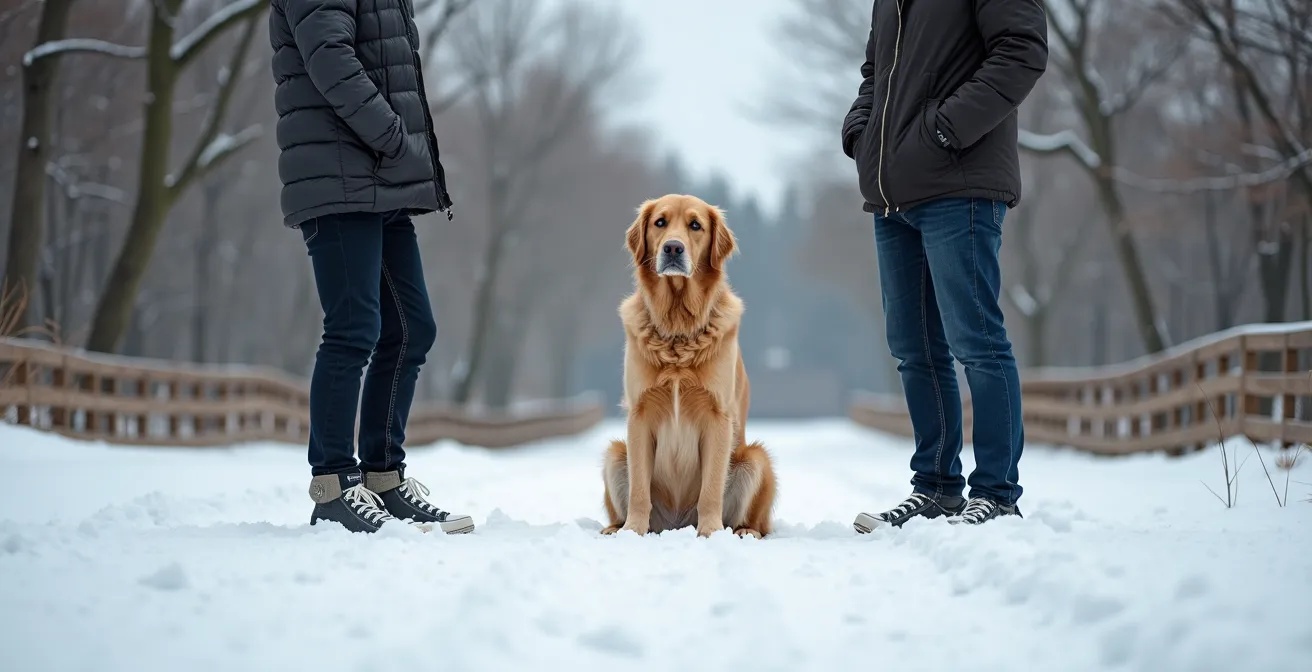
The biggest source of a dog’s anxiety isn’t a lack of love or too many rules—it’s unpredictability.
- Inconsistent commands and boundaries from owners dramatically increase a dog’s cognitive load and chronic stress.
- Clear, predictable boundaries, even if they seem strict, create a calm and understandable world for a dog.
Recommendation: Adopt a ‘benevolent leadership’ style. This means providing consistent structure combined with positive reinforcement to build a confident, secure, and less anxious canine companion.
You bring a new dog into your Canadian home, and the advice floods in. Well-meaning friends, family, and a sea of online trainers present a dizzying array of philosophies. One camp champions a “permissive,” pure-positive approach, suggesting that any form of correction will damage your bond. The other advocates for a more “authoritative” or “balanced” style, insisting on the need for clear leadership and consequences to avoid raising an unmanageable dog. For new owners, this conflicting information isn’t just confusing; it’s paralyzing.
The common refrain you’ll hear from all sides is that “consistency is key.” While true, this advice is a platitude. It tells you *what* to do but fails to explain *why* it matters from a psychological perspective, or *how* to implement it in the chaos of daily life. The debate often devolves into a false dichotomy: are you a soft-hearted pushover or a stern drill sergeant? This leaves loving owners terrified of either failing their dog with a lack of structure or crushing their spirit with too much of it.
But what if this entire debate is flawed? As a human-canine psychology researcher, I propose that a dog’s anxiety stems not from the style itself, but from its predictability. An environment of inconsistent rules, fluctuating expectations, and ambiguous leadership places an immense cognitive load on a dog. This constant state of uncertainty is far more stressful than a world with clear, firm, and dependably enforced boundaries. A dog doesn’t crave total freedom; it craves a world that makes sense.
This article will deconstruct these parenting styles through a psychological lens, exploring the profound impact of inconsistency on canine stress. We will move beyond simplistic labels to provide a practical framework for becoming a benevolent leader—a trusted guide your dog can rely on. By focusing on creating a predictable environment, you can build a relationship based on mutual respect and security, perfectly adapted to the realities of life with a dog in Canada.
To navigate this complex topic, we will break down the core psychological principles, from the stress of inconsistency to the nuances of motivation and communication. The following sections offer a clear path to understanding your dog’s mind and becoming the predictable, confident leader they need.
Summary: Understanding the Psychology Behind Your Dog’s Behaviour
- Why Does Inconsistent Rule Enforcement Cause More Stress Than Strictness?
- How to Get Your Partner on Board with Training Protocols Without Arguing?
- Food Rewards or Verbal Praise: Which Actually Motivates Independent Breeds?
- The “He Knows He’s Wrong” Fallacy: Why Guilt Is a Human Projection
- When to Reward: The 1.5 Second Window That Makes or Breaks Learning
- How to Be a Benevolent Leader Without Using Physical Force?
- Genetics or Training: Which Has the Bigger Impact on Reactivity?
- How to Introduce a Second Dog Without Ruining Your First Dog’s Life?
Why Does Inconsistent Rule Enforcement Cause More Stress Than Strictness?
The modern dog is living in a state of quiet anxiety. A comprehensive Finnish study revealed that a staggering 72.5% of dogs display at least one anxiety-related behavior, from noise sensitivity to separation issues. While many factors contribute, a primary and often overlooked cause is the chronic stress of unpredictability. A permissive household, where jumping on the couch is okay on Tuesday but not on Wednesday, forces the dog into a constant state of guesswork. This mental effort, or cognitive load, is exhausting and anxiety-inducing.
From the dog’s perspective, a strict rule, like “never allowed on the furniture,” is simple. It is a clear, predictable binary: on the floor is safe, on the couch is not. An inconsistent rule, however, creates a complex and stressful algorithm. The dog must constantly assess the owner’s mood, who is in the room, and what happened the last time it tried. When it guesses wrong and is suddenly reprimanded for a behavior that was ignored yesterday, it doesn’t learn the rule; it learns that its environment is arbitrary and its owner is unpredictable. This is the very foundation of anxiety.
This challenge is particularly acute for Canadian dog owners, where drastic seasonal changes can naturally disrupt routines. A dog that is not allowed to jump on people with muddy spring paws might be tolerated when its paws are dry in the summer. This is a classic example of well-intentioned inconsistency. The key is not to abandon all rules, but to manage exceptions with clarity and intention.
Your Action Plan: The Canadian Winter Exception Protocol
- Create a specific ‘winter mode’ cue (like ‘indoor rules’) that signals temporary relaxation of certain boundaries, making the change predictable.
- Use a distinct mat or area near the door for wet paw management instead of trying to enforce fluctuating rules about jumping.
- Maintain core safety commands (sit, stay, come) with absolute consistency, regardless of weather conditions.
- Return to standard rules with a clear ‘normal mode’ signal when the weather improves and the messy conditions subside.
- Reward compliance with weather-appropriate behaviors to maintain motivation, even during the harshest winter months.
By making even your exceptions predictable, you reduce your dog’s cognitive load. You are teaching them that the world operates on a set of understandable principles, which is the cornerstone of a secure and confident temperament. Strictness isn’t cruelty; in many ways, when applied with fairness, it is a form of kindness.
How to Get Your Partner on Board with Training Protocols Without Arguing?
A dog living with two owners who have different rules is living in two separate worlds. If one partner enforces a “no dogs on the bed” rule while the other invites the dog up for cuddles, the dog doesn’t learn a nuanced lesson. It learns that one human is the source of comfort and the other is the source of seemingly random denial. This erodes the trust and clarity necessary for a healthy dog-human relationship and creates a significant point of stress for everyone in the household.
The first step is to shift the dynamic from arguing to collaborating. This isn’t about one person “winning” the training debate; it’s about the humans presenting a united front for the dog’s benefit. This often means sitting down without the dog present to create a shared ‘canine constitution’—a clear, written set of rules and protocols. The goal is to agree on the non-negotiables first: feeding times, potty schedules, and safety commands.
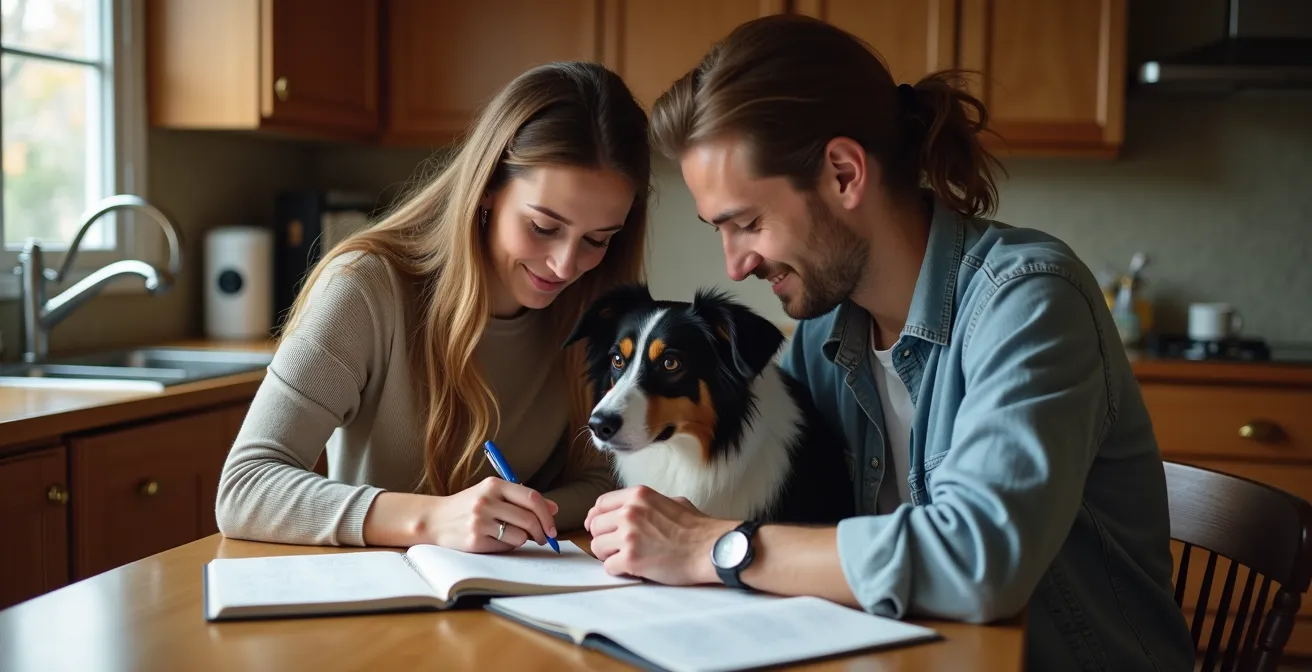
As the image above illustrates, this process should be a partnership. It’s about shared purpose, not conflict. The success of this approach is demonstrated by renowned Canadian trainers like McCann Professional Dog Trainers. With over 40 years of experience, their entire methodology is built on family-wide consistency, recognizing that a dog’s training success depends on every member of the household reinforcing the same set of expectations.
Discussing your individual ‘why’ behind each desired rule is crucial. Perhaps one partner’s insistence on no-counter-surfing is about hygiene, while the other’s leniency is about not wanting to be “mean.” Understanding these underlying motivations allows for compromise. Maybe the solution is better management (keeping counters clear) combined with a consistent ‘off’ command. By focusing on the shared goal—a happy, well-behaved dog—couples can transform a point of conflict into an act of collaborative leadership.
Food Rewards or Verbal Praise: Which Actually Motivates Independent Breeds?
The pure-positive training movement has rightly emphasized the power of rewards, but it has also created a near-total reliance on a single tool: the food treat. While effective for many dogs, this approach can fall flat with independent, intelligent breeds who were bred for a purpose beyond simple compliance. For a Siberian Husky, a piece of kibble is a poor substitute for the thrill of pulling. For a Border Collie, a dry biscuit pales in comparison to the mental engagement of herding.
Understanding what truly motivates your dog requires looking beyond the treat pouch and considering functional rewards. These are rewards that tap into a dog’s innate genetic drives. This doesn’t mean you must provide sheep for your collie, but it does mean incorporating activities that satisfy that herding instinct, such as advanced obedience, treibball, or complex puzzle toys. Acknowledging and providing outlets for these drives is a far more powerful motivator than endless, repetitive food rewards.
For many independent breeds common in Canada, environmental and work-based rewards are supreme. An analysis of reward effectiveness highlights these crucial distinctions.
| Breed Type | Primary Motivator | Secondary Motivator | Least Effective |
|---|---|---|---|
| Siberian Husky | Functional rewards (pulling, running) | Novel scents/exploration | Repetitive food treats |
| Canadian Eskimo Dog | Work/job completion | Environmental rewards | Static verbal praise |
| Nova Scotia Duck Toller | Retrieving games | High-value treats | Calm petting |
| Akita | Owner proximity/attention | Environmental access | Standard kibble |
This doesn’t mean food or praise has no place. A high-value treat (like freeze-dried liver) at the right moment can be a powerful tool, and genuine verbal praise reinforces the social bond. However, an authoritative, benevolent leader understands that the ultimate reward is often access to the world in a controlled way. A calm “sit” at the door is rewarded by opening the door for a walk. A reliable “stay” is rewarded with release to a favourite sniffing spot. By controlling access to what the dog truly values, you become the most relevant and motivating force in their life.
The “He Knows He’s Wrong” Fallacy: Why Guilt Is a Human Projection
One of the most common and damaging misinterpretations in the human-canine relationship is the belief that dogs experience guilt. An owner comes home to a shredded cushion, sees the dog cowering with “whale eye” and a tucked tail, and declares, “He knows he did something wrong!” This assumption often leads to scolding the dog long after the event, an action that is both ineffective and detrimental to the relationship.
From a canine psychology standpoint, the dog is not displaying guilt. It is displaying appeasement behaviors. These are a sophisticated set of signals—including lip licking, avoiding eye contact, lowering the head, and cowering—designed for one purpose: to de-escalate a perceived threat. The dog is not reflecting on its past transgression with remorse; it is reacting in the present moment to its owner’s tense body language, angry tone, and overall displeasure. It is, in effect, saying, “You seem angry, and I would like you to stop being angry at me.”
Case Study: Misinterpreting Appeasement as Guilt
Research shows that dogs raised with a physically or verbally harsh authoritarian style exhibit signs of chronic stress that impede their ability to learn. In these situations, owners frequently misinterpret the dog’s behaviour. What they label as a ‘guilty look’—cowering, showing the whites of their eyes, or excessive lip licking—are in fact classic appeasement signals. The dog displays these behaviors to de-escalate the owner’s perceived anger, a reaction to the owner’s immediate emotional state, regardless of whether the dog understands the specific reason for the anger.
This concept of emotional contagion is critical. Your dog is an expert at reading your emotional state. The “guilty look” will appear whether the dog actually chewed the cushion or was simply asleep in another room when it happened. It is a direct response to your discovery and subsequent anger. Punishing a dog based on this misinterpretation only teaches it that the owner is a source of unpredictable and frightening outbursts, deepening anxiety and eroding trust.
The authoritative yet benevolent leader understands that correction must be immediate and linked to the action, not the aftermath. If you don’t catch the dog in the act, the moment for a teaching opportunity has passed. The only effective path forward is to clean up the mess and focus on better management to prevent it from happening again.
When to Reward: The 1.5 Second Window That Makes or Breaks Learning
Effective dog training is a science of timing. You can have the highest-value treat in the world, but if you deliver it too late, you may be rewarding the wrong behavior entirely. Imagine trying to take a crystal-clear photograph of a fast-moving bird; a slight delay and you’ve missed the shot. The same principle applies to marking and rewarding a desired behavior in a dog. While the title suggests 1.5 seconds, dog training experts agree that the optimal time window is even shorter, around 1.3 seconds for reward delivery after the desired behavior occurs.
Within this brief window, the dog’s brain can form a clear association: “When I performed action X, I received a reward.” If you call your dog and reward them only when they finally reach you five seconds later, you are not rewarding the recall. You are rewarding the act of being near you. The crucial behavior—the split-second decision to turn and come toward you—was missed. This is why marker training (using a clicker or a verbal marker like “Yes!”) is so powerful. The marker acts as a camera shutter, capturing the exact moment the dog does the right thing and promising that a reward is coming.
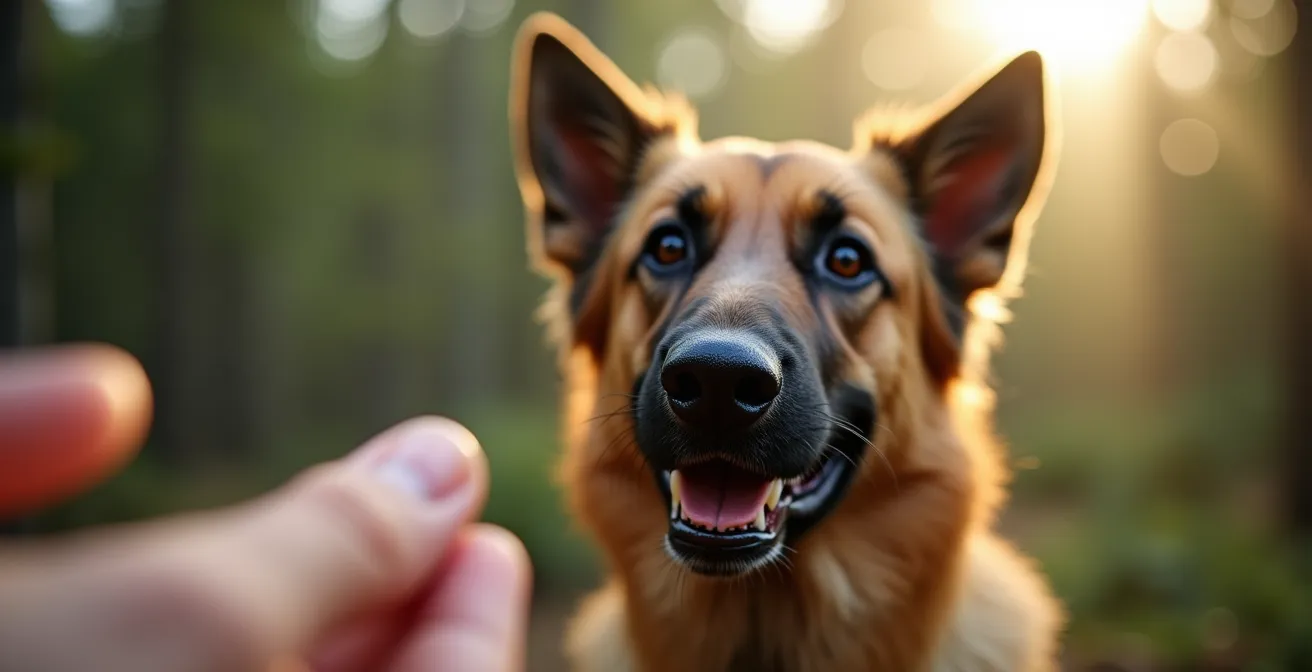
This level of precision, as captured in the image above, requires intense focus from the handler. It means anticipating and being ready to mark the instant your dog offers the correct behavior. To achieve this, you must practice in progressively challenging environments. Start in your quiet backyard, then move to a calm residential street, before attempting a high-distraction area like a busy Toronto park or a wilderness trail in Algonquin. Using a clear marker and high-value, easy-to-deliver Canadian treats like Benny Bully’s freeze-dried liver can make all the difference in these critical moments.
Mastering this timing transforms you from someone who simply gives a dog treats into a clear and effective communicator. Your dog learns that you pay close attention and that their specific choices have immediate, positive consequences. This clarity builds confidence and dramatically accelerates the learning process.
How to Be a Benevolent Leader Without Using Physical Force?
The term “leader” in dog training has been unfortunately co-opted by outdated “alpha” and dominance theories, which often rely on physical intimidation. A modern, psychologically-sound approach reclaims the term as benevolent leadership. This has nothing to do with force and everything to do with being a trustworthy, predictable guide who provides structure and controls access to resources. It’s about being the one your dog looks to for information and guidance because you have proven to be a reliable source of safety and reward.
Benevolent leadership is demonstrated through daily actions. You decide when a game starts and ends. You ask for a calm “sit” before a food bowl is put down. You manage the environment to prevent unwanted behaviors, rather than constantly correcting them. This approach is gaining traction across Canada. A 2024 study of dog training businesses found that 72% of dog training businesses in British Columbia now use reward-based methods exclusively, signaling a professional shift away from coercive tactics.
This authoritative-but-not-authoritarian style is about teaching a dog how to live successfully in a human world. It’s not permissive; there are clear rules and boundaries. But these rules are taught and enforced primarily through positive reinforcement and the strategic withholding of rewards, not through fear or pain. As experts in the field note, this balanced approach yields the best results. As highlighted by Psychology Today Canada:
An authoritative pet parenting style can optimize outcomes with pet dogs
– Psychology Today Canada, The 4 Types of Dog Parents
Ultimately, leadership is about being relevant. When your dog learns that all good things—food, walks, play, affection—come through a moment of polite cooperation with you, your position as a benevolent leader is solidified. You are not their boss, but their trusted partner and guide, a figure they respect and willingly follow without the need for physical force.
Genetics or Training: Which Has the Bigger Impact on Reactivity?
When a dog displays reactive behavior—barking, lunging, or growling at triggers—owners often ask a simple question: was my dog born this way, or is it something I did? The answer, as with most things in behavioral science, is not a simple “either/or.” The most accurate framework is to understand that genetics loads the gun, but environment and training pull the trigger.
A dog’s breed and lineage create predispositions. A Border Collie is genetically wired to be hyper-aware of movement. A terrier is built to react quickly to small, fast-moving objects. These are not character flaws; they are the very traits that made them exceptional at the jobs they were bred for. To ignore these genetic inclinations is to ignore the fundamental nature of the dog you have. However, genetics are not destiny. They create a potential, but how that potential is expressed is heavily influenced by the dog’s life experiences, socialization, and training.
This interaction is clearly visible in breed-specific patterns across Canada. Research and anecdotal evidence from trainers show how environment shapes genetic tendencies. A Border Collie living in urban Calgary, with no sheep to herd, may redirect its intense herding instincts toward passing cars or bicycles, becoming dangerously reactive. A Nova Scotia Duck Tolling Retriever, bred for high-arousal excitement in the hunt, may show generalized over-arousal and frustration-based reactivity in a quiet suburban home. In both cases, genetics creates the underlying impulse, but it is the environment that provides the trigger and the training (or lack thereof) that determines the dog’s response.
An effective owner, acting as a benevolent leader, does not try to suppress these genetic traits. Instead, they seek to understand them and provide appropriate outlets. The reactive Collie needs a “job” like scent work or agility to channel its focus. The Toller needs structured retrieving games to satisfy its arousal patterns. The goal is not to change the dog’s fundamental nature, but to manage and direct it constructively, which is the essence of effective, breed-aware training.
Key Takeaways
- A dog’s anxiety is primarily caused by owner unpredictability, not strictness or a lack of love.
- Clear, consistent boundaries reduce a dog’s cognitive load and create a sense of security.
- Becoming a “benevolent leader” who controls resources positively is more effective than outdated “alpha” roles or a fully permissive style.
How to Introduce a Second Dog Without Ruining Your First Dog’s Life?
Introducing a second dog into the home is one of the most significant moments of disruption in a resident dog’s life. The success or failure of this transition often hinges entirely on the structure and leadership that were established *before* the new dog ever arrives. As Canadian animal behaviorists warn, a permissive household where the first dog has unrestricted access to all resources—couches, beds, toys, and owner attention—is a recipe for intense and potentially dangerous sibling rivalry.
The first dog in a permissive home sees the new arrival not as a playmate, but as a direct competitor for a world of unlimited resources it has never had to share. Conversely, a dog raised with benevolent leadership understands that resources are controlled by the human. It has learned to be polite and patient. This foundation of structure makes the introduction of a new dog far smoother, as the resident dog already looks to the owner for cues on how to behave.
A successful introduction is a slow, methodical process, not a “let them work it out” free-for-all. The protocol requires patience and careful management, following a clear set of steps:
- Neutral Ground First: The initial meeting must happen in a neutral location, like a local conservation area or community park, not the home or yard. Keep the dogs at a “hockey stick length” distance initially, walking them parallel to each other.
- Parallel Walks: Continue with parallel walks in the neighborhood for several days, gradually decreasing the distance between the dogs as they show calm, neutral behavior.
- Supervised Yard Time: Once walks are going well, allow supervised time in the backyard with all toys, food, and bowls removed to prevent any possibility of resource guarding.
- Indoor Separation: Begin short, supervised indoor sessions with physical barriers like baby gates. This allows the dogs to see and smell each other in the home environment without direct physical contact.
- Gradual Resource Introduction: After a week or more of successful separation, begin to re-introduce low-value resources under strict supervision, ensuring each dog has its own space. Establish separate feeding stations permanently to prevent competition.
This deliberate process respects the resident dog’s territory and establishes from day one that the humans are the calm, predictable facilitators of all interactions. It sets the stage for a peaceful multi-dog household, rather than a chaotic battle for dominance.
To build a truly confident and calm dog, whether it’s your first or your third, the next logical step is to honestly assess your own consistency. Start today by creating your family’s “canine constitution” and commit to becoming the benevolent leader your dog deserves.