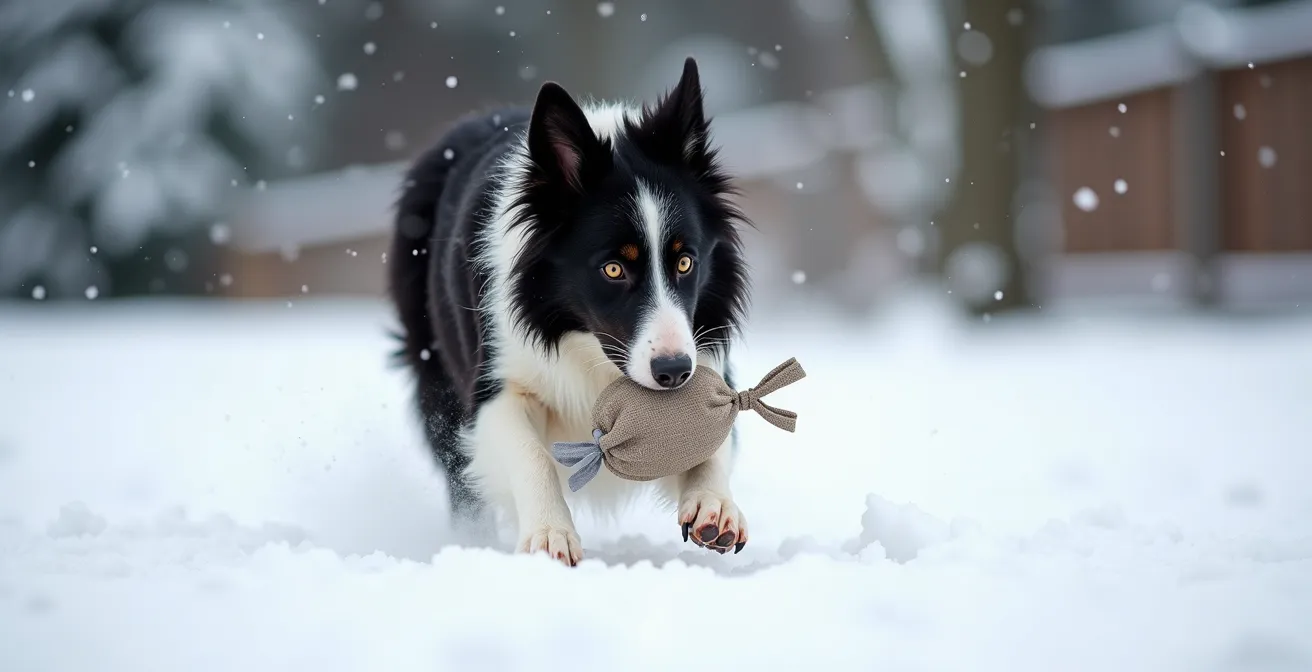
Contrary to popular belief, a structured game of tug is one of the single best tools for teaching high-drive dogs impulse control, not aggression.
- Tug doesn’t create aggression; it reveals a lack of communication and rules, which can be fixed.
- The goal isn’t to “win” or dominate the dog, but to use the game’s mechanics to build a reliable “off-switch.”
- Proper technique is non-negotiable to protect your dog’s physical health, especially their neck and joints.
Recommendation: Stop avoiding tug. Instead, learn to use it as a precision training tool to channel your dog’s drive into a focused, controlled partnership.
You feel the power thrumming through the rope, a low growl vibrating from your dog’s chest. For owners of powerful breeds like shepherds or bullies, this moment can be intimidating. You’ve probably heard the warnings: “Tug makes dogs aggressive,” or “You’re just teaching them to fight you.” This fear is valid, and it causes many owners to shelve one of the most powerful training tools they have. Many guides suggest generic rules like “be the boss” or simply “teach ‘drop it’,” but they fail to address the real problem: how to manage the explosive arousal of a high-drive dog and communicate clearly in the heat of the moment.
But what if the growl wasn’t a threat, but a sign of intense engagement? What if the pulling wasn’t a challenge to your authority, but a biological instinct you could harness? The truth is, tug isn’t a game of strength; it’s a structured dialogue for building your dog’s ‘off-switch’. The key isn’t to suppress your dog’s power but to channel it. By shifting your perspective from seeing tug as chaotic play to a precision training exercise, you can transform that raw drive into focus, build bulletproof impulse control, and forge a deeper bond built on clear communication.
This guide will deconstruct the game of tug, moving beyond the myths to give you the mechanics of drive-building. We will cover the essential rules of engagement, the correct techniques to ensure safety, how to read your dog’s arousal levels, and how to adapt the game to satisfy their deepest instincts, even in a suburban backyard or a downtown condo. It’s time to pick up the toy with confidence.
This article provides a complete framework for turning a potentially worrying game into a cornerstone of your training. Explore the sections below to master each component of controlled, productive tug play.
Summary: Master the Art of Controlled Tug Play
- Why Is the “Tug Makes Dogs Aggressive” Myth False?
- How to Teach an Instant “Out” Command During High Arousal?
- French Linen or Jute: Which Bite Roll Material is Safer for Teeth?
- The Whiplash Danger: Why Shaking the Toy Side-to-Side is Risky
- When to End the Game: Stopping Before Over-Arousal Occurs
- How to Channel Herding Instincts in a Suburban Backyard?
- Flirt Pole or Hallway Fetch: Which Builds More Drive in Small Spaces?
- How to Train Jump Sequences Without Destroying Your Dog’s Joints?
Why Is the “Tug Makes Dogs Aggressive” Myth False?
The belief that tug-of-war fosters aggression is the single most persistent myth that holds owners back. This idea stems from a misunderstanding of canine drive and play. Aggression is rooted in fear, conflict, or resource guarding with intent to cause harm. A structured game of tug, however, is a cooperative activity that channels a dog’s natural prey drive—the instinct to chase, bite, and hold. The growling and shaking you see are often just expressions of effort and engagement, not malice. It’s the canine equivalent of a weightlifter grunting during a heavy lift.
The difference between a healthy game and a problematic one isn’t the tugging itself, but the absence of rules and communication. When a dog becomes possessive or overly frantic, it’s not because the game is inherently bad; it’s because the handler hasn’t established clear game mechanics. In fact, research from the University of Guelph’s Ontario Veterinary College, which surveyed 85 veterinary behavior experts, consistently points to a lack of socialization and training, not specific games, as a key driver of aggression.
A well-managed game of tug is a powerful tool for building a dog’s confidence and strengthening the handler-dog bond. As the American Kennel Club notes, it promotes impulse control and is a highly motivational training reward. Letting your dog “win” periodically by releasing the toy isn’t a sign of weakness; it’s a strategic move that prevents frustration and reinforces their desire to play *with* you. This builds engagement and teaches the dog that the fun comes from the interaction, not just from possessing the toy. By establishing rules, you are not suppressing their nature; you are teaching them how to control it.
How to Teach an Instant “Out” Command During High Arousal?
A reliable “Out” or “Drop It” command is the cornerstone of safe tug play; it’s the ‘off-switch’ that gives you complete control. Teaching this during low-arousal moments is simple, but getting a response when your dog is fully engaged in the game is the real test. The key is not to create a conflict by trying to pry the toy from their mouth. Instead, you need to make dropping the toy the most rewarding option available. The most effective way to achieve this is through the Two-Toy Method, a technique used by professional trainers to build a fast, clean release.
This method leverages the dog’s prey drive. You start the game with one tug toy. While the dog is pulling, you introduce a second, identical toy, wiggling it like prey to make it more exciting. As soon as you give your “Out” cue, you make the first toy go completely still and “dead.” Simultaneously, you increase the life and movement in the second toy. Most high-drive dogs will instinctively release the “dead” toy to engage with the new, “live” one. The moment they drop the first toy, you praise them and immediately start tugging with the second. This process teaches the dog that “Out” doesn’t mean the game ends; it means the fun switches to a new object.
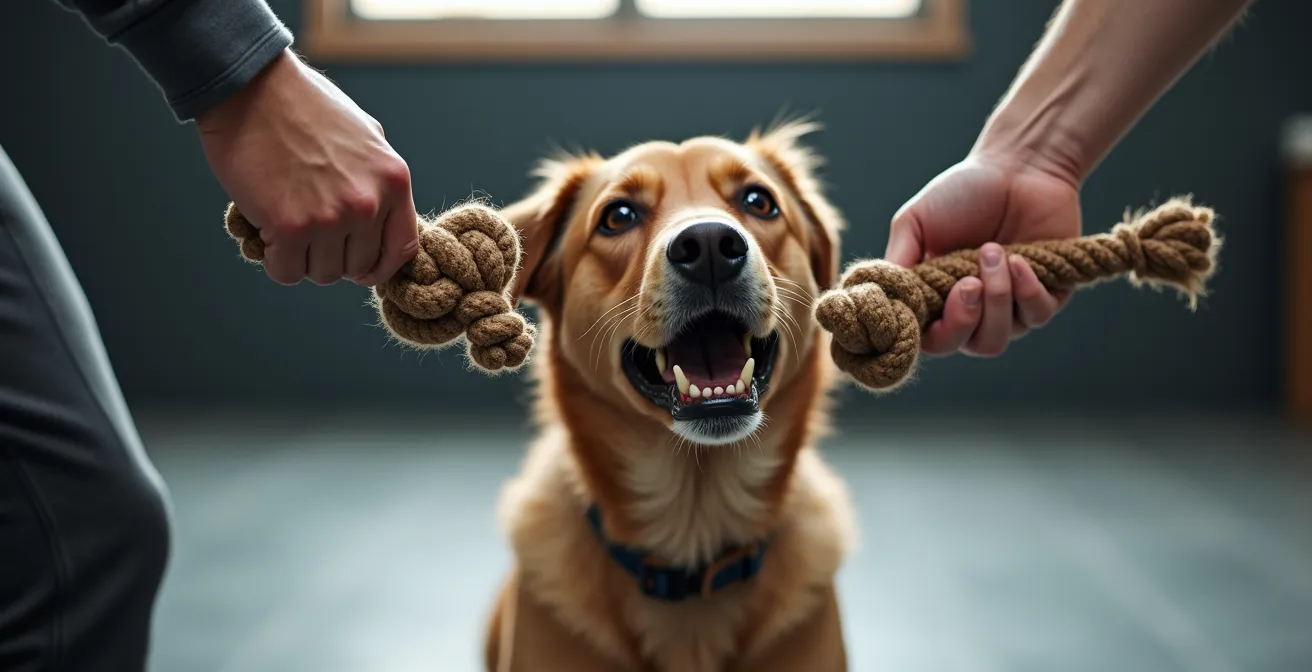
As you can see, the technique relies on making a clear distinction between a “live” toy and a “dead” one. Repeating this game mechanic builds an almost automatic response. Your dog learns that releasing the toy on command leads to an immediate continuation of the game they love. This is not about force or dominance; it is a clear piece of communication that uses the dog’s own drive to build a rock-solid ‘off-switch’. With consistency, the “Out” command becomes a reflex, even at the peak of excitement.
French Linen or Jute: Which Bite Roll Material is Safer for Teeth?
Choosing the right tug toy is about more than just durability; it’s a critical safety decision that directly impacts your dog’s dental health. For high-drive breeds, especially in a country with extreme weather like Canada, the material of the toy matters. The two most common professional-grade materials are French linen and jute, but synthetics and fleece also have their place. Your choice should depend on your dog’s age, bite strength, and where you’ll be training. For instance, some materials become brittle or dangerously hard in the freezing temperatures of a Canadian winter.
Specialized equipment is not just a luxury; it’s a necessity for safety and performance in dog sports. It’s no surprise that for over 15 years, Canadian dog sport professionals have relied on specialized equipment from brands like Redline K-9, which serves as the official equipment provider for the German Shepherd Schutzhund Club of Canada championships. This highlights the importance of using gear designed for the task.
To make the best choice for your dog, especially considering the diverse Canadian climate, this comparison breaks down the most common materials:
| Material | Cold Weather Performance (-20°C) | Durability | Tooth Safety | Best Use Case |
|---|---|---|---|---|
| French Linen | Can become brittle in extreme cold | High durability, resists fraying | Softer on teeth, passes thumbnail test | Indoor winter training, moderate biters |
| Jute | Absorbs water, can freeze solid | Very durable, professional grade | Rougher texture, harder on teeth | Building grip strength, advanced dogs |
| Synthetic (Firehose) | Maintains flexibility in cold | Extremely durable | Medium hardness | All-weather outdoor training |
| Fleece/Cotton | Remains soft in cold | Lower durability | Safest for teeth | Puppies, seniors, gentle play |
For most Canadian owners, a combination of toys is ideal. A synthetic firehose tug is an excellent all-purpose choice for outdoor play, as it won’t freeze or become brittle. For indoor training sessions or for younger dogs, a softer French linen or fleece toy is a safer option for developing teeth. Jute should generally be reserved for experienced handlers working with mature dogs on specific grip-building exercises.
The Whiplash Danger: Why Shaking the Toy Side-to-Side is Risky
One of the most common and dangerous mistakes handlers make during tug is violently shaking the toy from side to side. While it might look like enthusiastic play, this action puts immense torque on the dog’s cervical spine, creating a high risk of whiplash-style injuries. A dog’s neck is incredibly muscular, but it’s not designed to withstand rapid, forceful lateral movements, especially when they are bracing against your pull. This is not just a theoretical risk; it can lead to acute spinal cord damage, intervertebral disc disease, or chronic pain.
Veterinary professionals emphasize caution with any potential spinal trauma. As experts in Today’s Veterinary Practice advise in their clinical guidelines on acute spinal cord injuries:
Whenever spinal cord injuries secondary to trauma are suspected, manipulate the patient as little as possible.
– Today’s Veterinary Practice, Acute Spinal Cord Injuries Clinical Guidelines
This principle of minimal manipulation should be applied proactively during play. The goal of tug is to build drive and control through the dog’s opposition reflex—their natural instinct to pull back against pressure. The safest and most effective way to engage this reflex is with a steady, straight-back pulling motion. Your role is to be a stable anchor, not an erratic opponent. This allows the dog to do the work, strengthening their core and rear muscles without jeopardizing their neck.
Your Action Plan: Safe Drive-Building Alternatives to Shaking
- Encourage straight-back pulling to build opposition reflex safely; keep the toy low to the ground to maintain proper body alignment.
- Use your body as a stable anchor point, planting your feet and using your core while the dog pulls steadily backward.
- Allow the dog to “pop” or shake the toy on their own while you hold your end of the toy perfectly still.
- Practice controlled resistance by matching your dog’s pulling force with steady tension, avoiding any sudden jerks or yanks.
- Incorporate brief pauses where the toy goes completely still to reset arousal levels and reinforce your control of the game.
When to End the Game: Stopping Before Over-Arousal Occurs
Knowing when to stop the game is just as important as knowing how to start it. Pushing a high-drive dog too far can lead to over-arousal, a state where their brain’s “thinking” part is overwhelmed by its “reacting” part. In this state, a dog can no longer process cues, their bite pressure can become harder, and they may exhibit frantic or reactive behaviors. The goal is to end the game while the dog is still engaged and successful, but before they go “over the threshold.” This leaves them wanting more and reinforces a positive association with the training session.
To do this effectively, you must become an expert at reading your dog’s body language. Journey Dog Training outlines a helpful Canine Arousal Ladder that identifies this progression. Stopping the game at Level 2 or 3 maintains your dog’s ability to learn and respond, preventing the escalation to a point of no return. The levels are:
- Level 1 (Calm Focus): Soft eyes, loose body, responds to all cues.
- Level 2 (Engaged): Forward ears, tail up, may still take treats gently.
- Level 3 (Excited): Harder eye contact, a tighter and more possessive grip on the toy, may start to miss some cues. This is the ideal zone to end the game on a high note.
- Level 4 (Over-Threshold): Dilated pupils (“whale eye”), excessive panting, no longer responding to known commands. If you reach this level, you’ve gone too far.
Once you’ve ended the tug session, the job isn’t done. You need a structured cool-down protocol to help your dog’s nervous system return to a calm state. This is especially crucial for dogs living in apartments or condos where space is limited. Simply stopping the game and expecting the dog to settle can lead to frustration behaviors like barking or destructive chewing. A five-minute cool-down protocol can effectively redirect their remaining energy into calming activities.
- Minute 1: Drop the tug toy and scatter 5-6 high-value treats on the floor. This encourages calm sniffing and searching behavior.
- Minutes 2-3: Transition to a sniff mat or a simple food puzzle to engage their brain and scenting abilities.
- Minute 4: Practice three calm ‘sit-stay’ or ‘down-stay’ cues with increasing duration (e.g., 5, 10, and 15 seconds), rewarding calm stillness.
- Minute 5: Provide a stuffed Kong, a long-lasting chew, or a similar appropriate item in their designated rest area (crate or bed).
- Final Step: Maintain a quiet environment for at least 10 minutes after the protocol to allow their nervous system to fully reset.
How to Channel Herding Instincts in a Suburban Backyard?
For breeds like Border Collies, Australian Shepherds, or even German Shepherds, the urge to herd is a deeply ingrained genetic trait. In a suburban backyard with no sheep to manage, this instinct can manifest as frustrating behaviors like chasing cars, nipping at heels, or obsessively circling children. A structured game of tug can be the perfect outlet to satisfy this drive, but it must be applied with purpose. It’s not just about pulling; it’s about using the toy to direct movement and reward control, which is the very foundation of herding work.
In fact, impulse control is a non-negotiable prerequisite for any formal herding activity. According to Canadian Kennel Club standards for herding trials, a dog must demonstrate the ability to be controlled and directed by the handler before they are ever allowed to work with livestock. This proves that control is the first step in channeling instinct, not a barrier to it. You can build this exact skill in your own backyard.
One highly effective protocol is the “Shadow Herding” technique. This game adapts traditional herding movements to small spaces using a tug toy as both a motivator and a target. The handler acts as the “flock,” and the dog learns to circle them on cue. The steps are simple:
- 1. Build Toy Drive: Ensure your dog has a strong desire for a specific tug toy. In Canadian winters, a brightly coloured toy is especially useful for visibility against snow.
- 2. Introduce Directional Cues: While holding the toy, use a directional cue like “Away” (move clockwise) or “Come By” (move counter-clockwise) and toss the toy a short distance in that direction for the dog to grab.
- 3. Shape the Circle: Gradually, instead of tossing the toy, you’ll use it as a lure to guide the dog in a circle around your body before rewarding with a short game of tug.
- 4. Add Control: The game is punctuated by “Out” and “Down” commands, teaching the dog to stop their movement instantly on cue, just as they would need to do with live sheep.
This technique doesn’t just burn energy; it gives your dog a “job” that satisfies their mental and genetic needs, preventing the development of undesirable behaviors and strengthening your partnership.
Flirt Pole or Hallway Fetch: Which Builds More Drive in Small Spaces?
For Canadian dog owners facing long winters or living in condos, exercising a high-drive dog indoors is a major challenge. Two of the most popular tools for small spaces are the flirt pole and simple hallway fetch. While both are excellent for burning energy, they build very different skills. Choosing the right one depends on your training goals: are you trying to build prey drive and agility, or are you focused on reinforcing the retrieve and the ‘out’ command?
A flirt pole, which is essentially a giant cat toy for dogs, is unparalleled for building prey drive, practicing sharp direction changes, and teaching control during high-speed chases. It’s ideal for sight hounds and terriers. A key benefit is the high energy burn rate with a relatively low noise level, making it perfect for apartment living. The game inherently requires impulse control, as the dog must learn to “out” the lure and wait for the cue to start the chase again.
Hallway fetch, on the other hand, is a more linear game. It primarily reinforces the act of retrieving and returning a toy. While it has a moderate energy burn, the potential for noise from paws skidding on floors is higher. This game is excellent for practicing a fast ‘out’ command upon the dog’s return and is a natural fit for retriever breeds. However, it lacks the dynamic movement and directional changes of a flirt pole, focusing more on transactional repetition.
For the specific goal of building drive and impulse control simultaneously, the flirt pole often has the edge in small spaces. It more closely mimics the unpredictable chase of prey, forcing the dog to stay mentally engaged with the handler to see where the lure will go next. Controlled tug remains a top contender for the smallest spaces, like a 4×4 foot area, as it builds immense grip strength and impulse control with virtually no noise. Ultimately, the best approach is to vary the games to keep your dog mentally stimulated and physically conditioned through the long indoor season.
Key Takeaways
- Tug is a tool for communication and control; the growling is effort, not aggression.
- A reliable “Out” command is the non-negotiable ‘off-switch’, best taught using the Two-Toy Method.
- Safe technique is paramount: always encourage a straight-back pull and never shake the toy side-to-side.
How to Train Jump Sequences Without Destroying Your Dog’s Joints?
For high-drive dogs, activities often involve jumping—whether it’s for a frisbee, in an agility sequence, or even just leaping for a tug toy. While this is a natural expression of their athleticism, repetitive high-impact jumping can be devastating to a dog’s joints, especially if started too early. The most critical factor to consider is the dog’s age. A puppy’s bones have soft areas at the ends called growth plates, which are responsible for bone elongation. These plates are vulnerable to injury from excessive force.
According to general veterinary guidelines, a dog’s growth plates close between 12 and 18 months of age, with larger breeds typically maturing later. Engaging in high-impact or repetitive jumping exercises before these plates have fully hardened can cause permanent damage, leading to deformed limbs, arthritis, and a lifetime of pain. Therefore, any structured jump training should be postponed until your dog is at least 18 months old. Until then, the focus should be on building a strong foundation through low-impact proprioception exercises.
Proprioception is your dog’s sense of body awareness. Improving it helps them learn how to place their feet carefully and move their body efficiently, which drastically reduces the risk of injury later in life. You can use everyday objects, many of which are easily found on Canadian trails or in your home, to create a fun and effective conditioning program:
- Log Walks: On your local trails, practice having your dog walk carefully over fallen logs of varying heights and textures. This teaches them to adjust their footing naturally.
- Homemade Wobble Board: For indoor balance work, you can create a simple wobble board using an old skateboard deck placed on a stable, rounded object.
- Hockey Stick Cavaletti: Set up a series of hockey sticks as low cavaletti poles (2-4 inches off the ground). This encourages your dog to lift their feet carefully and deliberately without any impact.
- “Paws Up” Drills: During walks, ask your dog to place their front paws up on park benches or stable rocks, holding the position for a few seconds to build core and rear-end strength.
- Pool Noodle Poles: Foam pool noodles laid on the ground are excellent, safe ground poles for practicing careful foot placement.
By focusing on these foundational exercises, you build a physically resilient and mentally aware dog, preparing their body for the demands of more advanced activities once they are fully mature.
Start implementing these safe and structured game mechanics today. By transforming your dog’s raw drive into a focused, controlled partnership, you’re not just playing a game; you are building a stronger, safer, and more trusting relationship that will last a lifetime.