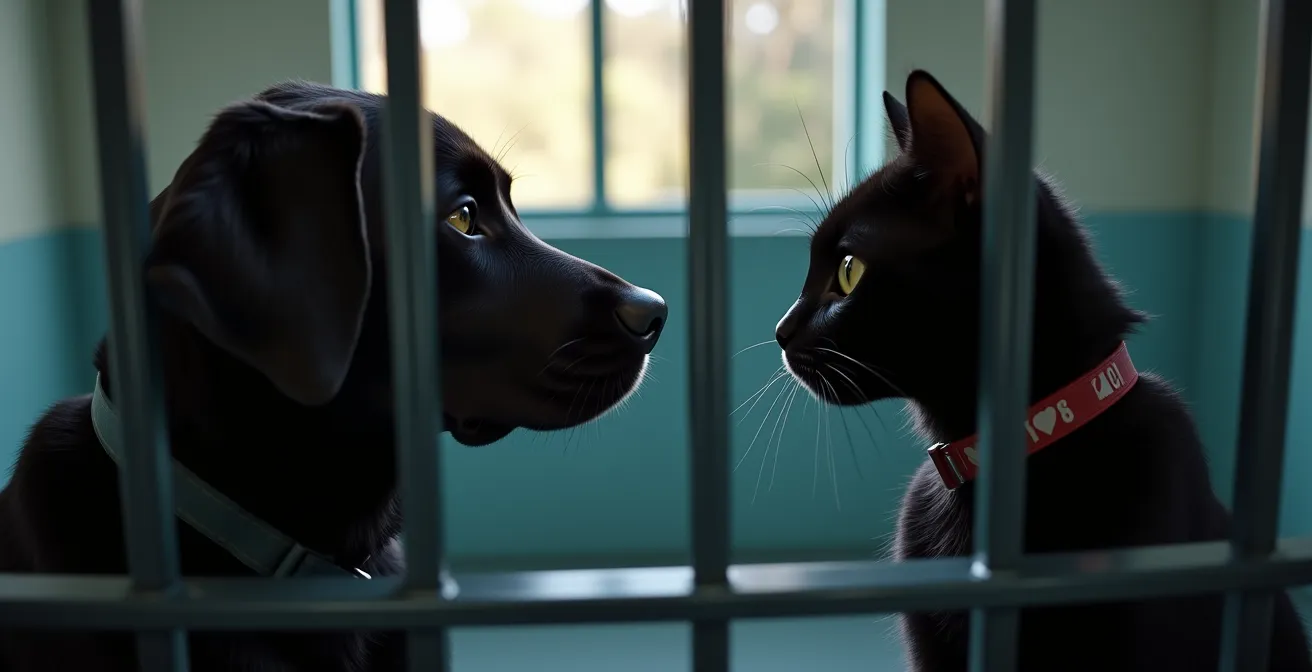
Contrary to popular belief, superstition isn’t the main reason black pets linger in Canadian shelters; the real culprits are subtle, systemic disadvantages within the shelter system itself.
- Poor kennel lighting and low-quality photos make it difficult for adopters to see a black pet’s personality, creating an “operational blind spot.”
- Generic or negatively-framed adoption bios fail to create an emotional connection, reinforcing unconscious biases instead of showcasing the individual animal.
- Overlooking a black pet often means missing out on a senior animal that is calmer, already trained, and less expensive in the first year than a puppy.
Recommendation: When you next visit a shelter, consciously ask to meet a black dog or cat outside of its kennel and use a “chemistry test” to connect with its personality, not just its appearance.
As a shelter director in Canada, I see it every day. A potential adopter walks down a row of hopeful faces, their eyes scanning for a connection. They pause at the bouncy Labrador, smile at the fluffy calico, but their gaze so often glides right past the sleek black dog or the elegant black cat waiting quietly in the shadows. It’s a phenomenon we in the animal welfare community know all too well: “Black Dog and Cat Syndrome.” Many people assume this bias is rooted in outdated superstitions about bad luck or negative portrayals in movies. While those cultural echoes play a small part, they are not the driving force.
The truth is far more practical and, in many ways, more frustrating. The challenge these beautiful animals face is often systemic, built into the very operations of the shelters meant to save them. It’s a problem of poor lighting that flattens their features into a silhouette, of hastily written biographies that fail to capture their unique spark, and of compounding biases where a “pit bull” head shape on a black dog creates a double barrier to adoption. These are not issues of malice, but of “operational blind spots” that unintentionally sentence our most numerous residents to the longest waits.
This isn’t just about fairness; it’s about saving lives. With shelters across Canada, like the Ottawa Humane Society reporting a 15% intake increase in early 2024, finding homes efficiently is more critical than ever. This guide is an inside look at why this syndrome persists and, more importantly, a playbook for how you, as a potential adopter, can look beyond the shadows to find your perfect companion. We will dismantle the myths, reveal the hidden system flaws, and give you the tools to see the individual, not the colour.
To help you navigate this topic, this article breaks down the complex factors contributing to “Black Pet Syndrome” in Canadian shelters and offers practical ways to overcome them. Here is a look at what we will cover.
Summary: Why Black Dogs and Cats Still the Last to Be Adopted in Canada?
- Why Does Bad Lighting Sentence Shelter Animals to Longer Waits?
- How to Write an Adoption Bio That “Sells” a Shy Dog in 30 Seconds?
- Senior Dog vs. Puppy: Which is Actually Cheaper in the First Year?
- The Pit Bull Label: Why Judging a Dog by Its Head Shape is statistically Flawed
- How to Test Chemistry with a Shelter Dog in Just 15 Minutes?
- The “He Knows He’s Wrong” Fallacy: Why Guilt Is a Human Projection
- Why Can You Not Predict Aggression Based on a Dog’s Physical Appearance?
- Why Was Your Adoption Application Denied Despite Being a Good Owner?
Why Does Bad Lighting Sentence Shelter Animals to Longer Waits?
The first barrier a black pet faces in a shelter is purely physical: they are incredibly difficult to see properly. Most shelters, operating on tight budgets, are lit with standard, cool-toned fluorescent or LED fixtures. This type of lighting is harsh and lacks a high Colour Rendering Index (CRI), which is the ability to show colours faithfully. For a black animal, this is a disaster. Their glossy fur, which might have rich undertones of chocolate or blue in natural light, absorbs the poor-quality light and appears as a flat, featureless void. This creates a significant “operational blind spot” in our adoption process.
This problem is magnified in adoption photography, the single most important tool we have for reaching potential adopters online. According to animal welfare organizations, black fur doesn’t translate well in photographs because the lack of contrast makes it nearly impossible to capture the animal’s expressive eyes, gentle smile, or inquisitive brow. The result is a gallery of dark, indistinct shapes next to brightly-lit, clearly-defined tabbies and golden retrievers. An adopter scrolling through a website makes a snap judgment in seconds, and an animal whose features aren’t immediately visible is at a profound disadvantage.
To overcome this, shelters are learning the importance of investing in better lighting for photography and meet-and-greet rooms. A high-CRI light source can reveal the subtle beauty of a black coat and allow an animal’s personality to shine through.
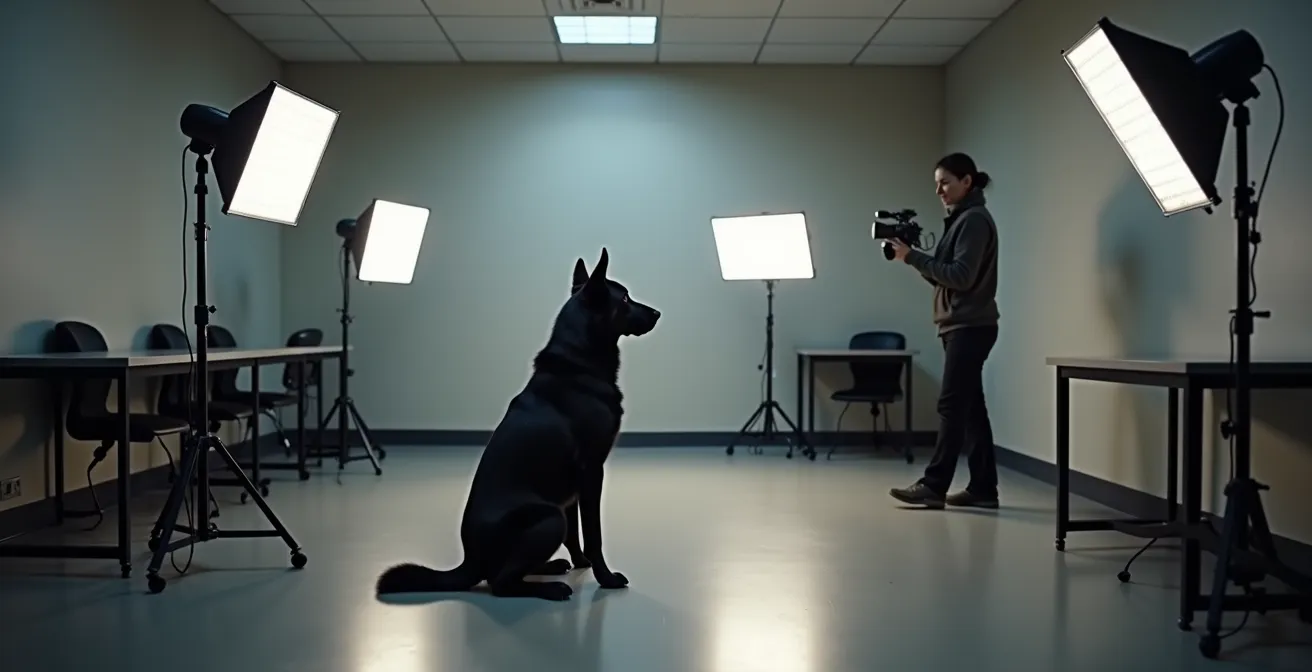
As this setup demonstrates, the difference is not subtle. Proper lighting transforms a potential adoptee from a shadow into a stunning individual. For adopters, the lesson is clear: never judge a black pet by its kennel photo. Always ask to see them in a well-lit area or, even better, outdoors. You will be amazed at the detail and character that a simple change in lighting can reveal, moving beyond the perceptual fluency that makes us favour easily-processed images.
How to Write an Adoption Bio That “Sells” a Shy Dog in 30 Seconds?
If a photo is the first impression, the adoption biography is the conversation starter. For a black pet, and especially a shy one, this short piece of text is often the only chance to showcase the personality hidden behind a dark coat and a reserved demeanour. Unfortunately, many shelter bios fall into predictable and unhelpful traps. Pressed for time, staff and volunteers often rely on generic phrases like “sweet and friendly” or, worse, use language that unintentionally reinforces negative stereotypes. Phrases like “a shadow in the night” or “a void of love” are meant to be poetic but can trigger unconscious bias in potential adopters.
The key to a successful bio is “narrative reframing”—moving beyond physical appearance to paint a vivid picture of life with that specific animal. This requires a focus on sensory details and specific behaviours. Instead of saying a black cat is “affectionate,” describe how her fur feels “like crushed velvet” or how her purr “rumbles like a tiny motor.” Instead of labelling a shy black dog as “timid,” detail his endearing habits: “He’ll greet you each morning with a gentle, sweeping tail wag and wait patiently for you to finish your coffee before nudging your hand for a walk.”
This approach helps an adopter visualize the animal in their home, creating an emotional connection that transcends coat colour. As the PAWS Organization notes in their research on what is often called “Black Dog Syndrome,” this bias is a well-documented phenomenon in the rescue community. The antidote is powerful, specific storytelling.
Black pets are often overlooked in shelters, leading to lower adoption rates compared to their lighter-colored counterparts. This phenomenon, often referred to as ‘Black Dog Syndrome’ or ‘Black Cat Syndrome,’ is a form of color bias well documented in animal rescue and adoption communities.
– PAWS Organization, The Scary Truth About Black Cat and Dog Adoption Rates
By focusing on unique personality traits and using emotionally resonant language, we give these animals a voice. We tell a story that says, “I am more than my colour. I am a companion with quirks, habits, and a world of affection to give.” This simple shift in narrative can be the difference between a life spent in a kennel and a life spent in a loving home.
Senior Dog vs. Puppy: Which is Actually Cheaper in the First Year?
Another layer of bias that frequently affects black dogs is age. Because they tend to wait longer for adoption, many black dogs in shelters are no longer cute, clumsy puppies; they are mature adults or distinguished seniors. Adopters, often dreaming of raising a puppy from scratch, overlook these older dogs, assuming they will be more expensive or have more health problems. However, in the first year of ownership, a senior dog is almost always the more financially sound choice, a crucial consideration as post-pandemic pet surrenders rise due to financial strain.
Data from across Canada highlights this pressure. In 2022, for instance, there was a 75% increase in pets surrendered to Toronto shelters compared to the previous year, often due to cost-of-living increases. A puppy’s first year is a whirlwind of expenses: multiple sets of vaccinations, spay/neuter surgery (often costing $500-$1000+), initial supplies like crates and pens, and the potential cost of repairing chewed-up furniture. A senior dog, by contrast, typically comes from the shelter already spayed or neutered, fully vaccinated, and house-trained. Their personality is already formed, meaning you know exactly what you’re getting—a calm couch companion rather than a tiny, energetic tornado. While senior pets can have age-related health issues, many shelters offer reduced adoption fees or even medical support for known conditions.
The table below, showing adoption statistics from major Canadian shelters, underscores the sheer volume of animals needing homes. Each number represents an individual, many of whom are overlooked adults.
| Shelter | Total Adoptions | Dogs/Puppies | Cats/Kittens | Year-over-Year Change |
|---|---|---|---|---|
| Regina Humane Society | 2,085 | 453 | 1,612 | +6% from 2021 |
| Calgary Humane Society | 2,371 | Not specified | Not specified | +12% from 2021 |
| Ontario SPCA | 3,918 | 911 | 2,693 | +16% from 2021 |
By choosing a senior, you are not only saving on initial costs but also giving a deserving animal a comfortable and loving retirement. You are skipping the exhausting puppy phase and gaining an instant, grateful companion. For many households, especially those with busy schedules, a senior black dog is not a compromise; it’s the perfect fit.
The Pit Bull Label: Why Judging a Dog by Its Head Shape is statistically Flawed
For a black dog, the challenges of perception are often compounded by a second, more potent bias: breed labelling. Many black, medium-sized dogs with short fur and muscular builds are arbitrarily labelled as “pit bull-types.” This label, regardless of the dog’s actual genetics or individual temperament, brings with it a mountain of negative stereotypes and, in some parts of Canada, legal restrictions. When this “pit bull” label is applied to a black dog, it creates a form of double jeopardy that can make adoption nearly impossible. Statistics consistently show that black pit bulls still wait the longest time to get adopted and are at the highest risk of euthanasia.
The irony is that “pit bull” is not even a recognized breed but a loose category encompassing several distinct breeds and a multitude of mixed-breed dogs. Visual identification of these breeds is notoriously inaccurate, even by shelter professionals. We are essentially judging a dog based on the shape of its head. This is the canine equivalent of profiling, and it ignores the single most important factor: individual personality and behaviour. These dogs are often some ofthe most loyal, affectionate, and resilient animals in the shelter system.
Interestingly, some research suggests that the breed label may be a more significant barrier than coat colour itself. A groundbreaking study challenged the very existence of Black Dog Syndrome, proposing that other factors are more at play.
A 2016 study published in Animal Welfare found black dogs were actually more likely to be adopted than dogs with lighter coat colours. This casts doubt on the existence of black dog syndrome, and author Christy Hoffman suggests that other breeds (such as pit bulls and other bully dogs) are more likely to be overlooked than black dogs.
– Christy Hoffman, Animal Welfare Journal Study
This doesn’t mean black dogs don’t face challenges, but it highlights that the problem is complex. It’s a combination of colour, perceived breed, age, and behaviour that creates a cumulative disadvantage. As an adopter, the most powerful thing you can do is ignore the label on the kennel card and meet the dog inside.
How to Test Chemistry with a Shelter Dog in Just 15 Minutes?
So, you’ve decided to look past the kennel card and the blurry online photo. How do you connect with a black dog whose expressions might be harder to read at first glance, especially in the stressful shelter environment? The key is to move beyond a purely visual assessment and conduct a simple “chemistry test.” This isn’t about running through a formal temperament test; it’s about facilitating a short, low-pressure interaction to see if your personalities mesh. A great framework for this is the “Three P’s”: Patience, Pressure, and Play.
First, practice Patience. A dog, especially one who has been in a shelter for a while, may be reserved or overly excited. Ask a volunteer to bring the dog to a quiet meeting room or outdoor pen. Instead of approaching them directly, sit on the ground and let them come to you. This respects their boundaries and allows you to gauge their natural level of confidence and curiosity. A dog that approaches, sniffs, and moves away is just gathering information. A dog that stays near or makes gentle contact is showing interest.
This is when you can see the subtle cues that are often missed in black dogs. A relaxed posture, a soft eye, a slightly open and panting mouth—these are all signs of a comfortable dog. Look for the “whale eye” (showing the whites of the eyes) or a tucked tail as signs they may need more space.
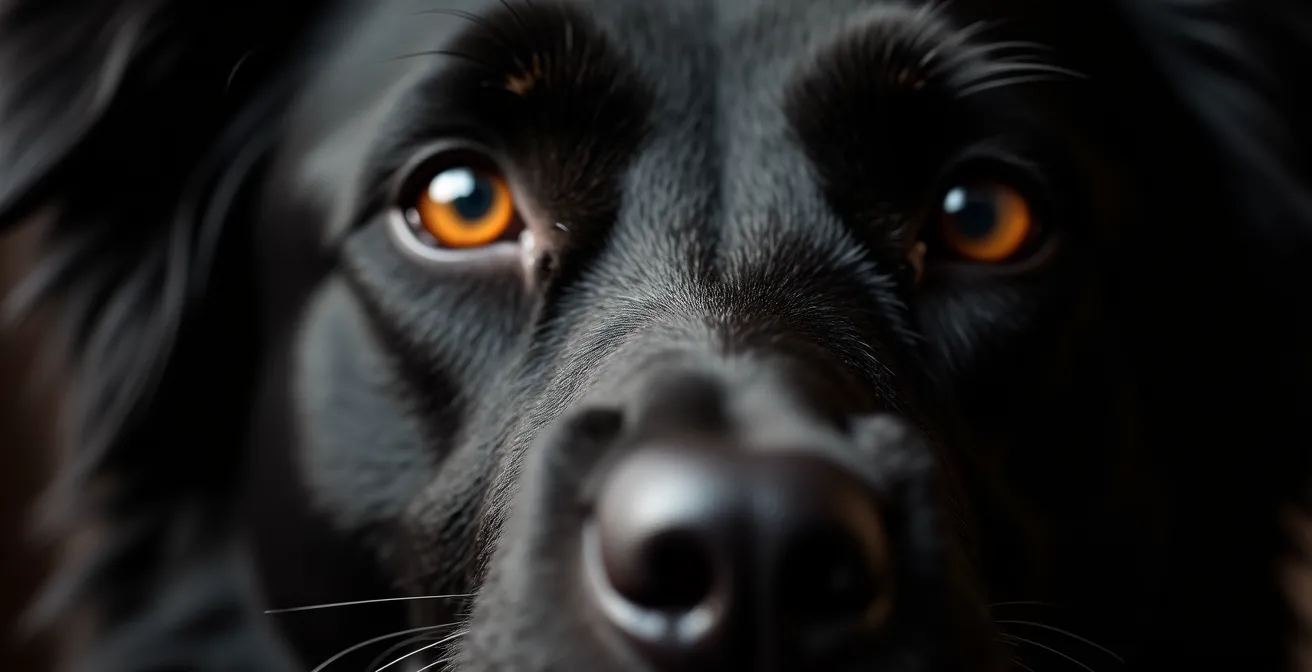
Once the dog shows signs of comfort, you can move to the next two P’s. This structured approach provides a clear path to understanding the animal beyond its appearance, ensuring you make a connection based on true compatibility.
Your 15-Minute Chemistry Test: The “Three P’s” Framework
- Consent: Let the black dog approach you first rather than reaching out immediately. This respects their boundaries and allows you to gauge their comfort level without adding pressure.
- Pressure: Observe their reaction to gentle petting on the chest or side (avoid the top of the head initially). Watch for positive signs like leaning in, a soft body, or a wagging tail.
- Play: Casually offer a toy without forcing interaction. See if they show interest by sniffing, pawing, or picking it up. Note their play style—is it gentle, energetic, or are they not interested right now? This reveals a huge part of their personality.
The “He Knows He’s Wrong” Fallacy: Why Guilt Is a Human Projection
One of the most pervasive myths that harms black dogs is the projection of human emotions onto them, especially negative ones like guilt or malice. An adopter might see a large, dark-coloured dog cowering in the back of its kennel and interpret that behaviour through a human lens: “He looks menacing,” or “He must have done something wrong.” This is a fundamental misunderstanding of canine behaviour. The “guilty look”—averted eyes, lowered head, tucked tail—is not an admission of wrongdoing. It is a posture of appeasement, a signal designed to de-escalate a perceived threat. The dog isn’t feeling guilty; it’s feeling scared or anxious.
This fallacy is particularly damaging for black dogs, as their colour is already associated with negative stereotypes in media and folklore. Research from animal welfare groups has shown how these portrayals impact perception.
Dark-colored dogs are often depicted as threatening and unapproachable. These negative stereotypes can make potential adopters hesitate, mistakenly worrying that a black dog might be more difficult to handle or train.
– PAWS Animal Welfare Research, The Scary Truth About Black Cat and Dog Adoption Rates
This creates a vicious cycle. An anxious dog displays appeasement signals, a human misinterprets them as a sign of a “bad” dog, and the dog remains in the shelter, becoming even more anxious. Furthermore, the sheer number of black pets entering shelters means they are, by default, the most represented in both adoption and euthanasia statistics. An ASPCA analysis revealed that while black dogs had the highest adoption numbers (32% of all adoptions), their high intake numbers mean they also feature prominently in negative outcomes. It’s a numbers game, not a reflection of their inherent “goodness” or “badness.”
Understanding this fallacy is crucial for any potential adopter. When you see a dog exhibiting “guilty” body language, your first thought should not be “What did he do wrong?” but “What is making him feel so insecure?” By shifting your perspective from judgment to empathy, you open the door to connecting with a wonderful animal that just needs a little patience and understanding to feel safe.
Why Can You Not Predict Aggression Based on a Dog’s Physical Appearance?
The most dangerous myth attached to certain dogs, particularly large, dark-coloured ones, is that their appearance can predict aggression. This belief is not only scientifically baseless but also deeply damaging to countless loving animals. There is absolutely no correlation between coat colour, head shape, or muscle mass and a dog’s propensity for aggression. Aggression is a complex behavioural response to a perceived threat, driven by factors like genetics, early socialization, training (or lack thereof), fear, and pain—not by the amount of melanin in their fur.
In fact, some studies directly contradict the “big black dog is scary” trope. One clever study used poodles of different sizes and colours to test human perception. The results were surprising: participants consistently ranked the large black poodles as *more friendly* than the white ones. This suggests that our biases are inconsistent and highly susceptible to context (a “scary” breed versus a “friendly” breed). It dismantles the idea that the colour black is intrinsically seen as aggressive.
Moreover, the entire concept of Black Dog Syndrome has been challenged by research. A 2013 study conducted in two New York no-kill shelters found that a dog’s coat colour had no discernible effect on its length of stay. While this doesn’t mean black dogs face no hurdles—the photography and visibility issues are very real—it does suggest that a simple “people don’t like black dogs” explanation is incomplete. The problem is a tapestry woven from many threads: breed stigma, age, size, and the operational challenges within shelters.
For an adopter, this is liberating. It means you can and should ignore all the visual stereotypes. The only reliable way to assess a dog’s temperament is through its documented history (if available), direct observation of its behaviour, and interaction guided by shelter staff who know the animal best. A dog’s character is revealed in its actions, not its appearance. By trusting behaviour over bias, you might just find the most gentle, loving soul wrapped in a sleek black coat.
Key takeaways
- “Black Dog Syndrome” is less about superstition and more about systemic issues in shelters like poor lighting and generic storytelling.
- Judging a dog by its photo is a mistake; always ask to meet a black pet in a well-lit space to see its true personality.
- Breed labels like “pit bull” are often inaccurate visual guesses that create an unfair double bias against black dogs.
Why Was Your Adoption Application Denied Despite Being a Good Owner?
Imagine this scenario: you’ve done your research, you’ve looked past the colour, and you’ve found the perfect black dog or cat. You fill out the application, confident you can provide a wonderful home, only to be denied. This can be a frustrating and demoralizing experience. While sometimes it’s due to a simple mismatch (e.g., a high-energy dog in a small apartment with no yard), other times it’s because shelter staff are exercising an abundance of caution specifically because the animal is black. This is not to punish you, but to protect the animal from a history of negative outcomes.
For black cats, this caution often peaks around Halloween, when some shelters historically limited adoptions to prevent them from being used as props or in cruel pranks. For large black dogs, especially those labelled as pit-bull types, screeners are looking for an owner who can handle not just the dog, but also the societal prejudice that comes with it. They need to be sure you have a secure living situation (e.g., no restrictive breed legislation in your city, a landlord who approves), and the confidence to advocate for your gentle giant when confronted with public fear.
The stakes are incredibly high. The simple, tragic truth is that being black puts an animal at a higher statistical risk. While intake numbers explain some of this, the outcomes remain stark. For example, some data shows a 74% euthanasia rate for black cats in certain shelters, with only a 10% adoption rate. Faced with statistics like these, adoption counsellors have a profound responsibility to get it right. They are looking for a truly “forever” home, because they know that for these animals, a return to the shelter is often a death sentence.
If you’re ready to look beyond the colour and find a hidden gem, the best first step is to visit your local Canadian shelter with an open heart and an open mind. Use the tools you’ve learned here to truly see the individuals waiting in the wings and start your own adoption story today.
Frequently Asked Questions on Why Are Black Dogs and Cats Still the Last to Be Adopted in Canada?
Why do shelters screen black cat adopters more carefully around Halloween?
Some shelters halt or restrict black cat adoptions around Halloween to prevent them from being used in cruel pranks or rituals, though this practice is becoming less common as shelters focus more on year-round adoption screening.
How can I address landlord concerns about adopting a black dog that might be perceived as aggressive?
Create a ‘pet resume’ including temperament assessment results, training certificates, references from previous landlords or veterinarians, and professional photos showing the dog’s friendly demeanor to counter visual bias.
What should I say if I’m worried my enthusiasm might seem overwhelming for a shy black dog?
Use language like ‘I’m experienced with timid dogs and understand the need for a slow, patient approach’ to demonstrate you understand the specific needs a long-stay black dog might have.