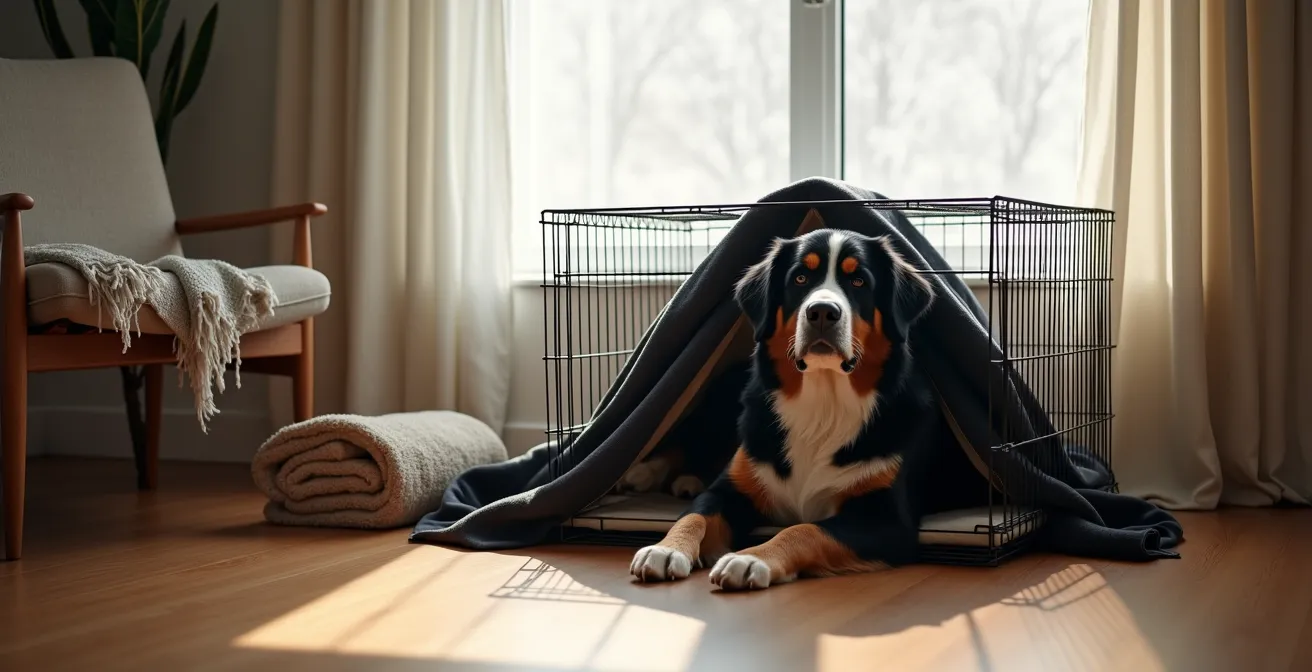
For an anxious dog, a den isn’t just a cozy bed—it’s a critical tool for managing a nervous system on high alert.
- It actively blocks overwhelming external triggers like storms, household traffic, and unexpected noises.
- It fulfills a deep-seated instinct for a predictable, controllable space, which is essential for a dog with a history of trauma or uncertainty.
Recommendation: Stop thinking of the crate as a ‘dog house’ and start treating it as a therapeutic sanctuary that allows your dog’s brain to perform essential sensory recalibration.
If you’re the owner of a rescue dog, you’re likely familiar with the heart-wrenching sight of pacing, whining, and an inability to settle. You see your dog in a state of high alert, scanning the environment, unable to switch off. It’s a common struggle for owners who have provided a loving home, only to find their dog is still living in a state of perpetual anxiety. Conventional wisdom often suggests simple solutions: more exercise, a comfy bed, or basic obedience training. While these have their place, they often fail to address the root cause of this deep-seated unease.
The problem is that many anxious dogs, particularly those from rescue situations, are in a state of constant sensory overload. Every sound from the street, every shadow moving past the window, every change in the home’s atmosphere contributes to a phenomenon called trigger stacking. Their brains are so busy processing potential threats that they never have a chance to enter a state of true rest. The pacing and vigilance aren’t bad behaviour; they are the outward expression of an overwhelmed nervous system desperately seeking control.
But what if the key wasn’t just making your dog comfortable, but giving them the power to control their sensory input? This is where the concept of a den moves beyond a simple ‘dog bed’ and becomes a therapeutic tool. The true power of a den, especially a covered one, is not just in providing shelter, but in creating a space for sensory recalibration. It’s an environment where your dog can intentionally dim the lights, muffle the sounds, and find a predictable stillness that the outside world denies them. This article will deconstruct the psychology of this safe space, showing you how to build and maintain a true sanctuary that helps your anxious dog finally find peace indoors.
To fully understand how to create this therapeutic environment, this guide explores every facet, from the science of storm anxiety to the specifics of orthopedic support. The following sections will provide a clear roadmap for transforming a simple crate into a powerful tool for your dog’s well-being.
Summary: Understanding the Den as a Therapeutic Tool for Anxious Dogs
- Why Do Dogs Seek Out Tight Spaces During Thunderstorms?
- How to Place a Dog Bed to Satisfy the “Sentry” Instinct Without Stress?
- Airline Kennel or Wire Crate: Which Reduces Visual Stimulation Better?
- The “Safe Zone” Violation: Why Dragging a Dog Out of Its Crate Causes Bites
- How to Choose Orthopedic Foam Density for a 100lb Dog?
- How to Place Your Diffuser for Maximum Coverage in an Open-Concept Home?
- How to Train Your Cat to Enter a Carrier in Under 30 Seconds During an Alarm?
- Why Do Dogs Seek Out Tight Spaces During Thunderstorms?
Why Do Dogs Seek Out Tight Spaces During Thunderstorms?
A dog’s frantic search for a hiding spot during a thunderstorm is more than just a fear of loud noises. It’s a reaction to a complex array of sensory inputs that they perceive long before we do. From a behavioral perspective, this is a classic example of an animal attempting to manage overwhelming environmental stimuli. The primary trigger isn’t always the clap of thunder itself, but the atmospheric changes that precede it. In fact, research indicates that dogs are highly sensitive to atmospheric changes, particularly the drop in barometric pressure that signals an approaching storm. This change can be physically uncomfortable, creating a sense of unease they can’t rationalize.
Beyond pressure changes, storms generate static electricity in the air. Dogs, especially those with long or double coats, can experience uncomfortable static shocks on their fur, nose, and ears. This is why you may see them retreat to grounded spaces like basements, bathtubs, or shower stalls—these locations can help dissipate the static charge. The low-frequency rumbles of distant thunder, often inaudible to humans, also contribute to the trigger stacking that pushes an anxious dog over their threshold.
Seeking a tight, enclosed space is a deeply ingrained instinct to counter this sensory assault. By squeezing into a closet, under a bed, or into a covered crate, the dog is instinctively attempting to create a buffer. A covered den significantly dampens the disorienting flashes of lightning and muffles the sharp cracks of thunder. For dogs in Canada, this behaviour is just as pronounced during intense winter storms. The den becomes a sanctuary that reduces the overwhelming sensory data, allowing their nervous system a chance to perform that crucial sensory recalibration. Covering the crate on three sides is a simple but powerful way to enhance this den effect, making it a dark, cozy shelter from the storm.
How to Place a Dog Bed to Satisfy the “Sentry” Instinct Without Stress?
For an anxious dog, the home is not a place of rest but a territory to be monitored. This “sentry instinct” is particularly strong in rescue dogs, who may feel a constant need to watch for threats. Placing their bed or crate in the wrong location can amplify this stress, turning their resting spot into a high-alert guard post. The goal is to position their den where they can feel part of the family “pack” without feeling responsible for front-line security. This is especially challenging in the open-concept homes common across Canada, where sightlines are long and boundaries are few.
To solve this, we must think in terms of zones. Identify your home’s “red zones” or Sentry Hotspots: the front door, the main entryway, and large picture windows looking onto the street. A crate placed with a direct view of these areas forces your dog into a constant state of vigilance. Conversely, a crate hidden away in a bedroom can induce isolation anxiety. The ideal location is a “green zone”—a quiet corner of a primary living area (like the living room or family room) where the family spends time. This placement should have one or two solid walls behind it for security and should be positioned out of the direct line of sight of the red zones.
This strategic placement allows the dog to observe the household’s normal comings and goings (the “yellow zone”) without being the first responder to every external event. The use of furniture, like the side of a sofa or a bookshelf, can create effective partial barriers, further reducing the perceived need to be on guard. It satisfies their need to be with their people while removing the pressure of a security role.
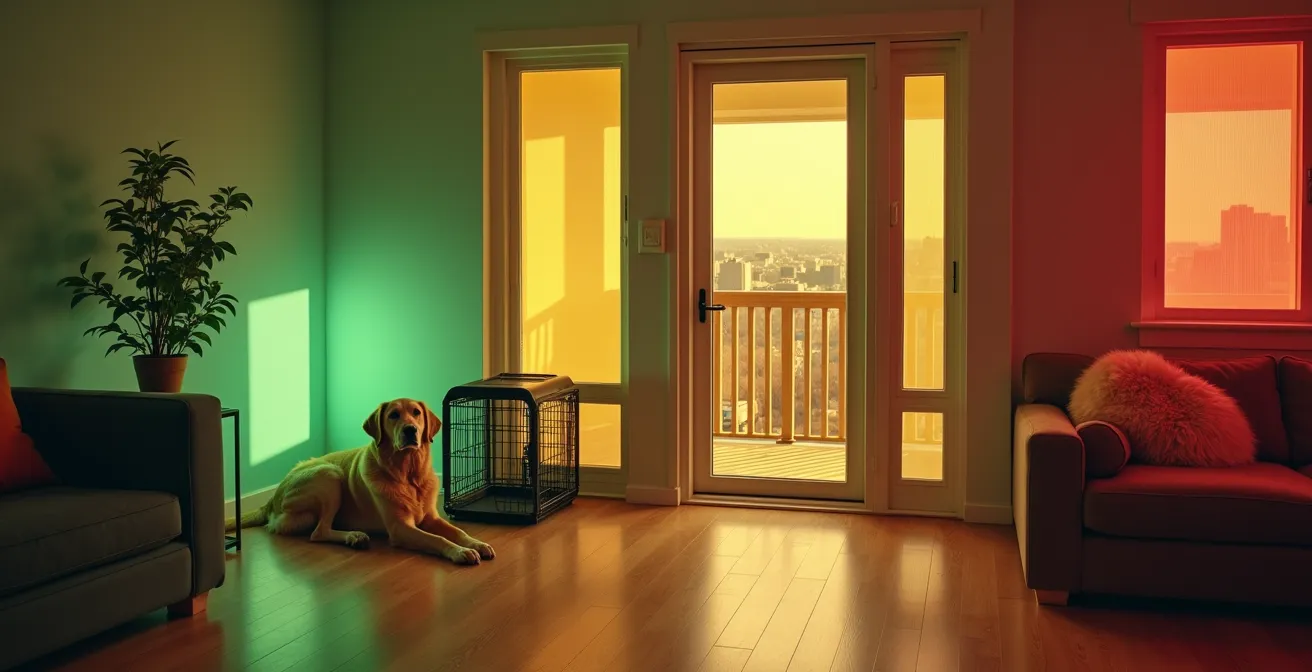
As the image above illustrates, the den is integrated into the family space but buffered from high-traffic and high-alert areas. This strategic positioning is fundamental to transforming the crate from a simple box into a place of genuine relaxation, allowing the sentry to finally go off-duty.
Action Plan: Creating Safe Zones in Your Home
- Identify your home’s ‘green zone’: Choose a quiet corner away from main traffic, typically in the living room but out of direct sightlines to the front door.
- Create the ‘yellow zone’: Mark areas where your dog can be present but relaxed, such as the main living area where family gathers.
- Define the ‘red zone’: Identify high-alert areas like front entrances and main windows that trigger sentry behavior.
- Position the crate in the green zone with one side against a wall for security.
- Use furniture or room dividers to create partial visual barriers from red zones.
Airline Kennel or Wire Crate: Which Reduces Visual Stimulation Better?
Once you’ve chosen the perfect location, the next question is what kind of den to use. The two most common options are the open-design wire crate and the enclosed plastic airline kennel. For a highly anxious dog, the choice has significant implications for managing sensory input. While a wire crate offers superior ventilation, its 360-degree view is a nightmare for a dog prone to visual trigger stacking. Every movement, shadow, or passing family member can keep their nervous system on high alert. Although a blanket can help, it’s often pulled down or chewed, and it does little to dampen sound.
An airline-style kennel, by contrast, is purpose-built for sensory reduction. Its solid, opaque walls are extremely effective at blocking visual stimuli, immediately creating a darker, more den-like interior. This enclosed design provides a significant advantage in helping an anxious dog’s brain switch off. As the Holistapet Expert Team notes in their “9 Best High Anxiety Dog Crates Review”:
A high anxiety crate with an enclosed style helps reduce outside triggers. Covered walls or small circle ventilation holes block out sights while still allowing airflow. This style gives nervous pets a den-like space that feels secure.
– Holistapet Expert Team, 9 Best High Anxiety Dog Crates Review
However, the choice isn’t always simple, especially within the context of Canada’s diverse climate. An airline kennel’s reduced airflow can become a serious overheating risk during a humid Montreal summer, while a wire crate can be dangerously drafty in a cold Calgary basement during winter. A balanced approach is often best, using the airline kennel as the primary sanctuary and ensuring the room’s ambient temperature is well-regulated.
The following table provides a sensory scorecard, factoring in these crucial Canadian climate conditions. The data is compiled from an analysis of crate features for anxious dogs.
| Feature | Airline Kennel | Wire Crate | Winner for Anxious Dogs |
|---|---|---|---|
| Visual Blocking | Excellent (solid walls) | Poor (requires cover) | Airline Kennel |
| Summer Ventilation (Montreal July) | Poor – can overheat | Excellent airflow | Wire Crate |
| Winter Insulation (Calgary basement) | Good heat retention | Too drafty | Airline Kennel |
| Sound Dampening | Moderate | Minimal | Airline Kennel |
| Canadian Brand Availability | Pet Valu, Canadian Tire | Widely available | Tie |
The “Safe Zone” Violation: Why Dragging a Dog Out of Its Crate Causes Bites
The single most important rule of a den is that it must be a sanctuary. This means it is a place of absolute safety, from which the dog chooses to enter and exit. When a human violates this sanctuary—by physically pulling the dog out, yelling into the crate, or using it as a place for punishment—the psychological damage is profound and immediate. This act, which we can call a Sanctuary Violation, shatters the dog’s trust and transforms their only safe space into another source of fear and conflict.
From the dog’s perspective, being cornered and forcibly removed from their den is a terrifying home invasion. It triggers a primal fight-or-flight response. With flight impossible, the only remaining option is fight. A bite in this context is not aggression; it is a desperate, defensive last resort from an animal that feels trapped and threatened in the one place it believed was safe. This is why behavioral research demonstrates that punishment-based methods, particularly those involving the crate, can dramatically increase fear-based aggressive and destructive behaviours.
A Sanctuary Violation poisons the crate, often permanently. The dog will begin to associate it with conflict and may refuse to enter it, or worse, may begin resource guarding the space with growls and snaps. The therapeutic value of the den is completely lost. It’s crucial for every family member, including children and guests, to understand that the dog in its crate is off-limits. They are not to be bothered, poked, or forced out for any reason other than a genuine life-or-death emergency.
But what about those true emergencies, like a fire alarm or a sudden evacuation order? Forcing the dog out is still the wrong approach. The solution is to train a specific, high-value emergency exit command that is never used in any other context. This preserves the sanctity of the den while ensuring your dog’s safety in scenarios all too familiar to many Canadians, from wildfire alerts in British Columbia to tornado warnings in Ontario.
How to Choose Orthopedic Foam Density for a 100lb Dog?
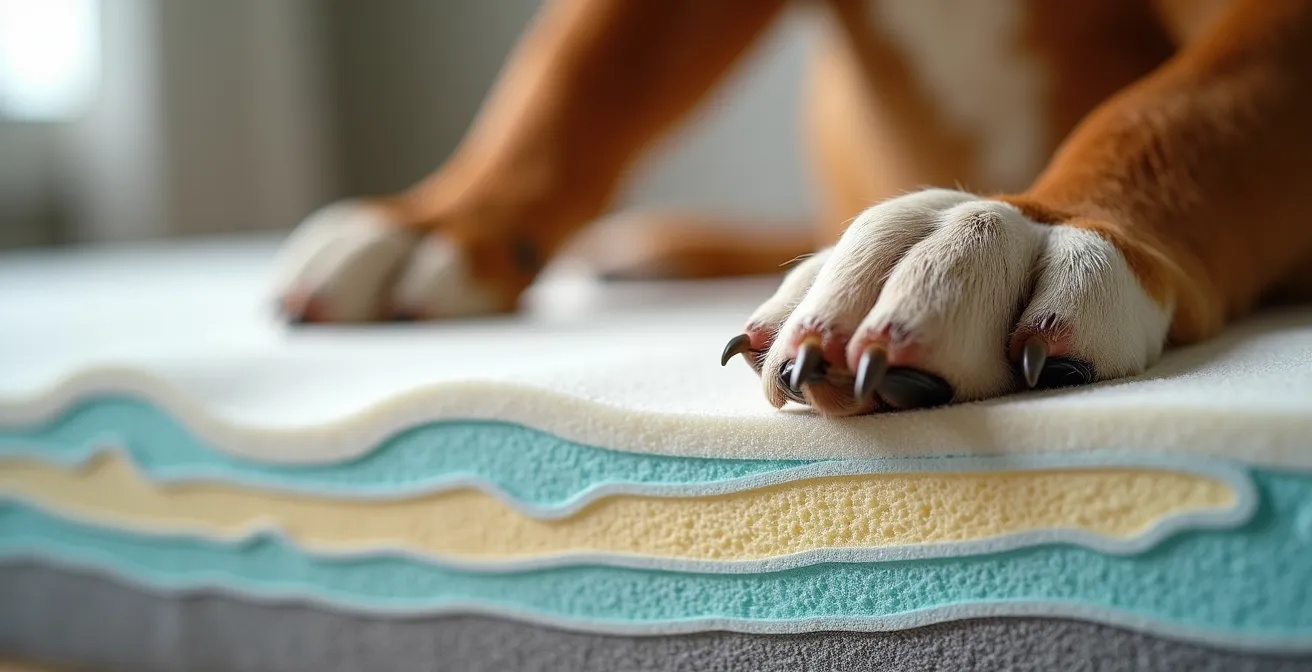
Creating a sanctuary is not just about psychological safety; it’s also about profound physical comfort. For a large breed dog, especially a senior or one with joint issues, a flimsy bed can be worse than no bed at all. A 100-pound dog like a Bernese Mountain Dog or Newfoundland requires significant support to prevent their joints from pressing through the foam and onto the hard floor. This is where understanding foam density and firmness becomes critical. Density, measured in pounds per cubic foot (lbs/ft³), indicates durability, while ILD (Indentation Load Deflection) measures firmness. For a large dog, you need both high density and appropriate firmness.
Memory foam is a popular choice, but it has a significant drawback in the Canadian climate: it becomes very rigid and hard in cold temperatures. A memory foam bed in an unheated cottage or a cool basement can be incredibly uncomfortable in the winter. High-resilience (HR) polyurethane foam or latex foam are often better all-season choices, as they maintain their flexibility and supportive qualities across a wider range of temperatures. For a 100lb dog, a base layer of foam should have a density of at least 2.8 lbs/ft³ and an ILD rating of 30 or higher to prevent “bottoming out.”
The visual below shows how different layers of foam work together to provide both comfort and support. The base layer is firm and dense to bear the weight, while the top layers offer a softer, contouring surface for comfort.
In response to this need, some Canadian companies are even engineering beds with extreme durability in mind. Products featuring heavy-duty, chew-resistant covers made of materials like ballistic nylon and reinforced with Kevlar thread are designed specifically for powerful dogs who may also exhibit destructive chewing behaviour as a symptom of their anxiety. These features ensure the bed is not only comfortable but also a lasting investment.
This comparative analysis of foam types is essential when selecting a bed for a large dog in Canada.
| Foam Type | Density Range | ILD Rating | Cold Weather Performance | Best For |
|---|---|---|---|---|
| Memory Foam | 4-5 lbs/ft³ | 12-14 | Becomes rigid in cold | Heated indoor spaces only |
| High-Resilience Polyurethane | 2.8-3.5 lbs/ft³ | 32-35 | Maintains flexibility | Canadian basements/cottages |
| Latex Foam | 4-5.5 lbs/ft³ | 24-30 | Good in all temperatures | Year-round use |
How to Place Your Diffuser for Maximum Coverage in an Open-Concept Home?
Enhancing the den’s calming atmosphere can also be achieved through olfaction. Calming pheromone diffusers, which release a synthetic version of the pheromone a mother dog produces to soothe her puppies, can be a valuable tool in reducing a dog’s general anxiety level. However, their effectiveness in a large, open-concept Canadian home depends entirely on strategic placement. Plugging a diffuser into a random outlet far from where your dog spends its time will render it nearly useless, as the pheromones will be too diluted to have an effect.
The goal is to create a “scent-scape” where the calming pheromones are most concentrated in the areas associated with rest and safety. The primary diffuser should be placed in an outlet near the dog’s den or primary resting spot. The pheromones are heavier than air, so placing the diffuser in a low-level outlet is ideal. It’s important to ensure the area has some gentle air circulation but is not in a direct draft from an open window or an HVAC vent, which would disperse the pheromones too quickly.
In a very large open-concept space (over 700 sq. ft.), a single diffuser may not be enough. A second diffuser can be placed near another key resting area or along the main pathway between the den and the family’s seating area. Avoid placing diffusers near the “Sentry Hotspots” like the front door; you want to associate the calming scent with rest, not with high-alert guarding behaviour. As the experts at Diggs, a company specializing in pet safety, point out on their Canadian website:
It should feel like a safe and secure den or shelter, and strategic diffuser placement near the den amplifies this calming effect.
– Diggs Pet Training Team, Dog Crate Anxiety: 8 Ways To Reduce Anxiety
By concentrating the calming pheromones around the den, you are layering another powerful, positive association onto the space. You’re communicating through scent that this specific area is for relaxation and security, further reinforcing its role as a therapeutic sanctuary.
How to Train Your Cat to Enter a Carrier in Under 30 Seconds During an Alarm?
While our focus has been on dogs, the core principle of building a positive association with a den space is universal across species. To truly grasp its power, it’s insightful to look at an extreme example: training a cat for emergency carrier entry. Cats are notoriously wary of carriers, associating them with stressful vet visits. However, using the same “sanctuary” principles, it’s possible to transform the carrier from a source of fear into a reliable safety point.
The process mirrors dog den training: the carrier must first be established as a positive, neutral object in the home. This means leaving it out at all times, with the door removed or secured open. Make it an appealing resting spot by placing a soft blanket inside and periodically dropping high-value treats into it. The goal is for the cat to voluntarily enter and rest in the carrier, viewing it as just another piece of furniture. This phase alone can take weeks or months and requires immense patience.
Once the carrier is a trusted space, you can introduce a unique emergency command, like “Shelter!” or “Muster Point!” This command should be used *only* for this training. Start by saying the command in a calm voice and tossing a jackpot of irresistible treats (like freeze-dried chicken or tuna) into the carrier. When the cat enters, give them praise. Gradually, you can start practicing with mild stressors, like a low-volume phone alarm, always pairing the command with an extremely high-value reward. The goal is to build a reflexive, positive response that overrides the fear of the alarm. This training creates an essential lifeline for rapid evacuation during a Canadian emergency, ensuring you can secure your pet in seconds, not minutes.
Key Takeaways
- An anxious dog’s den is not a bed; it is a therapeutic tool for managing sensory overload and allowing the nervous system to recalibrate.
- Strategic placement is crucial: the den must be in a “green zone” away from “sentry hotspots” like front doors to allow the dog to relax.
- Violating the den’s sanctity by forcing a dog out or using it for punishment destroys its therapeutic value and can lead to defensive aggression.
Why Do Dogs Seek Out Tight Spaces During Thunderstorms?
We’ve explored the external triggers and practical solutions, but to fully grasp the behaviour, we must look inward at the dog’s psychology. The drive to seek a den during a storm is not just a reaction, but a profound and adaptive evolutionary instinct. For the wild ancestors of our domestic dogs, a thunderstorm represented a real and present danger. An exposed canid was vulnerable to the elements and to predators that might take advantage of the chaos. The instinct to find a small, dark, and protected burrow was a critical survival mechanism.
This “denning instinct” remains deeply encoded in your dog’s DNA. When their senses are bombarded by the barometric pressure drops, static electricity, and low-frequency sounds of a storm, their ancient brain screams, “Find shelter now!” The tight space of a covered den provides more than just a physical barrier; it provides a feeling of being held and protected, similar to the comfort of a Thundershirt or a hug. This pressure can have a calming effect on the nervous system, helping to reduce cortisol levels.
Ultimately, a den gives a dog a sense of control in an uncontrollable situation. They cannot stop the storm, but they *can* retreat to their sanctuary. This act of choosing to enter the den is a powerful coping mechanism. It is the one thing they can do to actively manage their own anxiety. By providing and properly maintaining this sanctuary, you are not just giving your dog a bed; you are honouring a deep-seated biological and psychological need. You are giving them the tool they need to self-soothe and navigate a world that often feels overwhelming and frightening.
Start today by evaluating your dog’s current resting area through this new lens. Apply these principles to transform it from a simple bed into a true therapeutic sanctuary, and give your anxious companion the profound gift of a predictable and peaceful space to call their own.