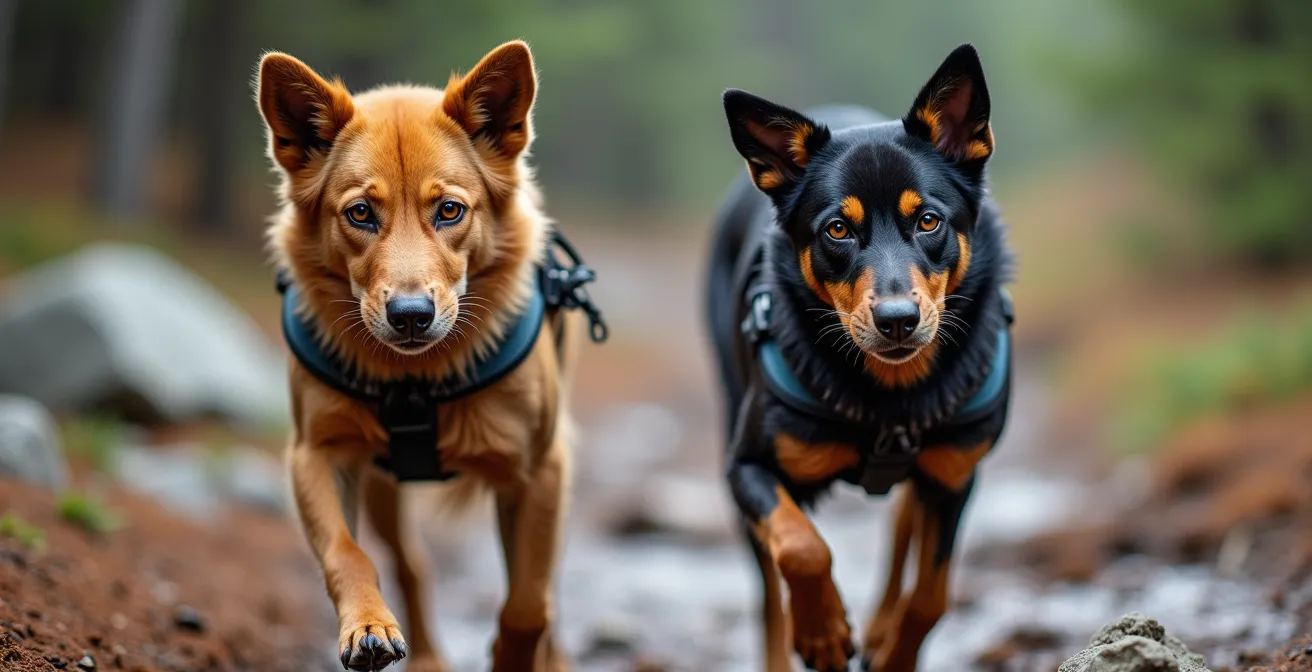
The root cause of harness chafing and gait issues isn’t just a poor fit, but a restrictive design that fundamentally alters your dog’s natural movement and kinetic chain.
- Y-front harnesses are designed to sit on the breastbone, allowing for full, unimpeded shoulder motion and preserving a natural, efficient stride.
- Norway-style harnesses, with their horizontal front strap, can cause shoulder impingement, shorten the stride, and lead to long-term compensatory joint stress.
Recommendation: For any activity involving sustained movement like hiking, prioritize a Y-front design. Follow a strict, multi-point measurement protocol that accounts for your dog’s specific build and coat to ensure true ergonomic safety.
You return from a stunning 10km hike in Kananaskis Country, your dog happily tired beside you. But later, while brushing them, you find it: a patch of raw, red skin under their front leg, or perhaps you’ve noticed a subtle, almost imperceptible change in their gait. The culprit is almost always the harness, but the reason is far more complex than a simple matter of “fit” or “padding.” Most advice focuses on surface-level comfort, ignoring the critical, underlying biomechanical principles that govern your dog’s movement.
The common refrain is to look for “no-pull” features or soft materials, yet these often fail to prevent the very problems they claim to solve. The truth is, the structural design of a harness dictates how forces are distributed across your dog’s body. An ill-conceived design doesn’t just rub; it actively interferes with their natural kinetic chain, forcing their body to make subtle, harmful adjustments with every step. This can lead to everything from chafing and hotspots to more serious, long-term musculoskeletal issues.
But what if the key wasn’t more padding, but better engineering? The debate between a Y-front and a Norway-style harness is not about aesthetics; it’s a fundamental question of canine ergonomics. Vets and canine physiotherapists often recommend Y-shaped harnesses precisely because they respect the dog’s anatomy. This article moves beyond generic advice to provide a biomechanical expert’s analysis. We will dissect how each harness design interacts with your dog’s body during strenuous activity, particularly on the varied terrain of Canadian trails.
We’ll explore why a restrictive front strap can shorten your dog’s stride, guide you through a precise measurement process for a truly custom fit, and analyze crucial features like materials and safety handles. By understanding the physics of your dog’s movement, you can make an informed choice that ensures their comfort, safety, and long-term health on every adventure.
To help you navigate this in-depth analysis, we have structured this guide to address every critical aspect of choosing the right hiking harness. The following sections will provide a clear, evidence-based comparison and practical advice for active Canadian dog owners.
Summary: Y-Front vs. Norway Harness: A Biomechanical Breakdown for Hiking
- Why Do Restrictive Front Straps Shorten Your Dog’s Stride Over Time?
- How to Measure Girth and Neck Depth for a Perfect Custom Fit?
- Lift Handle or Streamlined: Which is Safer for Scrambling Over Rocks?
- The “Wet Dog” Rub: Why Nylon Harnesses Cause Hotspots After Swimming
- When to Retire a Harness: Signs of Webbing Fatigue You Can’t See
- Weighted Backpack or Free Running: Which Burns More Energy on the Trail?
- The Overheating Paradox: Why Double-Coated Dogs Shouldn’t Wear Parkas
- How to Proof Your Recall Against Squirrels and Geese in City Parks?
Why Do Restrictive Front Straps Shorten Your Dog’s Stride Over Time?
The primary biomechanical failure of many harnesses lies in their interaction with the canine shoulder assembly. A dog’s stride is a complex motion originating from the shoulders, requiring a full, unimpeded range of extension and flexion. When a harness features a horizontal strap that cuts directly across the front of the shoulders, as seen in many Norway-style designs, it acts as a physical barrier. This restriction is not always obvious at a walking pace, but during a 10km hike with varied inclines and speeds, its effects become cumulative and damaging.
Video analysis confirms this flaw; studies show that dogs wearing restrictive harnesses have noticeably shorter strides because their shoulder blades and front legs are hampered. This is a critical issue because the body must compensate. To maintain pace, the dog is forced to increase the workload on its back and hind limbs, altering its natural gait and placing unnatural stress on the entire kinetic chain. This can manifest as muscle soreness, joint strain, and even long-term postural problems. In contrast, a well-designed Y-front harness sits on the prosternum (breastbone), leaving the points of the shoulder completely free to move. This design allows for a natural, efficient gait, which is crucial for endurance and injury prevention.
This difference is not trivial, especially considering a dog’s natural pace. While humans comfortably walk at 3-4 km/h, research from Alpine Dog Co. shows that dogs naturally walk closer to 6.5 km/h. Forcing them to shorten their stride to match our pace is already an adjustment; compounding that with a restrictive harness significantly increases the risk of repetitive strain injury.
The following table, based on mobility analysis, clearly breaks down the long-term impact of these two distinct designs on a dog’s natural movement.
| Factor | Y-Front Harness | Norway Harness |
|---|---|---|
| Shoulder Movement | Full range of motion | Restricted by horizontal strap |
| Stride Length | Natural extension maintained | Shortened over time |
| Joint Stress Risk | Minimal – pressure on chest | Higher – pressure on shoulder joints |
| Compensatory Movement | None required | Back and hip adjustments needed |
| Long-term Impact | Maintains natural gait | Can lead to altered posture |
Ultimately, a harness that shortens the stride is not just uncomfortable; it’s actively working against your dog’s anatomy. For long-distance hiking, choosing a design that respects this movement is the first and most important step in preventing chafing and injury.
How to Measure Girth and Neck Depth for a Perfect Custom Fit?
Even the most ergonomically superior Y-front harness will fail if it’s not sized correctly. A fit that is too loose will cause shifting and rubbing, while a fit that is too tight will constrict movement and create dangerous pressure points. Achieving a “perfect” fit is a science that goes beyond a single girth measurement. It requires a multi-point check that accounts for your dog’s unique anatomy, coat density, and dynamic movement. For active Canadian dogs, especially double-coated breeds like Newfoundlands or Huskies, this process is non-negotiable.
The first step is to measure the chest girth at its widest point, typically an inch or two behind the front legs. Use a soft measuring tape and ensure it is snug, but not tight. A crucial validation step is the “two-finger rule”: you should be able to comfortably slide two fingers between the harness straps and your dog’s body at any point. This ensures there is enough room for movement and air circulation without allowing excessive sloppiness.
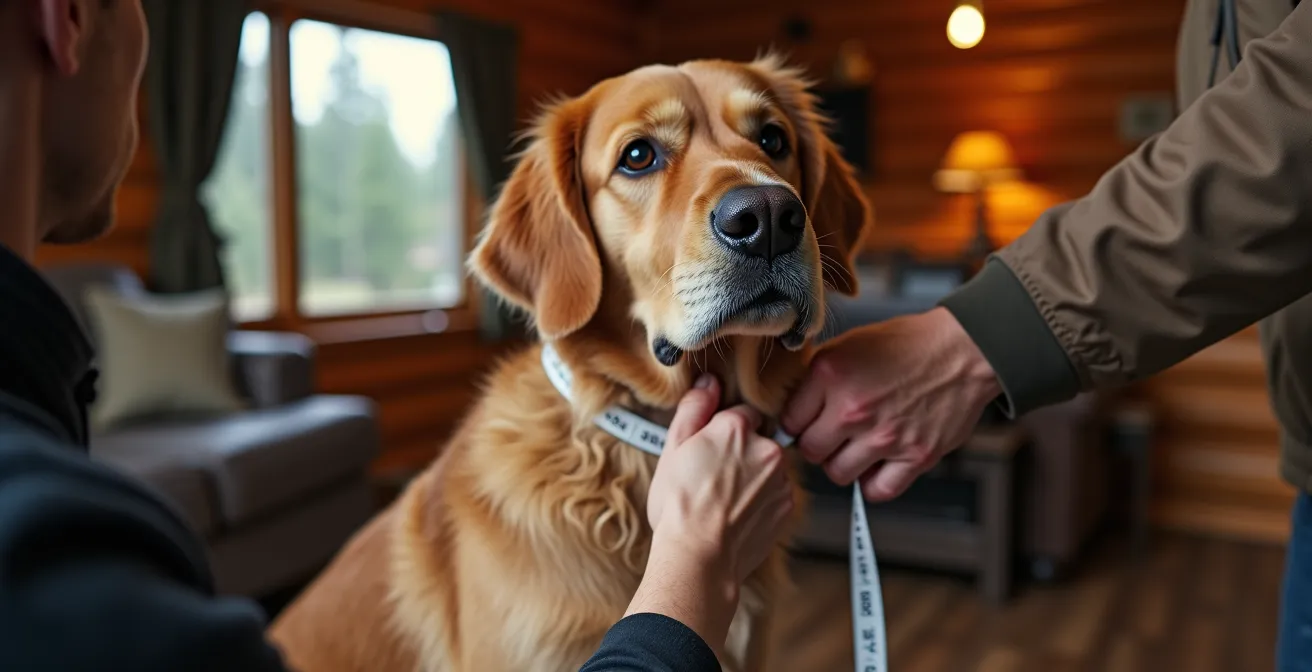
However, girth is only half the equation. The neck opening is equally critical. It should be large enough to not put pressure on the trachea or shoulder points, but small enough that the dog cannot back out of it. Most importantly, the harness should be checked during movement. Have your dog walk, stretch for a treat, and ideally, navigate a small incline or step. Watch for any gapping, bunching, or areas where the straps dig in. Dynamic pressure points often appear during motion that are not present when the dog is standing still.
For breeds with a heavy winter undercoat, it’s wise to measure them with both their summer coat and their full winter fluff to understand the range of adjustment needed. A harness that fits perfectly in July may be dangerously tight by January. Taking the time to perform these checks ensures the harness works with your dog’s body, not against it.
Your Action Plan for a Perfect Harness Fit
- Establish a Baseline: Have your dog stand naturally on all fours on a flat, level surface to ensure an accurate starting posture.
- Measure Chest Girth: Using a soft tape, measure the widest part of the chest, just behind the front legs. The tape should be snug but not constricting.
- Apply the Two-Finger Rule: Check all straps by sliding two fingers between the harness and your dog’s body. This is your primary check for proper clearance.
- Account for a Canadian Coat: For winter-coat breeds like Newfoundlands or Bernese Mountain Dogs, measure both with and without their full undercoat to ensure year-round safety.
- Perform a Dynamic Fit Test: Observe the harness fit while your dog is in motion—walking, stretching, and descending stairs—to spot any hidden pressure points or areas of excessive shifting.
This meticulous approach to fitting transforms a harness from a simple restraint into a piece of high-performance gear, safeguarding your dog’s comfort and health on the trail.
Lift Handle or Streamlined: Which is Safer for Scrambling Over Rocks?
On challenging Canadian trails, from the rocky shores of Lake Superior Provincial Park to the scrambles in the Rockies, a harness feature that seems minor at first can become a critical safety tool: the lift handle. The choice between a streamlined, minimalist design and one with an integrated handle is a trade-off between weight and utility. For casual walks, a handle is an unnecessary addition. But for technical hiking, it provides an indispensable “lift and assist” capability.
A sturdy, well-placed handle allows you to help your dog over obstacles they can’t manage alone, such as a large boulder, a washed-out section of trail, or even getting them in and out of a canoe. The key is that the harness must have an anatomical design that distributes this lifting pressure evenly across the dog’s chest and belly, not just their back. A poorly designed handle on a flimsy harness can put dangerous torque on the spine. High-quality harnesses like the Ruffwear Web Master are specifically engineered for this purpose, with a larger, sturdier structure that protects the dog’s neck and joints during an assisted lift.
Beyond lifting, the handle offers a vital element of control in tight situations. As the Alpine Dog Co. Testing Team notes, it’s invaluable in crowded spots or when your dog is off-leash and a sudden distraction appears. The team states: “When you’re in a crowded place, or your furry friend is off-leash, and he starts misbehaving, you just grab this handle. He won’t have the room to gain momentum and pull. This gives you more control compared to a leash attachment.” This immediate, close-contact control can prevent a dangerous lunge towards wildlife or another hiker far more effectively than yanking on a six-foot leash.
The handle’s safety benefits are not limited to difficult terrain. It can be a lifesaver if your dog is injured and needs to be carried, or simply for providing stability to an older dog navigating slippery surfaces. For any owner whose adventures go beyond the beaten path, the marginal extra weight of a harness with a robust lift handle is a small price to pay for a massive increase in safety and control.
Ultimately, for the serious Canadian hiker, a harness with a lift-assist handle is not a luxury; it’s an essential piece of safety equipment that prepares you for the unpredictable nature of the backcountry.
The “Wet Dog” Rub: Why Nylon Harnesses Cause Hotspots After Swimming
One of the most common sources of severe chafing occurs after a dog enjoys a swim, a scenario familiar to anyone hiking near Canada’s countless lakes and rivers. A perfectly fitted, comfortable harness can become an instrument of torture once it’s wet. The issue lies in the friction dynamics of the material. Standard nylon, the most common harness material, is highly absorbent. When saturated, it not only gets heavier but also takes a long time to dry, trapping moisture against the dog’s skin and undercoat.
This prolonged dampness softens the skin, making it incredibly vulnerable to friction. Every step the dog takes causes the wet strap to rub, gradually abrading the skin until a painful “hotspot” or raw patch forms. The problem is exponentially worse in sandy or silty environments. As the team at Walk Your Dog With Love notes, if a single grain of sand in your own shoe can cause a blister, imagine the effect of hundreds of tiny, abrasive particles trapped in a wet harness strap, acting like sandpaper against your dog’s skin with every movement.
Preventing this “wet dog rub” requires a proactive approach. It’s not enough to simply remove the harness after a swim; the damage often happens on the hike back to the car. The solution involves both material choice and maintenance.
- Check fit dynamically: Wet materials can stretch or shrink, altering the fit. Always re-check the two-finger rule after your dog has been in the water.
- Rinse thoroughly: After swimming in saltwater or mineral-rich lakes, rinse the harness in fresh water to remove salt crystals and bacteria that can irritate the skin.
- Dry completely: Never put a damp harness back on your dog. Allow it to air dry fully between uses to prevent bacterial and fungal growth.
- Consider hydrophobic materials: For water-loving dogs, investing in a harness made from quick-dry or waterproof materials like BioThane can eliminate the problem entirely.
- Inspect for debris: Always run your fingers under the straps to check for trapped sand, grit, or leaves that can cause severe chafing.
For owners whose dogs can’t resist a dip, selecting the right material and practicing diligent post-swim care are essential to ensuring that a fun cool-down doesn’t end in a painful skin condition.
When to Retire a Harness: Signs of Webbing Fatigue You Can’t See
A high-quality harness is a significant investment, and it’s tempting to use it until it falls apart. However, waiting for catastrophic failure is a dangerous gamble. The structural integrity of a harness degrades over time due to UV exposure, repeated stress cycles, and abrasion. This degradation is not always visible to the naked eye. While obvious signs like frayed webbing or a broken buckle are clear indicators for replacement, the more insidious threat is material fatigue you can’t see.
Visible wear often provides the first clue. One long-term tester of the popular Ruffwear Front Range harness, used extensively on Canadian mountain trails and river jaunts, noted, “I’ve noticed significant fraying of the front clip, which started after about a year of use. It’s frayed so much that I don’t use it anymore.” This type of visible fraying, especially around critical connection points like D-rings, is a non-negotiable sign that the webbing’s strength is compromised. Even if the rest of the harness looks fine, a weakened attachment point can fail under sudden pressure, such as when your dog lunges after a squirrel.
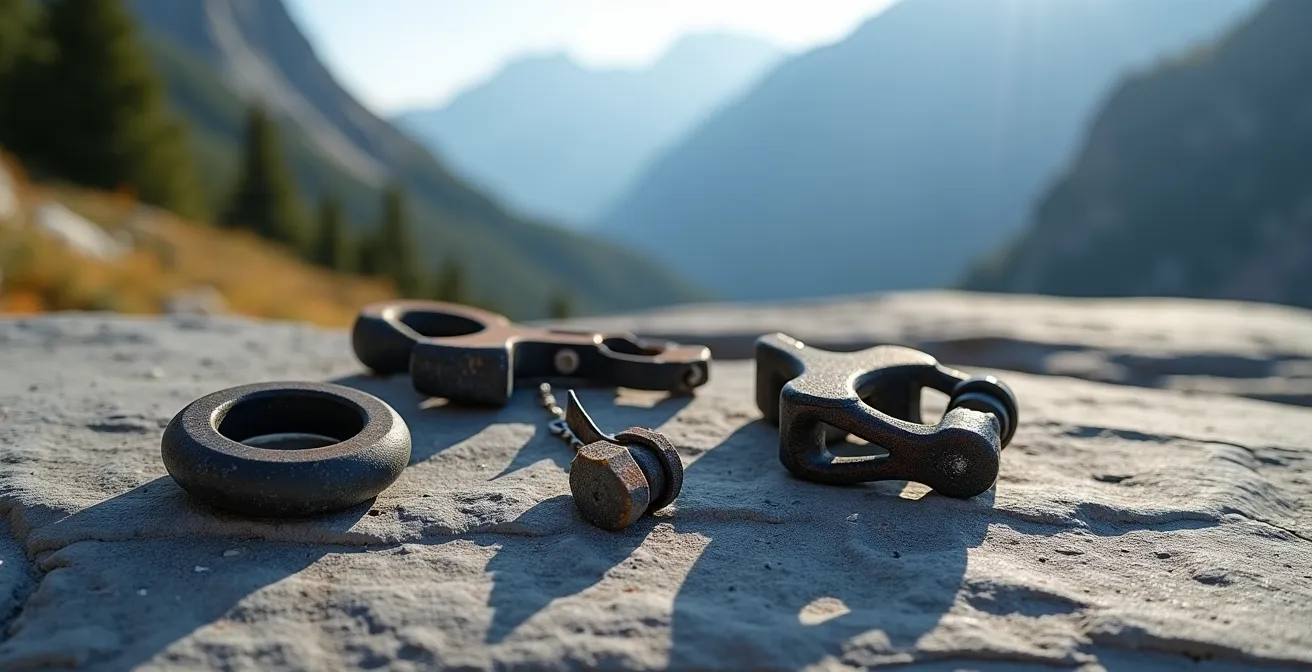
Even more dangerous are the invisible signs of wear. Plastic buckles and adjusters develop microscopic stress fractures from repeated freeze-thaw cycles in Canadian winters and embrittlement from summer sun. Metal hardware can corrode, especially after exposure to road salt or saltwater. The webbing itself loses its tensile strength long before it looks worn out. A good rule of thumb is to meticulously inspect all hardware for tiny cracks, rust, or stiffness before every major hike. Bend and flex the webbing; if it feels unusually stiff or brittle, its internal fibers are likely breaking down.
There is no fixed lifespan for a harness; it depends entirely on use, environment, and material quality. A harness used daily for vigorous hikes in harsh weather may only last a year or two, while one used for occasional weekend walks could last much longer. The key is to shift your mindset from “Is it broken?” to “Can I still trust it completely?”. When in doubt, it’s always safer to retire a harness early than to risk its failure at a critical moment on the trail.
Proactive inspection and timely replacement are fundamental aspects of responsible gear ownership, ensuring your dog’s safety is never compromised by fatigued equipment.
Weighted Backpack or Free Running: Which Burns More Energy on the Trail?
For owners of high-energy dogs, finding ways to effectively burn off steam on the trail is a common goal. This often leads to a debate between two approaches: adding a weighted backpack to a normal walk or allowing the dog to run free in a safe, off-leash area. From a biomechanical and energy-expenditure standpoint, the answer is clear: free running is superior. While a weighted pack does increase the physical load, it does so in a way that can be detrimental if not managed perfectly.
A backpack must be flawlessly balanced and not exceed 10-12% of a dog’s body weight to be safe. An improperly fitted or overly heavy pack can cause the same gait compensation and joint stress issues as a bad harness. It forces a plodding, unnatural movement pattern. In contrast, free running allows a dog to engage its body naturally and explosively. The acts of sprinting, turning, jumping, and rapidly changing pace—what trainers call proprioceptive enrichment—burn far more energy in a shorter amount of time than simply carrying a static weight. This dynamic movement engages the entire musculoskeletal system, from major muscle groups to the tiny stabilizer muscles that are crucial for agility and balance.
Furthermore, the mental stimulation of free running is a significant factor in energy expenditure. As an Alpine Dog Co. training expert points out, a dog’s excitement is a powerful motivator: “Dogs don’t pull because they’re wearing a harness. They pull because the world is full of excitement: smells, sounds, squirrels, other dogs, and unfamiliar people.” When running free, a dog is constantly processing this sensory information, a mentally taxing activity that contributes to their overall fatigue. A 20-minute session of off-leash sprints and exploration in a secure field can be more tiring for many dogs than a 60-minute leash walk with a pack.
For burning maximum energy safely and effectively, nothing beats allowing a dog to move as nature intended. While a weighted pack has its place for conditioning specific working dogs, for the average high-energy companion, the combination of physical exertion and mental engagement from free running provides a much healthier and more enriching form of exercise.
Prioritizing opportunities for safe, off-leash running will not only manage your dog’s energy levels more efficiently but also contribute positively to their mental well-being and physical conditioning.
Key Takeaways
- Prioritize Structure Over Padding: A Y-front harness that allows free shoulder movement is biomechanically superior to a restrictive Norway-style harness for any sustained activity.
- Measurement is a Science: A multi-point, dynamic fit test that accounts for girth, neck, and coat density is non-negotiable for preventing chafing and ensuring safety.
- Material Matters for Climate: For wet Canadian conditions, choose quick-drying materials like BioThane to prevent hotspots. For double-coated breeds, prioritize breathable, minimalist designs to avoid overheating.
The Overheating Paradox: Why Double-Coated Dogs Shouldn’t Wear Parkas
A common mistake well-intentioned owners make is outfitting their double-coated dogs—like Siberian Huskies, Samoyeds, or German Shepherds—in heavy, parka-like harnesses for winter hikes. This stems from a misunderstanding of their natural insulation. A double coat is an engineering marvel, with a dense, soft undercoat for insulation and longer guard hairs to repel snow and water. Covering this system with a thick, non-breathable harness traps heat and moisture, effectively disabling the dog’s natural thermoregulation and creating a risk of paradoxical overheating, even in freezing temperatures.
The key is to choose a harness that provides the necessary control and safety features with the smallest possible footprint. Minimalist Y-front designs are ideal as they leave the dog’s back, sides, and core—their primary heat-dissipating areas—uncovered. Material choice is equally critical. A harness for a double-coated breed should be made of lightweight and breathable materials that wick moisture away from the undercoat rather than trapping it. On a strenuous climb up Mont-Tremblant, for instance, a dog will sweat and pant; a breathable harness allows that moisture to evaporate, while a heavy padded one creates a swampy, uncomfortable microclimate against their skin.
The following table provides a clear guide to selecting materials based on climate, which is particularly useful for navigating Canada’s diverse regional weather patterns.
This data from a comparative analysis by Ruffwear shows how material breathability aligns with different Canadian hiking seasons and regions.
| Material Type | Breathability Score | Best Temperature Range | Canadian Trail Suitability |
|---|---|---|---|
| Open Mesh | 9/10 | 20°C to 35°C | Ontario/Quebec summers |
| Lightweight Nylon | 7/10 | 10°C to 25°C | Spring/Fall hiking |
| Neoprene-Lined | 5/10 | -10°C to 15°C | Winter activities |
| Padded Nylon | 4/10 | -20°C to 10°C | Rocky Mountain winters |
| Heavy-Duty Canvas | 3/10 | Below 0°C | Extreme cold only |
Instead of a “parka,” think “technical gear.” Choose a harness that acts like a high-performance athletic layer, providing structure and safety while interfering as little as possible with your dog’s built-in, all-weather protection system.
How to Proof Your Recall Against Squirrels and Geese in City Parks?
A reliable recall is the holy grail of dog training, especially in high-distraction environments like Canadian city parks, which are often teeming with squirrels, Canada geese, and other dogs. While consistent training is the foundation of this skill, the right equipment plays a crucial supportive role. A harness, particularly a no-pull design, can be a powerful tool in teaching your dog that staying connected to you is more rewarding than chasing a distraction.
The mechanical advantage of a no-pull harness comes from its front D-ring attachment point. The Canada Pooch Training Team explains this principle perfectly:
The best no-pull dog harnesses have the option of a front D-ring to clip the leash into to change the point of leverage, so when your pup pulls, the harness simply redirects the dog to the side and back towards you! The front D-ring sits on the dog’s chest rather than near the neck. This positioning prevents unwanted neck tension, making it the best and most comfortable harness for dogs that pull.
– Canada Pooch Training Team, Canada Pooch Harness Guide
This redirection is not a punishment; it’s a gentle, physical cue that makes pulling ineffective. When the dog surges forward, they are simply turned back towards the handler. This breaks the cycle of opposition reflex (where pulling on the leash makes the dog pull harder) and teaches them that a loose leash is the only way to move forward. This principle is especially important for powerful northern breeds like Canadian Eskimo Dogs or Huskies, whose instinct to pull is deeply ingrained.
However, it is critical to view the harness as a training aid, not an automatic fix. A no-pull harness gives you the control needed to effectively implement training protocols. When your dog looks at a squirrel but then looks back at you, that is the moment for a high-value reward. The harness prevents the lunge, giving you the split second needed to mark and reward the good choice. Over time, through consistent positive reinforcement, the dog learns that checking in with you is more rewarding than the chase. The harness is the tool that makes this communication possible in a distracting world.
By combining the mechanical advantage of a front-clip harness with consistent, reward-based training, you can build a rock-solid recall that holds up even when faced with the ultimate temptation of a fleeing squirrel.